
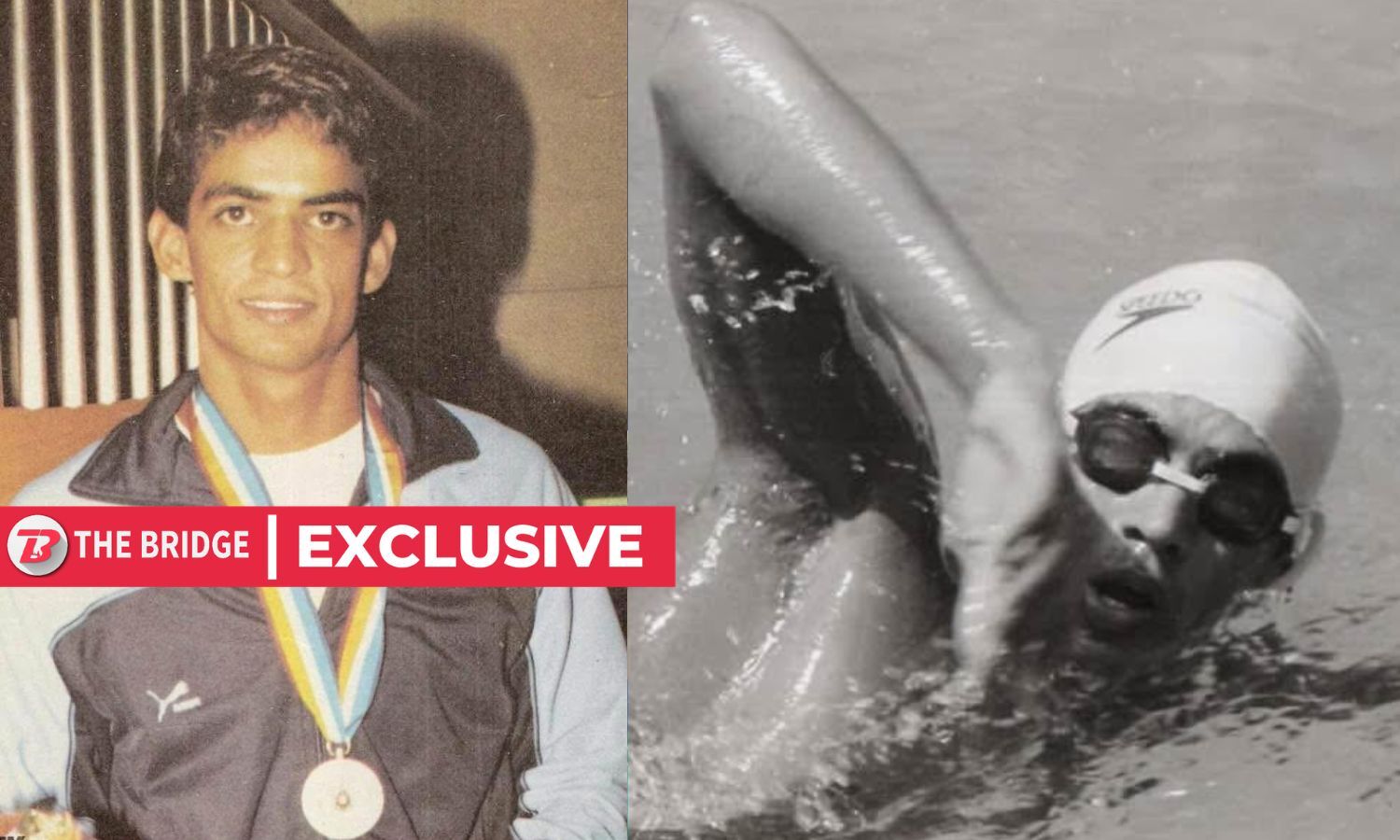

When Khajan Singh Tokas stepped onto the starting block for the men’s 200m butterfly at the 1986 Seoul Asian Games, he carried the weight of a 35-year wait.
Just over two minutes later he had rewritten Indian swimming history. For a brief moment, the arena seemed to fall away. He became the first Indian swimmer since 1951 and seventh overall to make the podium.
“I remember after winning the medal I was so happy. After a gap of 35 years, I got a medal for India, a silver medal,” Khajan Singh told Read on Wednesday.
Putting his nostalgia into words, Khajan goes back to the quiet confidence that began building long before the final dive. A strong swim in the heats had already given him the confidence that a medal was possible.
“When I swam my heat in the morning and qualified for lane 5, I was very sure in the evening that a medal was there. But whether it is gold, silver, or bronze that depends on the final swim,” the now 62-year-old recalled.
The final unfolded and strong competition from two swimmers from Japan, a powerhouse at the Asian level, would ultimately shape the colour of the medal. And every small detail began to matter.
“I got silver because the Japanese swimmers were a little smarter. The swimmer in lane 4 slowed me, and the one in lane 3 went faster than me. I couldn’t see him. Also, at the last turn, I hit my elbow on the wall. That made a difference,” he rued.
When he touched the wall and looked up at the results, the result carried weight far beyond the pool.
“I was second but I was happy. It was the first medal after 35 years. I clocked 2:02.38s, around three seconds better than before.”
Khajan Singh Tokas’ silver medal from 1986 Asian Games (Photo credit: Special Arrangement)
His coach Eric Arnold, an Australian, believed he could win gold. But sadly, he couldn’t travel with Khajan to Seoul owing to a government policy.
“He was not allowed to go travel the Indian flag,” he said. “Now foreigners are allowed, but at that time they were not.
“If he had been there in 1986, I believe the colour of the medal could have been different,” he added.
In Seoul, Khajan broke a 35-year jinx. But back home, he had done something even bigger. He had changed the narrative of Indian swimming and how the sport would be viewed for years to come.
There was an influx of young swimmers taking up the sport, particularly from his village, Munirka in South Delhi.
“My God, the scene at the airport and in the village was mesmerising. So many people were present there to catch a glimpse. They took me straight to the temple and then carried me on their shoulders around the village,” he shared.
“When I reached home, my mother was very emotional. I also felt a little emotional because my father was not there. My mother told me, ‘First go with the village people, then come home’. That moment I will never forget,” he added.
On returning, Khajan’s department, CRPF, promoted him and awarded ₹51,000, the Delhi government honoured with ₹50,000, and the central government awarded ₹75,000.
A newspaper clipping of Khajan Singh Tokas being honoured by CRPF (Photo credit: Special Arrangement)
After Khajan, it took 24 years for India to return to the Asian Games swimming podium, with Virdhawal Khade winning a bronze in 2010, followed by Sandeep Sejwal in 2014.
“I feel hopeful,” he said, when asked of India’s chances in swimming at the upcoming 2026 Asian Games.
“Some swimmers are doing very well, and I believe we will win more medals in the future,” he concluded.

Comments are closed.