


A hybrid revolution is waiting in the wings in the Indian automotive market. Electric vehicles sales have reportedly failed in matching early projections. This has made manufacturers rethink their strategies and investments.They even made many manufacturers resort to hybrids. Mahindra, the Indian company that has invested heavily in EV platform and powertrain is also following suit. Autocar India reports that Mahindra is working on hybrid versions of both the XUV 7XO and XEV 9e! The former is expected to be a strong hybrid while the other will be a range-extender (series) hybrid.
As mentioned above, the XUV 7XO and XEV 9e will take two different approaches towards hybridisation. The XUV 7XO is based on a versatile internal combustion platform. Designing a strong hybrid based on this will not be too much of a pain. The powertrain will likely pair the existing petrol engine with an electric motor and a battery pack. Details on this front remain sparse. The 7XO hybrid is expected to be out by 2027.
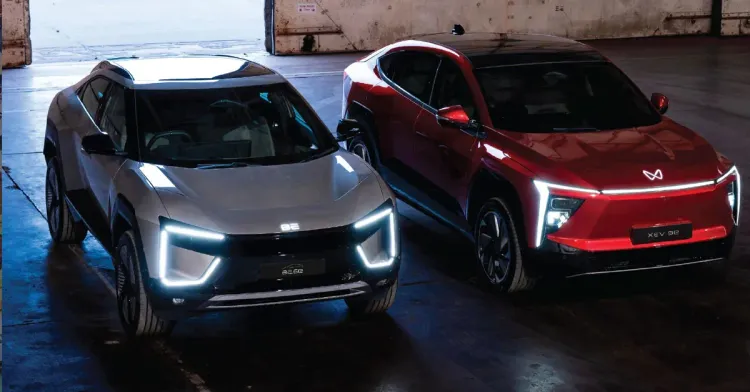
The XEV 9e, as you know, is based on the INGLO skateboard platform. It was never designed to accommodate an internal combustion engine or its ancillaries. Mahindra has invested heavily in the INGLO platform and is now reported to be working on multiple alternative products. Range Extender / series hybrid version of the XEV 9e is a strong possibility.
In a series hybrid powertrain, the wheels are powered by the electric motor (s). An internal combustion engine will also be part of this setup. It will operate at optimal efficiency and act as a generator to recharge the battery pack. This energy will then be used to power the electric motor. This range extender setup will deliver high fuel efficiency and will be much more practical in real life than a regular EV.
Mahindra will have to re-engineer the INGLO platform to accommodate the internal combustion engine and associated components. The versatile nature of this platform is expected to make the integration smoother. It will, however, have to undergo both technical and design changes. The real challenge is not the integration alone; it is engineering the entire setup in a way that it delivers optimum performance and fuel efficiency.

The INGLO architecture will reportedly accommodate Mahindra’s 1.2 petrol and 1.5 petrol engines. It’s a matter of time before we learn more about this setup. The XEV 9e hybrid is likely to launch in 2028.
Converting a skateboard platform into a range extender hybrid is much easier than turning it into a complete internal combustion vehicle. The latter will need extensive re-engineering of the architecture to accommodate the engine and its ancillaries. It may not be possible in many cases, due to space constraints.
Even if engineers manage to source space, packing proper thermal management and transmission systems into a pure EV platform without compromising on crashworthiness and dynamics, can be tricky. In the case of range extender vehicles (REVs), you don’t need to plonk in transmission and other systems as the engine is merely working as a generator and the electric motor drives the wheels.
The Indian carmaker has also showcased its next-generation platform- NU_IQ. This modular architecture is said to be very flexible. It is a multi-energy platform that will be able to support internal combustion, all-electric, hybrid and other powertrains. Transitioning to this will ensure that business cases are met and volumes keep going up. Using the same platform on a multi-fuel lineup can bring significant financial benefits.
Source: Coach India
Comments are closed.