
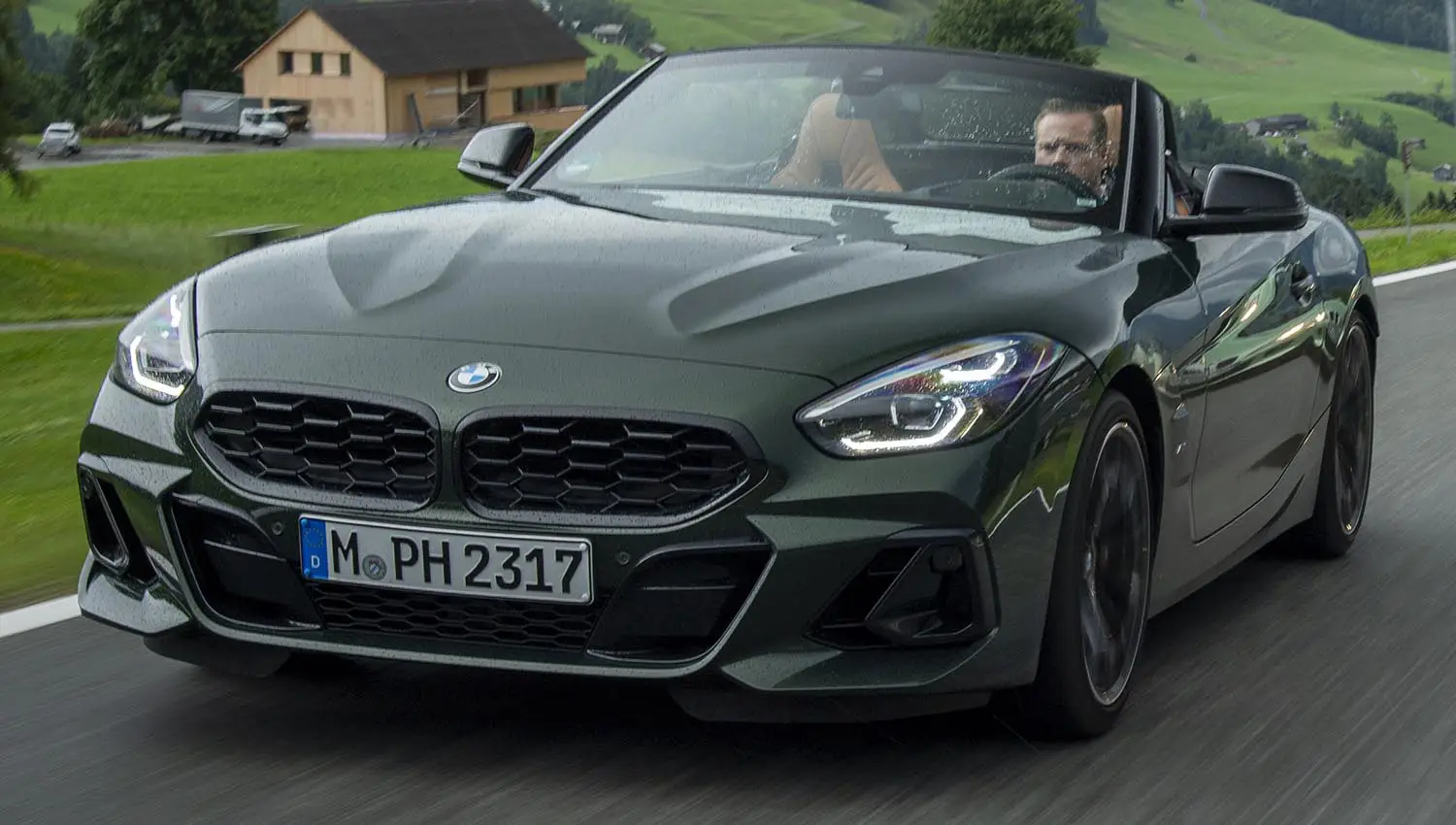

BMW’s roadster era has officially reached the end of the road.
After nearly three decades of uninterrupted two-seater convertible production, BMW has confirmed that the current-generation Z4 has officially ended production at Magna Steyr’s factory in Graz, Austria. The move quietly closes a chapter that began with the beloved Z3 in the 1990s and evolved through multiple generations of the Z4.
For enthusiasts, this is more than just another discontinued model. It marks the disappearance of one of the last traditional German roadsters still standing in an industry now dominated by SUVs, EVs, and high-tech crossovers.
The End of an Understated Icon
Unlike BMW’s M cars that often grabbed headlines with aggressive styling and track-focused performance, the Z3 and Z4 always played a different role. These cars were about the experience.
They blended sporty handling with long-distance comfort, offering drivers a refined but playful open-top machine. They were never as raw as a Mazda MX-5 Miata, nor as luxurious as a Mercedes-Benz SL. Instead, BMW’s roadsters carved out a personality of their own.
The final-generation G29 Z4 especially matured into a genuinely underrated sports car. Toward the end of its production run, BMW introduced a six-speed manual gearbox for the M40i variant, a move that instantly reignited interest among driving enthusiasts.
Ironically, the manual version arrived just as the car’s lifecycle was ending.
Sales Rose Just Before Goodbye
BMW never sold the Z4 in massive numbers, but demand surprisingly picked up during its final stretch. Special variants and the “Final Edition” created a wave of renewed appreciation for the roadster.
Many enthusiasts who had overlooked the car earlier suddenly realized what they were losing: a compact rear-wheel-drive convertible with an inline-six engine and a manual transmission. In today’s automotive landscape, that combination is becoming exceptionally rare.
The timing also reflects a broader shift within the industry. Carmakers are prioritizing electrification and high-volume SUVs over niche enthusiast vehicles. Low-slung two-seat convertibles simply no longer make financial sense for most manufacturers.
What Happens to the Toyota Supra?
The Z4’s departure also raises questions about the future of the Toyota Supra, which shares its platform and engineering roots with the BMW roadster.
Rumors suggest Toyota is planning another-generation Supra, but without BMW involvement this time around. If true, the next Supra could become a completely different machine altogether.
For BMW, however, there appears to be no replacement planned for the Z4. With the 8 Series Convertible also nearing the end of its production run, the 4 Series Convertible now stands as BMW’s only remaining drop-top model.
A Farewell to Classic Motoring
The Z3 and Z4 were never mainstream heroes, and maybe that’s exactly why enthusiasts loved them.
They appealed to drivers who valued balance over brute force and personality over outright lap times. They were stylish without trying too hard and sporty without sacrificing comfort.
As the automotive world races toward electrification, the death of the Z4 feels symbolic. It’s the end of a type of car that once defined carefree driving pleasure.
And while BMW may someday return to the roadster segment, the silence left behind by the Z4 will be difficult to replace.

Comments are closed.