
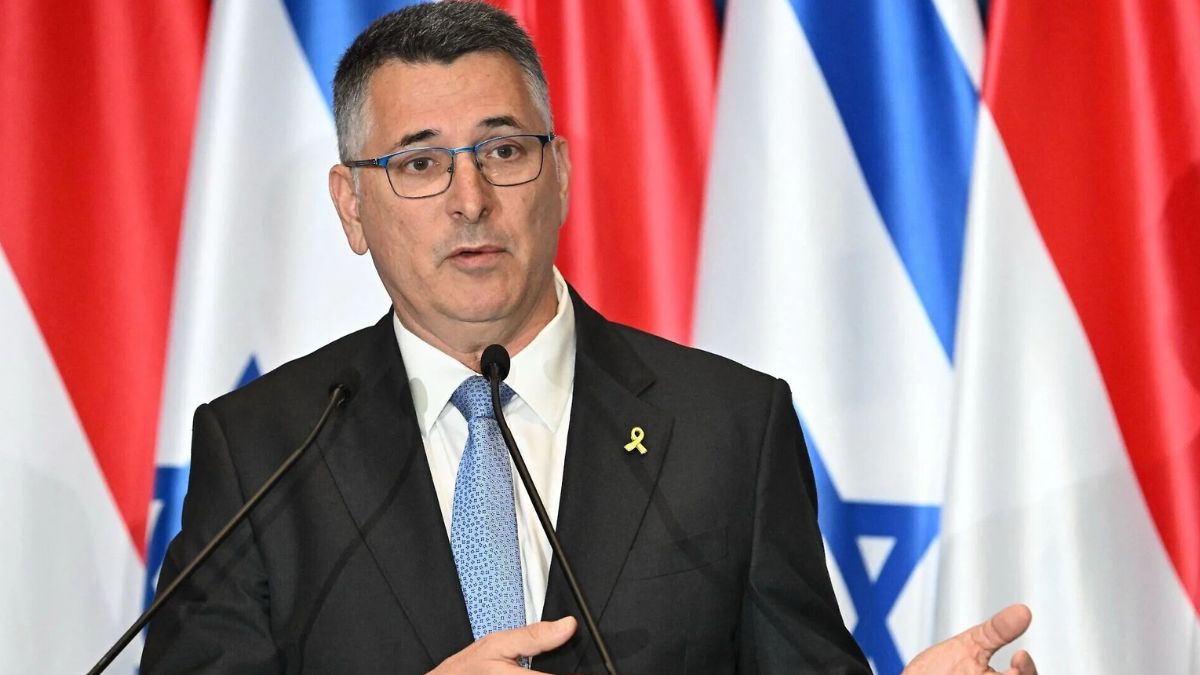

Israeli Foreign Minister Gideon Sa’ar has warned that allowing Iran to develop nuclear weapons would significantly raise the risk posed by a regime he describes as one that destabilizes the Middle East and targets US allies. Speaking in recent public remarks, Sa’ar reiterated that Israel is determined to prevent Iran from acquiring nuclear weapons, framing it as a core security imperative for the region and for Washington’s partners.
Sa’ar said that Iran’s pursuit of nuclear weapons capability would deepen dangers across the Middle East, making the region more volatile and threatening the security of American allies, including Israel and Gulf states. He argued that Tehran’s behaviour towards its neighbours—including support for armed groups and repeated missile and drone strikes, shows why the international community must not allow it to cross the nuclear threshold.
The minister has also pointed to the failure of nuclear‑deal efforts, saying that attempts to reach a new agreement have faltered because Iran has refused to discuss the core issues Washington has raised. These sticking points include nuclear restrictions, sanctions relief, maritime security in the Strait of Hormuz and broader regional tensions, with US demands on Iran’s nuclear programme seen as a major obstacle to breakthrough talks.
Sa’ar has underscored that Israel has not maintained any direct diplomatic contacts with Iran for nearly two decades, tracing the rift to what he describes as Iran’s long‑standing and explicit commitment to “eliminate Israel.” He noted that Tehran’s rhetoric and its backing of groups such as Hezbollah and Hamas have reinforced Israel’s position that there is no meaningful dialogue possible while Iran continues to advocate the country’s destruction.
The Israeli foreign minister has said that Israel’s security posture remains focused on deterrence and, if necessary, unilateral action to stop Iran from acquiring nuclear weapons, even as diplomatic channels involving the US and other powers remain open. His remarks come amid continuing regional tensions and after several rounds of US–Iran negotiations that have so far ended without a final agreement on Tehran’s nuclear activities.

Comments are closed.