
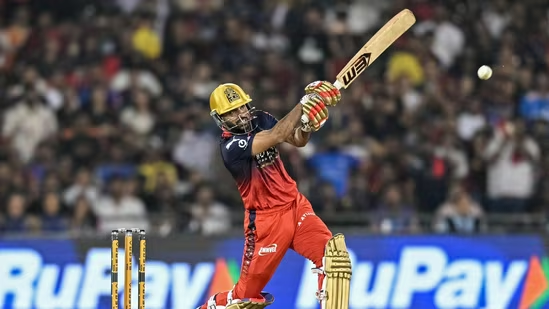
The INR 99 lakh Bhuvneshwar Kumar six that pushed RCB’s win percentage to 99.36% and left MI with nothing

Bhuvneshwar Kumar walked in to bat against the Mumbai Indians with the Royal Challengers Bengaluru eight down, Romario Shepherd gone, and 9 needed from the last three balls. MI had dragged the chase into its tightest corner, with Raj Angad Bawa defending the final over and RCB forced to trust a specialist bowler while the match still had enough danger to flip.
The model gave RCB a 51.49% chance at that point. The number captured the danger better than the equation alone could. The target was close, but the chase still needed a boundary from an unlikely source.
Bhuvneshwar gave them exactly that.
His six brought the equation down to 3 off 2, lifted RCB’s win probability to 99.38%, and turned one of the most fragile moments of the chase into the decisive break of the match. In the monetary layer of our model, the shot was worth close to ₹99 lakh because it cut through three layers of pressure at once: the scoreboard, the lower-order risk and MI’s final-over control.
RCB still needed the final run to be completed. Rasikh Salam eventually did that on the last ball, but the defining strike had already arrived. Bhuvneshwar’s six changed the chase from a boundary-dependent equation into a finish built around composure.
For a player picked to take wickets rather than close chases, it was a rare form of control.
The six that changed the price of the chase
The shot carried a batting impact of 19.88 raw points for Bhuvneshwar in our model. Raj Bawa took a -17.56 bowling impact hit on the same delivery. Those numbers came from timing, role difficulty and match state.
A six in the middle overs can inflate a score. A six with 9 required from 3 balls can rewrite the result. Bhuvneshwar struck at the point where every run carried a higher price because the match had entered its final three deliveries with the batting side eight down.
At 9 off 3, RCB needed a boundary or an MI mistake. At 3 off 2, they needed only execution. The fielding side’s room vanished. Bawa could no longer defend the boundary with comfort because singles and twos had become enough. MI’s final-over plan lost shape as soon as the ball cleared the rope.
The model’s win-probability jump explains the scale. RCB moved from 51.49% to 99.38% in one delivery. That nearly 48-percentage-point rise gives the shot analytical weight. The monetary estimate gives it its headline.
A ₹99 lakh shot from a specialist bowler is the kind of number that forces the match to be read differently. Bhuvneshwar was not adding tail-end bonus runs. He was buying RCB the safest version of the finish available from that position.
Bhuvneshwar’s match value had already been built with the ball
The six became more powerful because of what Bhuvneshwar Kumar had already done earlier in the night. His primary contribution came through his four-wicket spell, which gave RCB control in a match that kept tilting back and forth under pressure.
His match worth in the monetary file finished at around ₹5.20 crore. His match cost stood near ₹0.77 crore, generating an estimated match profit of roughly ₹4.43 crore.
That is an elite match return. The bowling spell created the bulk of the value. The six gave the return a final-over spike and a story strong enough to outlive the scorecard.
This is the unusual beauty of the moment. Bhuvneshwar had already delivered the work expected from him. The final over asked for work outside his role. He answered with the most valuable batting action of the chase.
Why Bawa lost control in one ball
Raj Angad Bawa’s final over briefly gave MI a route back. Shepherd’s dismissal pulled RCB into trouble and gave Mumbai a chance to drag the match into a last-ball squeeze. The over had pressure, wickets, runs to defend, and a lower-order batter on strike.
The wide softened the equation, and then the six broke the chase.
Once Bhuvneshwar cleared the boundary, Bawa had to defend 3 from 2 with the match slipping away. The change was brutal because a bowler’s authority in the final over comes from controlling the scoring options. At 9 off 3, he could still deny the boundary and back the field. At 3 off 2, every small error became fatal.
A single could hurt. A two could finish it. A misfield could finish it. A clean hit could finish it.
Bawa had taken a wicket and reopened the match, but Bhuvneshwar closed that opening before MI could breathe inside it.
Also Read: The hidden cheat code of CSK for IPL 2026: Jamie Overton at INR 1.5 crore delivering premium outputs
The role shock made the shot bigger
Bhuvneshwar’s six landed harder because it came from the wrong profile of player for that moment. RCB did not have a top-order batter or a specialist finisher at the crease. They had a veteran seamer facing a young bowler with the match still alive.
That role mismatch is central to the shot’s value.
A specialist batter hitting a final-over six carries expectation. A bowler hitting it carries surprise, pressure, resistance and hidden value. Bhuvneshwar did not need a long innings to influence the chase. He needed one clean decision, one clear swing, one strike strong enough to remove the most dangerous part of the equation.
He found the boundary at the exact point where RCB could not afford a dot ball.
The shot also gave his night a different emotional shape. Bhuvneshwar has built his IPL reputation through swing, seam position, control and wickets. His memorable moments usually begin with the ball in his hand. This one came with the bat, from a position where failure would have been immediate and public.
That is why the six will stay.
The season consequence
The result carried table consequence as well. While RCB’s win strengthened their position near the top, it ended MI’s playoff fight. A lower-order six from Bhuvneshwar became one of the hinge points of both outcomes.
Krunal Pandya gave RCB the innings that made the chase possible. Bhuvneshwar’s spell gave them the bowling control that kept the target within reach. His six supplied the final rupture.
RCB were dragged into danger, then rescued by a player whose main job had already been completed. MI created one final chance, then watched it disappear in a single strike.
The number gives the shot its force: nearly ₹99 lakh in model value.
The probability curve gives it its scale: 51.49% to 99.38%.
The match gives it its memory: Bhuvneshwar Kumar, a bowler known for swing, delivered the swing that ended MI’s season and carried RCB home.
Method note
This valuation is based on a cricket impact model designed exclusively by the author. The model assesses a player’s match contribution across batting, bowling, fielding, match situation, phase pressure, and role difficulty, then converts that impact into a rupee value using the player’s auction price and expected season usage. It is not a salary calculation or an official IPL metric. It is an analytical estimate meant to show whether a player delivered above or below his cost for that match or phase of the season. The figures should be read as model-based valuations, not exact financial earnings.

Comments are closed.