
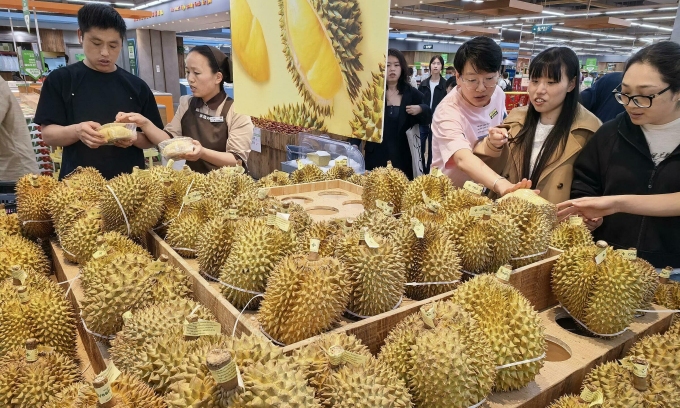

Once selling for 200 yuan (US$29.41) per kilogram, the “king of fruits” has become far more affordable in China.
At a wholesale market in Kunming, the capital of southwest China’s Yunnan Province, Thailand’s Monthong durians are now selling from 28 yuan (US$4.09) per kilogram, Xinhua reported.
Through livestreaming e-commerce platforms, consumers across the country can also buy durians weighing more than two kilograms and containing six large pods of flesh for as little as 129 yuan, including shipping.
The sharp drop in prices became a major talking point on Chinese social media late last month after large volumes of shipments arrived through sea and land ports, fueling discussion about consumers’ “freedom” to buy the once-costly fruit.
A new cold-chain rail service linking Thailand, Laos and Yunnan is helping Southeast Asian growers deliver durians to China more quickly. The service, featuring train cars kept at 13 degrees Celsius (55 degrees Fahrenheit), runs from Thailand’s Laem Chabang Port through Laos to Kunming.
Thai durians now reach Kunming in around 26 hours and arrive at more than 30 Chinese cities within two days.
The improved logistics network has also shortened shipping times to Chengdu in southwestern China’s Sichuan province to five days from roughly a week previously. Spoilage rates have also dropped to 3% from 10% thanks to the new rail link.
As a result, durian retail prices in Chengdu have fallen to about 40 yuan per kilogram from around 70 yuan, as reported by China Daily.
Customers select durians at a fruit store in Hangzhou, east China’s Zhejiang, May 2, 2026, as prices drop over 30% due to increased supply from Southeast Asia via China-Laos-Thailand railway. Photo by Imaginechina via AFP |
The service is projected to transport more than 200,000 tons of tropical fruit this year, according to the China Railway Kunming Group.
As the world’s largest market for the pungent fruit, China imported $7.5 billion worth of durian last year, with Thailand supplying about $4 billion while Vietnam shipped roughly $3.4 billion, according to a March BMI report cited by Named. Malaysia, Cambodia, Laos and the Philippines held much smaller shares.
Lim Chin Khee, an Asian durian expert based in Malaysia, said rail transport offers exporters a cheaper option than air freight and a faster alternative with less spoilage risk than cargo shipping.
“The China-Laos railway is becoming an important route for durian exports because it offers a good balance between speed, cost and fruit quality preservation,” he told the South China Morning Post. “For durians, especially premium varieties, time and temperature control are extremely important.”
He added that Laos, Thailand and Vietnam are particularly well placed to benefit from the new service because of their proximity to the route.
Sea and road freight services have also sped up deliveries. Guangdong’s Nansha Port, the largest seaport for durian imports in China, now operates 10 direct sailings each week from Thailand’s Laem Chabang Port, with the journey taking only four days.
Once unloaded, the fruit can reach wholesale markets across the southeastern province in as little as two hours and major cities nationwide within 24 hours.
A shift to quality competition
As supplies become more plentiful, Chinese consumers are placing greater emphasis on quality, according to a late-April blog post by JD Fresh, the produce unit of e-commerce giant JD.com.
To stay competitive, Southeast Asian producers are tightening quality control measures. Thailand has introduced a ban on four practices, including selling underripe fruit, distributing pest-infested produce, using false certifications and applying artificial coloring, with violations potentially resulting in entire shipments being rejected and exporters facing credit sanctions.
Some companies are also adopting AI-based sorting and full-chain traceability systems to better ensure fruit quality.
Penang, a Malaysian state known for its durians, has recently introduced a QR code tracking system that allows consumers to trace the origin of each fruit to its orchard within seconds.
Mohamad Sabu, Malaysia’s minister of Agriculture and Food Security, said on Sunday that further discussions with Chinese authorities were needed to “ensure Malaysian durians retain their branding identity and QR authentication system,” as quoted by The Star.
Malaysian durians are regarded as premium, high-quality products in China. Mohamad said in some countries, other durians are falsely marketed as Malaysian.
Mia Lu, procurement manager at Jiaxing Higo Import & Export Co, told the Global Times: “Going forward, the market will no longer be about price competition, it will shift to quality competition.”

Comments are closed.