

Rohit Kumar
NEW DELHI, May 12: The detection of a “guess paper” that significantly matched with the actual paper and was found to have been circulation among the aspirants for days in advance, has led to the cancellation of the National Entrance and Eligibility Test – Under Graduate (NEET – UG) conducted on May 3 and to be conducted afresh later, probably in June, to finalize the admissions in medical colleges.
When over 22.79 lakh students sat down to take the NEET UG 2026, after stringent scrutiny and checks, they had no idea that their labor would be infructuous and will have to re-do the entire exercise. The National Testing Agency (NTA) which conducts the tests every year, had put some of the strictest security measures. But what has followed has raised uncomfortable questions about whether those measures were enough.
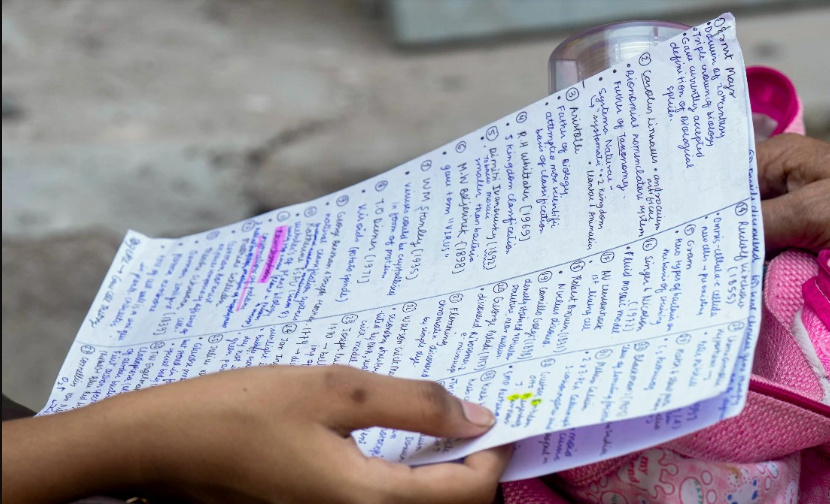
According to official sources, the Rajasthan Police Special Operations Group (SOG) is now investigating allegations that a so-called “guess paper” containing approximately 410 questions was circulated amongst students well before the examination, and that a significant number of those questions matched what actually appeared in the paper.
The alleged “guess paper” was reportedly shared through coaching networks and WhatsApp groups before the test. The handwritten document containing around 410 questions was in circulation among the NEET aspirants for days in advance, according to Rajasthan police. “There is a guess paper containing approximately 410 questions. Out of these, it is alleged that roughly 120 questions appeared from that,” Vishal Bansal, Additional Director General (ADG) of the Rajasthan Police’s SOG, said. Officials linked to the investigation said the similarities could account for nearly 600 out of the exam’s total 720 marks.
A guess paper is usually a set of predicted questions prepared before an examination. Such papers are often based on previous years’ trends, coaching material, mock tests, and expected topics. They are common in board exams and competitive entrance tests.
The Chemistry section in NEET contains 45 questions, but the examination reportedly used four different sets of question papers. The SOG later said more than 100 questions from the Biology and Chemistry sections combined showed “striking similarities” to the actual paper.
Bansal added, “It is reported that this guess paper had been circulating among the students well in advance; it began reaching them as early as 15 days to a month prior to the actual examination. We are investigating on the basis of the guess paper and it is also available in open domain.”
The “Guess paper” is believed to have originated from a Churu-based MBBS student studying at a medical college in Kerala. Investigators believe the student sent the document to an associate in Rajasthan’s Sikar on May 1, as per the investigation so far.
From there, a paying guest accommodation owner allegedly distributed it to students staying at the facility. The material then reportedly spread through coaching networks and WhatsApp groups. Investigators said recovered chats carried the “forwarded many times” label. It may have circulated 42 hours before the exam, police sources said.
The document was allegedly sold for up to ₹5 lakh two days before the exam. Sources in the investigation team said the price reportedly dropped to around ₹30,000 on the eve of the test. By May 11, thirteen suspects had been detained from Dehradun in Uttarakhand, and Sikar and Jhunjhunu in Rajasthan.
The Nashik city crime branch police arrested one Shubham Khairnar from the city’s Indira Nagar area acting on inputs received from the Rajasthan Police. He will be handed over to the Rajasthan Police before being transferred to the CBI for further investigation. This was the first arrest in the case.
The National Testing Agency maintained that the examination was conducted under “full security protocol.” The agency said question papers were transported in GPS-tracked vehicles carrying unique watermark identifiers, in a statement posted on X. Examination halls were monitored through AI-assisted CCTV systems from a central control room. Biometric verification was conducted for every candidate and 5G signal jammers were deployed at centres.
The agency said it received inputs regarding alleged malpractice on May 7, four days after the exam, and referred the matter to central agencies on May 8 for “independent verification and necessary action.” Neither the NTA nor the Rajasthan SOG officially used the term “paper leak.” Bansal described the material as a “guess paper” or “test series”, while the NTA referred to “alleged malpractice activity” and “alleged irregularities.”
Mr Bansal said, “Our investigation is currently focused on determining whether any cheating or criminal activity has occurred based on this guess paper.” We are actively examining this matter and are currently engaged in the investigative process. No, as of now, we have not made any arrests of any kind.”
The controversy has triggered widespread anger and anxiety among students and parents, many of whom have questioned the fairness of the process and expressed concern for honest aspirants preparing under intense pressure. Members of the medical fraternity have also criticized the alleged irregularities, recalling the 2024 paper leak episode. Conducted across 551 Indian cities and 14 abroad, NEET-UG remains the sole gateway to medical admissions, making repeated integrity lapses fuel demands for a systemic overhaul.
Every student seeking admission to undergraduate medical courses in India must clear NEET-UG, the national entrance examination for programs including MBBS, BDS, BAMS, BHMS and BUMS. It is the biggest entrance test in India by number of students appearing. The 2026 exam was conducted on May 3 in pen-and-paper mode from 2 pm to 5 pm, with 22.79 lakh candidates appearing across 551 cities in India and 14 abroad.
Educationists in the country believe that frequent complaints of paper leak in the NEET examination could not simply be attributed to chance. The NTA has asked the CBI to conduct the inquiry and issued the customary statement about “transparency” and “trust.” India had been here before, exactly two years ago. The language was the same. The apology was the same. The promise was the same. Only the year had changed.
“This is not incompetence. Repeated incompetence, left uncorrected, becomes a system. India’s examination governance has become a system that often faces major disruptions, absorbs outrage, and then resets,” some experts said.
Two years back on May 5, 2024, NEET-UG faced allegations of a question paper leak. In Patna, Bihar, police arrested 13 people – including four examinees – who had allegedly paid Rs 30-50 lakh to obtain the question paper before the examination.
The scale of the irregularity went beyond paper leaks. A total of 67 students achieved a perfect score – a significantly higher number than in previous examinations – which created immediate controversy. Several examinees received scores of 718 or 719, which students argued was mathematically impossible under the exam’s marking scheme.
On June 22, 2024, the government dismissed NTA Director General Subodh Kumar Singh from his position and handed the NEET-UG irregularities case to the CBI. This was framed as decisive action. To be more precise, it was the first move in a long game of institutional delay.
The CBI investigation revealed the mechanics of the breach with uncomfortable precision. The center superintendent of Oasis Public School in Hazaribagh had left the back door of the strong room – where exam papers were stored – open. At 8:02 am, the accused entered the room with a toolkit, opened the locker, removed the seal from a question paper, and photographed it. No satellite hacking. No sophisticated encryption bypass. A toolkit, an open back door, and a complicit superintendent. The India of 2024 was losing its medical entrance examination to a screwdriver.
The CBI ultimately arrested 36 persons in relation to the NEET paper leak case. On July 23, 2024, the Supreme Court established that while a paper leak had undeniably occurred – where 155 students directly benefited – there was no indication it was widespread enough to affect the exam as a whole. On this narrow ground, the examination was not cancelled. Counseling proceeded. The crisis was declared managed.
The CBI inquiry of June 2024 produced arrests. By July 18, 2024, the Bureau had carried out various arrests, including four MBBS students from AIIMS Patna and a civil engineering student from NIT Jamshedpur in connection with the paper leak and the solving of the leaked paper. Total arrests reached 36. But it ended there, as of now there was no report of any conviction in the 2024 paper leak case.
The syndicate model – which operates through layers of brokers, center superintendents, and local fixers – remains structurally intact. The individuals arrested were the hands of a machine whose mind continues to function. The 2025 cycle saw the CBI bust a ₹87.5 lakh NEET scam, demonstrating that the syndicate had merely recalibrated. Now, 2026 has produced the same outcome: cancellation, CBI referral, promises of cooperation.
The Public Examinations (Prevention of Unfair Means) Act, 2024, was passed by Parliament on February 9 and received Presidential assent on February 12, 2024. It was, in theory, exactly what India needed. The Act prohibits collusion or conspiracy to facilitate indulgence in unfair means, including unauthorized access or leakage of question papers or answer keys. Persons committing an organized crime face imprisonment between five and ten years and a fine of at least Rs 1 crore. If an institution is held guilty of an organized crime, its property will be attached and forfeited.
On June 21, 2024, the very day after the NEET crisis exploded nationally, the Union Government announced the enforcement of the Act, raising serious questions about the inexplicable delay in its implementation despite having been passed four months earlier. In effect, the Act came into force to manage an ongoing crisis, not to prevent the next one.
It also came with structural loopholes: there are no fixed timelines for agencies like the CBI to probe malpractices, no interim measures during investigations, and students are exempt from accountability under the law – meaning if a student found engaging in irregularities faces no penalty under this legislation.
The NTA was established in 2017 to be India’s premier, independent examination body – a professional, technology-driven alternative to the fragmented system that preceded it. The NTA conducts NEET, JEE, CUET, UGC-NET, and dozens of other examinations. Over 20 lakh students appeared for NEET alone. Centralizing all high-stakes examinations in one agency – without independent audit, without genuine oversight, without term-limited leadership – creates a single point of systemic failure. When the system fails, it fails catastrophically, for millions simultaneously.

Comments are closed.