
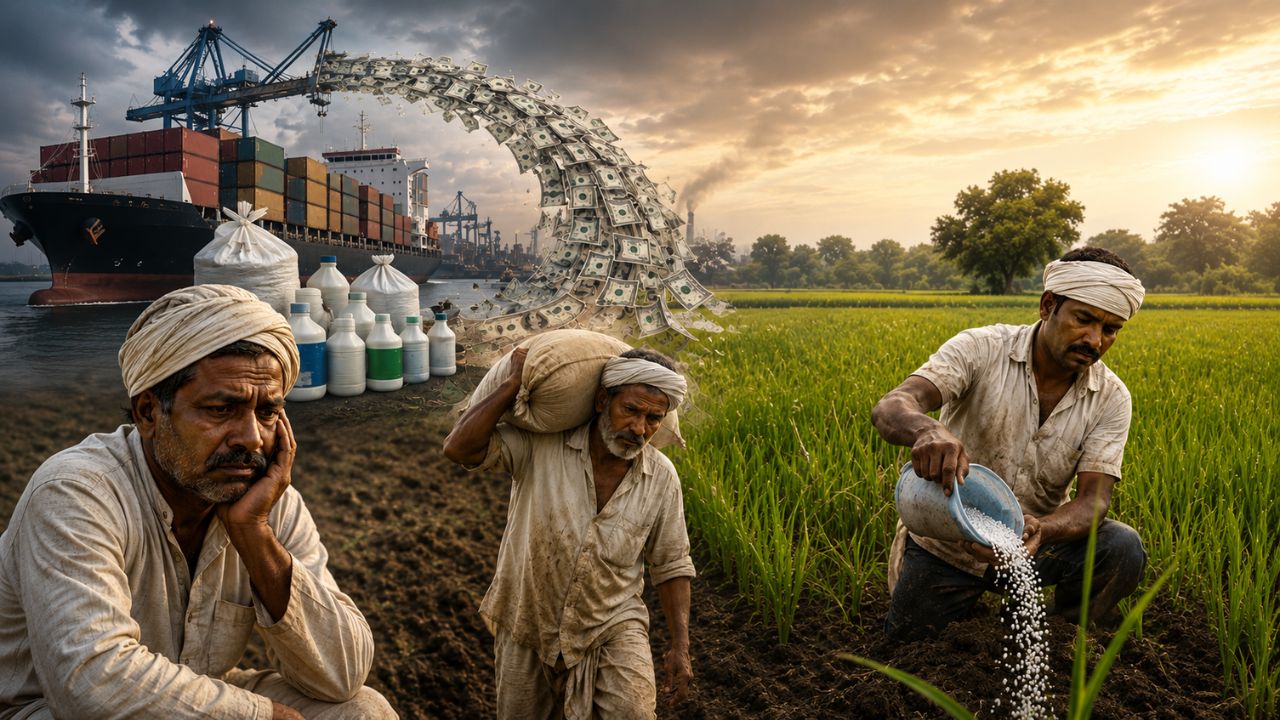
Bumper import, subsidy and heavy use, how does foreign fertilizer loosen the country’s pockets?

Summer season is going on in India. After wheat harvesting, sowing of Zaid crops is taking place and fields are being prepared for Kharif crops in many states. Meanwhile, an appeal by Prime Minister Narendra Modi has caught everyone’s attention. PM Modi’s appeal for using indigenous products, not buying gold and using oil also included an appeal to increase the use of organic fertilizers. The main reason for this is that chemical fertilizers are either imported in India or the raw materials used to make them are purchased from other countries. This import is increasing every year and a lot of the country’s money is being spent on it. In such a situation, PM Modi’s appeal has drawn attention towards this also.
India, which buys millions of tonnes of chemical fertilizers every year from countries like China, Saudi Arabia and Morocco, has to spend huge amounts of foreign exchange for this. The Government of India also gives subsidy on the fertilizer procured in this way so that the fertilizer can be available to the farmers at a lower price. A considerable amount of the government’s budget is also spent on this subsidy. Let us understand this whole matter in detail and know how much foreign fertilizer weakens the country’s pockets.
Understand Indian agriculture
In India mainly two crops are grown and in some areas three or four crops are also grown. Crops like paddy, wheat, cotton and sugarcane require a lot of fertilizer. India, which was previously dependent on cow dung and other traditional fertilizers, has increased its dependence on chemical fertilizers such as urea, DAP and potash over the past several decades. In the last few years, due to the changing pattern of rainfall, the need for fertilizer has increased to increase production and to prepare crops quickly.
Also read: Why is PM Modi talking about buying less gold, oil and fertilizers? Statistics will tell the truth
There are many fertilizer factories in India but the raw materials required for making fertilizer like phosphoric acid, rock phosphate etc. are imported from other countries. This is the reason why due to increase in prices at the global level and impact on the supply of gas and raw materials, the cost of preparing fertilizer increases and the supply is affected. In the last Rabi season, it was seen in many states of the country that due to shortage of fertilizers, long queues formed at government shops, yet many farmers were forced to do farming without fertilizers.
How much is the fertilizer consumption?
According to a reply given in Parliament, last year in the Rabi season, the requirement of urea was 192.20 lakh metric tonnes, the requirement of DAP was 52.80 lakh metric tonnes, the requirement of potash was 15.23 lakh metric tonnes and the requirement of NPK was 80.57 lakh metric tonnes. According to statistics, at that time the stock in India was sufficient and adequate quantity of fertilizer was also made available to the farmers.
Let us tell you that in the last few years, the need for fertilizers has increased rapidly due to which imports have also increased and India’s expenditure has also increased. According to data from India’s Ministry of Commerce and Industry, in the year 2022-23, India had spent a record $ 17.21 billion, or about Rs 1.45 lakh crore, on the import of fertilizers. It declined in the next two years but is expected to reach Rs 1.5 lakh crore in 2025-26.
Also read: How do people buy and sell gold in digital gold? understand the game
Fertilizer work is dependent on imports
According to Indian Government data86 percent of the rock phosphate required for the production of fertilizer in the country comes from other countries. Similarly, 52 percent of sulfur, 78 percent of natural gas for urea, 75 percent of ammonia for other fertilizers, 52 percent of phosphoric acid and 100 percent of muriate of potash come from abroad.
Most of these chemicals are imported from China. According to the answer given in Parliament, India imports 73.71 percent of these chemicals from China and 3204 million dollars i.e. about Rs 30 thousand crores is spent on it. 13.64 percent chemical is imported from European Union, 2.49 percent from Singapore and 1.96 percent from America.
If we talk about import of major fertilizers, then in the year 2024-25, 56.47 lakh metric tons of urea, 45.69 lakh metric tons of DAP, 35.41 lakh metric tons of potash and 22.72 lakh metric tons of NPK were imported. If we look at the import of urea, it was 98.28 lakh metric tonnes in 2020-21, which means its import has decreased. However, the import of NPK has increased rapidly in these five years. Import of NPK was 13.90 lakh metric tons in 2020-21, which increased to 22.72 lakh metric tons in 2024-25. It is important to mention here that apart from these chemicals, some fertilizers are also imported from other countries.
Also read: NEET (UG) exam held on May 3 cancelled, exam will be held again, NTA announced
How much is spent on subsidy?
In the last Parliament session, MP MK Vishnu Prasad had asked a question in the Lok Sabha related to the subsidy given on fertilizers. He had asked how much subsidy did the government give for urea in the last four years? Besides, it was also asked that how much subsidy has increased and what efforts have been made to ensure smooth supply? The answer to this was given by Anupriya Patel, Minister of State, Ministry of Chemicals and Fertilizers.
According to the answer given by Anupriya Patel, the Central Government transfers subsidy under Director Benefit Transfer (DBT). This subsidy is given to fertilizer companies on the basis of different grades. According to the data, a total of Rs 1.04 lakh crore was given as subsidy in 2021-22, Rs 1.68 lakh crore in 2022-23, Rs 1.3 lakh crore in 2023-24, Rs 1.24 lakh crore in 2024-25 and a total of Rs 1.36 lakh crore in 2025-26 till March 23.
It was also told that to maintain the supply of fertilizer, the government has demanded to sign long term agreements and memorandum of understanding between Indian fertilizer companies and many countries. Due to this, many companies have made agreements with Saudi Arabia, Morocco and Russia. Similarly, agreements have also been made with Jordan, Russia, Turkmenistan, Israel, Canada and Belarus.

Comments are closed.