
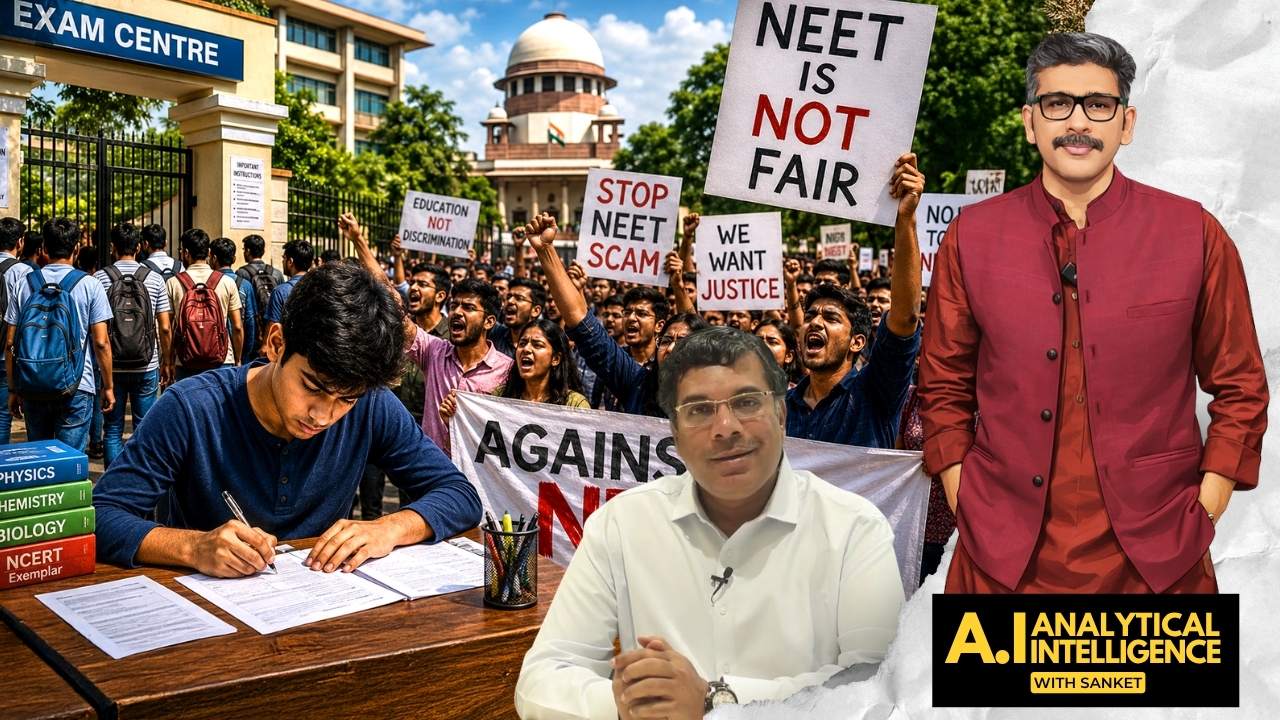

NEET-UG has once again become the centre of a storm of controversy, with allegations of paper leaks, repeated cancellations and questions being raised about the credibility of India’s national-level entrance testing system. The recurring disruptions have triggered a deeper debate on whether the system is failing structurally or being allowed to fail repeatedly. In this episode of AI with SanketSanket Upadhyay spoke to Maheshwar Peri, founder of Careers360to unpack what he believes is going wrong with the examination ecosystem and the National Testing Agency (NTA).
What is your opening reaction to what is happening with NEET and the National Testing Agency again?
I think it is ridiculous that we don’t learn lessons from what happened in the past. We don’t try to understand; we try to move on from an earlier problem by covering it up and not really going deeper into what exactly happened, so that it doesn’t repeat again.
In 2024, it was exactly the same scenario, and it has been repeated again. If we don’t deal with it properly this time, it will repeat again. If there had been a white paper or proper recommendation after 2024, we would not have reached this stage again.
The problem is that the government tried to move on by saying it was only a grace marks issue, which is not true. It was just that they did not want to go through the motions again. It was July at that time, and the issue surfaced late, after results. So the government likely felt it was too late and it might spoil an academic year, so they moved on. But had they investigated properly, this would not be happening again.
Also read: How Rajasthan’s Sikar became ground zero of the NEET 2026 scandal
What happened to the recommendations after the NEET-UG 2024 controversy? Were they implemented?
There are two parts to this. One is structural recommendations, and the other is about integrity in examination conduct.
The structural suggestions included things like moving towards computer-based testing because it reduces physical handling of papers and reduces chances of leakage. These are fundamental suggestions.
But the deeper issue—whether there is an integrity problem in how examinations are conducted—has never really been addressed. We don’t know how leaks happened, where they happened, and who was responsible.
In my opinion, there must have been a report, but it was not made public. I feel the integrity-related findings were brushed under the carpet, possibly because it was already too late and inconvenient to deal with.
Also read: NEET-UG 2026 cancellation: Of shattered dreams and burned-out lives of aspirants
Why do you think these examination failures keep repeating, and what guarantees exist that they won’t happen again?
The first issue is that whenever you have a physical paper, the chances of leakage are very high.
There are around 5,500 centres, multiple printing presses, transport systems, banks, security guards, and exam officials involved. The paper passes through many hands.
It is printed in multiple places, transported to banks, stored in lockers, and then opened on the day of the exam in the presence of officials, a bank manager, and security personnel.
Now imagine this chain: printing press, transport, bank storage, exam centre. At any point, if even a small group colludes—say a bank manager, a security person, and a centre head—the paper can be accessed. That is enough.
We are dealing with thousands of such centres, so the system becomes extremely vulnerable unless every single person involved has absolute integrity.
The second issue is the financial incentive in NEET. A government medical seat may cost around Rs 5 lakh in education costs, while private medical education can go up to Rs 1.5 crore.
So even if someone pays Rs 20-30 lakh to access a leaked paper, they still save a huge amount. That imbalance creates a strong incentive for malpractice.
In JEE, this incentive is not as skewed because private alternatives are not as expensive in comparison, so the pressure is different.
Even officials have acknowledged this reality. People know papers are being offered, and some students are advised to report such offers—but the temptation is high, and expecting moral restraint alone is unrealistic in such a system.
Is the centralised examination system, like NTA and CUET, actually failing its purpose of fairness?
A centralised system assumes that decentralised systems are inherently unfair, but that argument is not so simple.
Around 12-13 per cent of schools are CBSE schools, but they produce nearly 60 per cent of IIT and other top entrance qualifiers. Meanwhile, 87 per cent of students come from state boards.
Is it fair that students from state boards, who do not even have access to CBSE curriculum, are competing under identical conditions?
A student may be a state topper but still fail CUET because of coaching dependency. So we are not evaluating schooling anymore; we are evaluating coaching access.
Unless we balance school education value and entrance exam value, this inequality will continue.
How do you explain the dominance of certain coaching hubs like Sikar in NEET results and leak allegations?
Coaching centres survive only when students succeed. It becomes what is often called “topper farming”—one topper is used to market thousands of students.
In 2024, around 2.27 lakh students from Sikar appeared for NEET, which is only about 1.2 per cent of total candidates. But they accounted for a disproportionately high number of high scorers.
Roughly 2,800-2,900 students from there scored 650+, which is enough for government medical seats. That is a huge concentration.
If it were purely coaching excellence, other hubs like Kota, Hyderabad, Vijayawada, and Kerala should show similar patterns. But the pattern is uneven.
There are also repeated allegations that leaked or “guess papers” circulate in such hubs before exams. That creates suspicion that needs to be investigated seriously with data, not ignored.
Is the problem limited to coaching centres, or is there a deeper institutional failure involved?
It is difficult to isolate it to just coaching centres.
There is also the issue of timing—exam results and major political events often coincide, which diverts attention.
The question also arises: why not conduct exams online?
But even online exams are not foolproof. There are cases where proxy candidates sit in front of computers while someone else answers from behind. These rackets have been reported in multiple exams.
So the issue is not just paper or online—it is systemic vulnerability.
We need to reduce dependence on a single entrance exam determining a student’s entire future. Otherwise, the system will always remain vulnerable to manipulation.
Should NEET be conducted online, and would that solve the problem?
Online exams increase transparency, but they do not eliminate malpractice.
There are cases where proxy candidates or dummy test-takers are used even in computer-based exams.
So simply shifting to online mode is not a complete solution.
The deeper issue is equity. Students from remote areas like Manipur or Mizoram, who do not have access to coaching, are at a disadvantage.
We need a balance where school performance and entrance exams both matter, so that one three-hour exam does not define 18 years of education.
(The content above has been transcribed from video using a fine-tuned AI model. To ensure accuracy, quality, and editorial integrity, we employ a Human-In-The-Loop (HITL) process. While AI assists in creating the initial draft, our experienced editorial team carefully reviews, edits, and refines the content before publication. At The Federal, we combine the efficiency of AI with the expertise of human editors to deliver reliable and insightful journalism.)

Comments are closed.