

10
First Captagon seizure raises fears of emerging maritime narco corridor.
India’s first-ever seizure of Captagon, the notorious synthetic stimulant that emerged as one of the defining narcotics of the Syrian conflict economy, has triggered a major multi-agency investigation into whether international trafficking syndicates linked to West Asian narco networks are beginning to use Indian territory as a covert maritime transit corridor for Gulf-bound drug shipments.
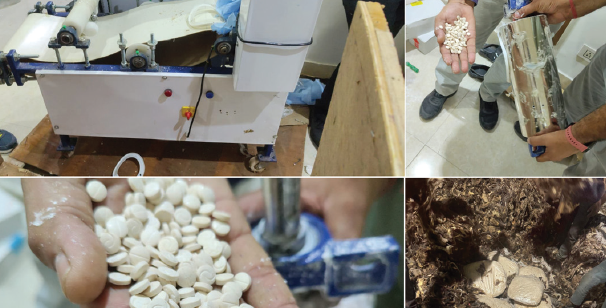
Nearly 200 kg of Captagon tablets valued at around Rs 182 crore in the illicit international market were seized by the Narcotics Control Bureau during “Operation RAGEPILL” at Gujarat’s Mundra Port, in what officials describe as one of the most strategically significant narcotics interceptions in recent years.
The operation led to the arrest of a Syrian national allegedly operating from Delhi’s Neb Sarai area and facilitating the movement of the consignment through India. Investigators said the shipment originated in Syria and was destined for Saudi Arabia, one of the world’s largest Captagon destination markets.
According to officials, the drugs were concealed inside tea leaf boxes packed within a shipping container falsely declared as carrying wool. The consignment was intercepted following intelligence-led profiling and detailed scrutiny of maritime cargo movements.
Union Home Minister Amit Shah described the seizure as a major success under the government’s anti-narcotics campaign and reiterated the Centre’s zero-tolerance approach towards international drug trafficking networks.
In a statement posted on X on Saturday, Shah said: “Modi govt is resolved for a ‘Drug-Free India’. Glad to share that through ‘Operation RAGEPILL’, our agencies have achieved the first-ever seizure of Captagon, the so-called ‘Jihadi Drug’, worth Rs 182 crore. The busting of the drug consignment destined for the Middle East and the arrest of a foreign national stand out as shining examples of our commitment to zero tolerance against drugs.”
He further said the government would “clamp down on every gram of drugs entering India or leaving the country using our territory as the transit route.”
What has deeply concerned Indian enforcement and intelligence agencies is not merely the quantity seized, but the drug itself and the geopolitical ecosystem surrounding it.
Captagon, chemically known as fenethylline, was originally developed in Germany during the 1960s as a pharmaceutical stimulant prescribed for conditions such as attention disorders and narcolepsy before being banned internationally because of its highly addictive properties.
Modern illicit Captagon, however, is usually a crude synthetic blend of amphetamines, caffeine and chemical fillers manufactured inside clandestine industrial facilities.
Over the last decade, the drug transformed into one of the central pillars of Syria’s wartime shadow economy.
International investigations, intelligence assessments and United Nations studies repeatedly identified Syria under the Assad regime as the world’s dominant Captagon production hub, with industrial-scale manufacturing networks allegedly embedded within wartime military, political and smuggling structures.
The United Nations Office on Drugs and Crime estimated that before the collapse of the Assad regime in late 2024, Syria’s Captagon industry had evolved into a multi-billion-dollar transnational narcotics enterprise supplying Gulf markets at enormous scale.
International security researchers and investigative organisations have alleged that trafficking revenues became deeply intertwined with conflict financing systems, sanctions evasion networks and regional power structures during the Syrian civil war.
The drug gained global notoriety after repeated intelligence and media reports linked its use to militant fighters operating in Syria and Iraq because of its stimulant effects, including heightened alertness, prolonged wakefulness, reduced fatigue and increased aggression.
That association led to Captagon being widely labelled the “jihadi drug” in international security discourse, although experts caution that the term is often sensationalised and oversimplified.
Nevertheless, counter-terror and anti-narcotics agencies across the Middle East, Europe and the United States have repeatedly examined overlaps between Captagon trafficking networks, armed groups, organised crime syndicates and conflict-zone financial ecosystems.
Globally, Captagon trafficking operates at an industrial scale rarely seen in synthetic narcotics markets. In one of the world’s largest known interceptions, Italian authorities in 2020 seized approximately 84 million Captagon tablets hidden inside industrial machinery arriving from Syria. In 2023, Dubai Police intercepted nearly 86 million pills worth more than $1 billion concealed inside decorative building panels. Saudi Arabia, Jordan, Lebanon, Iraq and Türkiye have also announced repeated multi-million-pill seizures over recent years involving concealment inside fruit consignments, machinery, commercial cargo and construction equipment.
Officials familiar with the Indian investigation said the Mundra seizure is particularly significant because the consignment was not intended for domestic circulation inside India.
Instead, investigators suspect India may have been used as a logistical transit point within a wider Syria-to-Gulf trafficking chain.
That possibility has raised alarm because international anti-narcotics agencies believe the Captagon trade is currently undergoing a major structural transformation following the collapse of the Assad regime in December 2024.
According to recent United Nations and international security assessments, large industrial Captagon production facilities inside Syria were dismantled or disrupted after the regime’s fall. However, experts say the trade itself did not disappear. Instead, trafficking systems appear to have fragmented into decentralised and adaptive networks operating through unstable border regions, smaller clandestine laboratories, cross-border smuggling corridors and alternative maritime routes.
International media investigations and regional security reports indicate that southern Syrian regions bordering Jordan have increasingly emerged as volatile trafficking zones after the collapse of centralised regime-linked control structures. Jordanian authorities and military forces have over recent years conducted repeated operations targeting heavily armed Captagon smuggling networks along the Syrian border, with several incidents escalating into deadly armed confrontations. Security assessments suggest traffickers have increasingly attempted to diversify routes and reduce dependence on traditional overland corridors that came under intense scrutiny from regional governments and international intelligence agencies.
Investigators in India are now examining whether traffickers may be experimenting with Indian maritime and logistics infrastructure as part of that wider rerouting strategy.
Multiple agencies are probing shipping records, communication trails, financial transactions, customs documentation and possible front import-export entities linked to the seized consignment.
Officials are also examining whether shell companies, layered cargo transfers and falsified commodity declarations were used to obscure the Syrian origin of the shipment.
The concealment method used in the case mirrors international Captagon trafficking patterns documented across the Middle East and Europe.
Global seizures over recent years have uncovered Captagon hidden inside industrial machinery, fruit consignments, tomato paste containers, furniture, milk packaging, metal structures and commercial cargo shipments. Investigators say such concealment methods indicate sophisticated organised logistics systems rather than isolated smuggling attempts.
The seizure once again places Gujarat’s Mundra Port under the spotlight.
The port has repeatedly featured in major narcotics investigations over recent years, including the 2021 seizure of approximately 3,000 kg of heroin valued at around Rs 21,000 crore, one of India’s largest-ever drug interceptions.
Subsequent investigations in multiple Mundra-linked cases explored possible links involving transnational trafficking syndicates, hawala channels and terror-financing concerns connected to maritime cargo smuggling routes.
Security officials say the Captagon seizure may force a reassessment of India’s evolving narcotics threat environment.
For decades, India’s anti-drug architecture primarily focused on heroin flows linked to the Golden Crescent and methamphetamine trafficking from Southeast Asia.
Captagon represents an entirely different geopolitical narcotics ecosystem rooted in the instability of the Syrian conflict, Gulf demand markets and transnational synthetic drug logistics.
International anti-narcotics experts increasingly believe synthetic drug trafficking networks are becoming more adaptive, decentralised and geopolitically fluid than traditional narcotics systems because synthetic drugs can be manufactured rapidly, relocated easily and concealed within legitimate global supply chains with relatively small operational footprints. The latest seizure also comes amid an intensified anti-narcotics campaign by Indian agencies.
Earlier this month, the NCB seized 349 kg of cocaine worth approximately Rs 1,745 crore in the Mumbai region under “Operation WHITE STRIKE”, while authorities have simultaneously expanded international cooperation efforts aimed at dismantling overseas trafficking chains and extraditing wanted traffickers.
According to official data, narcotics worth more than Rs 11,000 crore were seized at Indian seaports between 2020 and 2024.
Security agencies believe the Captagon interception may ultimately prove significant not only because of the quantity seized, but because it could represent the first visible indicator that the rapidly evolving post-Syria synthetic narcotics ecosystem is beginning to probe Indian commercial and maritime infrastructure as part of wider transnational trafficking recalibrations.
Further arrests are expected as the investigation progresses.

Comments are closed.