
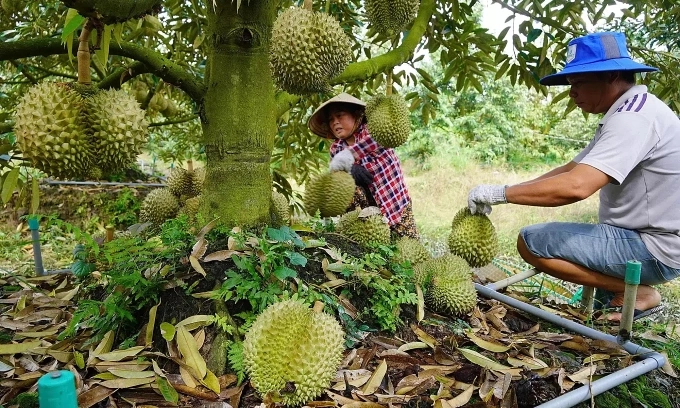
Loopholes leave durians vulnerable to banned chemical residues, hitting billion-dollar industry

Farmer Le Van Nhan sells durians on a street in Can Tho City, southern Vietnam. Photo by Read/Ngoc Han |
Five years ago, he converted 3,000 square meters of rice paddies into durian orchards after seeing it was a lucrative crop for many.
He harvested two tons of durian this year, but prices have plunged by almost 40% in recent weeks, forcing him to sell on the street to sell his fruits before they rot.
He vaguely knew prices fell since “not being eligible for exports to China” was a big factor, but says he has no idea what the standards are in the world’s largest market.
“If the fruit looks good, then it can be exported,” is all he thinks about export criteria.
Another southern farmer, Nguyen Van Trung in Dong Thap Province, Trung, who has 10 years of experience in cultivating durian, also admits he paid little attention to market standards, focusing mainly on keeping his trees healthy and maximizing yields.
“When buying fertilizers and pesticides, I rarely look closely into whether the ingredients leave residues of banned substances. It’s not just me – many farmers around here are the same.”
 |
A farmer sprays pesticides on durian trees. Photo by Read/Ngoc Tai |
The ignorance of farmers in controlling banned substances is one of the reasons why durians are struggling to enter the China market, forcing farmers them to sell domestically at VND20-30,000 (US$0.76–1.14) per kilogram, the lowest in years.
The habit of prioritizing output and appearance over quality and environmental standards was highlighted in a study by Can Tho University on awareness of and demand for plant protection chemicals among Mekong Delta farmers.
It found that 72% purchased and used pesticides based on advice from dealers.
When agricultural prices rise, many orchard owners tend to spray more chemicals to maintain yields and profits.
Among the banned substances in China, the biggest importer of Vietnamese durian, is cadmium, a heavy metal generated from industrial activities.
If waste is not properly treated, cadmium can spread into the environment, seeping into soil and water sources.
Bui Thanh Liem, former head of the agriculture and rural development office of Cho Lach District in the delta’s Vinh Long Province, says cadmium accumulates in soil mainly from industrial-origin organic fertilizers with high heavy metal content.
Due to poor oversight, many toxic chemicals are sold in the market, leading farmers to use them over long periods, he says.
The delta, as an old fruit-growing region, suffers higher levels of cadmium accumulation than many other areas, he says.
Farmers’ failure to comply with production processes, lax management of growing-area codes, and dishonest testing procedures also cause difficulties for durian exporters, he says.
Strict control is needed across the entire chain, from production, purchasing, and packaging to testing and exports, and everyone involved must be required to comply with procedures, he says.
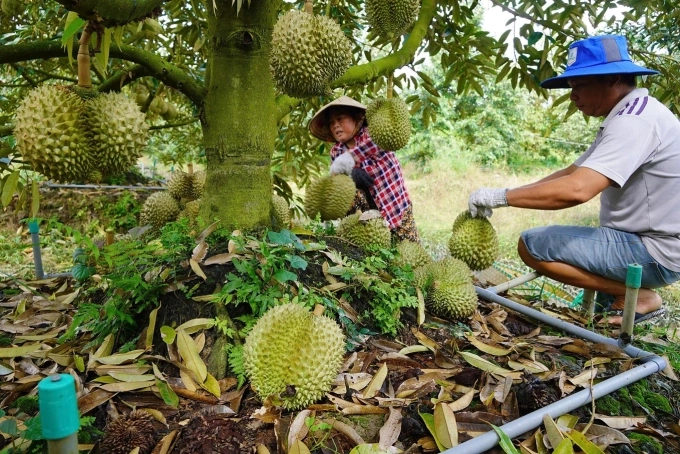 |
Farmers harvest durians in Dong Thap Province. Photo by Read/Hoang Nam |
Dong Thap Province, a major durian-growing area, has collected thousands of soil samples to test for cadmium residues.
The province is shifting from experience- to data-driven farming, with traceability down to individual orchards when required by markets.
Farms who meet standards will be connected with export companies.
The chairman of the Vinh Long people’s committee, Tran Tri Quang, says durian farming has expanded rapidly but without planning, and supply-chain linkages remained weak.
Vinh Long too is collecting soil samples for residue analysis to enable remediation measures such as increasing soil pH, controlling fertilizers containing cadmium, and treating soil residues besides zoning,.
Over 150,000 ha are under the fruit in Vietnam, more than twice the figure targeted in 2030, according to the Plant Production and Protection Department.
The delta accounts for more than 56,000 ha and an annual output of 750,000 tonnes.
Comments are closed.