
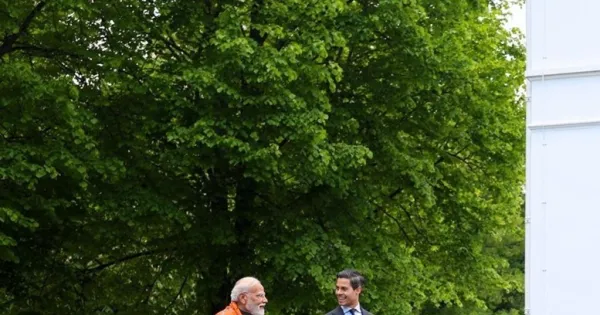
India-Netherlands transformed bilateral relations into partnership, talks between Rob Jetton and Modi

The Hague. India and the Netherlands have upgraded their bilateral relations to a ‘strategic partnership’. The Strategic Partnership Roadmap (2026-2030) was approved after bilateral talks held in The Hague between Netherlands Prime Minister Rob Jetton and Indian Prime Minister Narendra Modi. Its objective is to strengthen trade, technical and security cooperation. This historic joint statement places special emphasis on several key areas.
Movement and Migration Agreement
An important migration agreement was signed to promote easy movement of professionals and students between India and the Netherlands.
semiconductor and technology
Partnership between Tata Electronics and ASML for the development of semiconductor fab in Dholera. Along with this, the Ministry of Mines has also signed an agreement for exchange of critical minerals.
Green Hydrogen and Energy
India and Netherlands launch ‘India-Netherlands Roadmap for Green Hydrogen Development’. This will accelerate cooperation in renewable energy transition.
Cultural exchange and art
Netherlands returned historical copper plates of Chola dynasty to India. Along with this, an agreement was also signed regarding the National Maritime Heritage Complex located in Lothal (Gujarat) for the conservation of maritime heritage.
Important meaning of this journey
Prime Minister Modi’s visit to Netherlands proved to be important for India in many ways. Prime Minister Modi said that Netherlands is among the top five investors of India and the relations between the two countries have strengthened rapidly in the last 10 years.
Relationships got a new direction
Prime Minister Modi said that the progress being made towards a trade agreement between India and the European Union will further strengthen the relations between the two countries. He said that India and Netherlands together can create new possibilities in the field of innovation, technology and economic development.
17 major agreements
During Prime Minister Modi’s visit to Netherlands, 17 major agreements were signed between the two countries. Their focus will not be limited to just business, but big changes will also be seen in areas like technology, education, energy, farming, health, dairy, water management and cultural heritage. Both countries said that these decisions will give a new direction to development, employment, investment and global cooperation in the times to come. This will give India access to new technology, employment and global markets. Both countries will also work together on defence, cyber security and supply chain.
Agreement on simplifying the visa process
An agreement was reached between India and Netherlands to ease the visa process. This will provide better education and job opportunities to Indian students, professionals and workers. There will also be facilities for internship and long term visa.
cooperation in higher education
There is also a partnership between Nalanda University and the University of Groningen. Universities of both the countries will now be able to run joint research and degree programs. Indian students and teachers will get new opportunities for study and research in Dutch universities.
India’s industrial strength will increase.
The agreement on cooperation in critical minerals will strengthen the supply of essential minerals for electric vehicles, batteries and high-tech industries. This will increase India’s industrial strength. Not only this, India and Netherlands will work together in green hydrogen production and export. This will increase investment and employment in the clean energy sector. India will be able to make a strong place in the green energy market of Europe. Both countries will share technology and expertise in solar and wind energy projects.
NITI Aayog and Netherlands
Joint projects on energy security, green energy and new technology will be carried out in collaboration with NITI Aayog of India. This will benefit investment and industries. Netherlands will provide technical help in the big water project of Gujarat, India. This can increase the availability of water for drinking water, irrigation and industries.
Tripura’s flowers will fragrance the world
Netherlands will support Flower Center of Excellence, Tripura. This will provide modern technology to flower farming. This will increase the income of farmers and promote exports. Netherlands has also promised to help the Indo-Dutch Dairy Center in Bengaluru. This will provide new technology and training to dairy farmers and animal husbandry sector. This will improve milk production and quality. Not only this, the Indian animal husbandry sector will get the benefit of better health system, disease control and skill training.
cooperation in health sector
Both countries will cooperate in the health sector. The statement emphasized public health, medical research and sharing of scientific information. This cooperation will help in dealing with future health challenges.
most important agreement
An important agreement has been reached to make the trade and import-export process safe and transparent. This will provide relief to entrepreneurs. Both countries agreed to enhance long-term partnership in areas such as investment, green development, food security, water management and public health.
Strong stance on terrorism
It is noteworthy that India and the Netherlands share a strong and common stance against terrorism at the global level. Both countries strongly condemn not supporting terrorism in any form, stopping its funding and using any kind of “double standards” in combating terrorism. India and the Netherlands have called on all countries to eliminate terrorist safe havens and disrupt terrorist networks and their funding channels.

Comments are closed.