
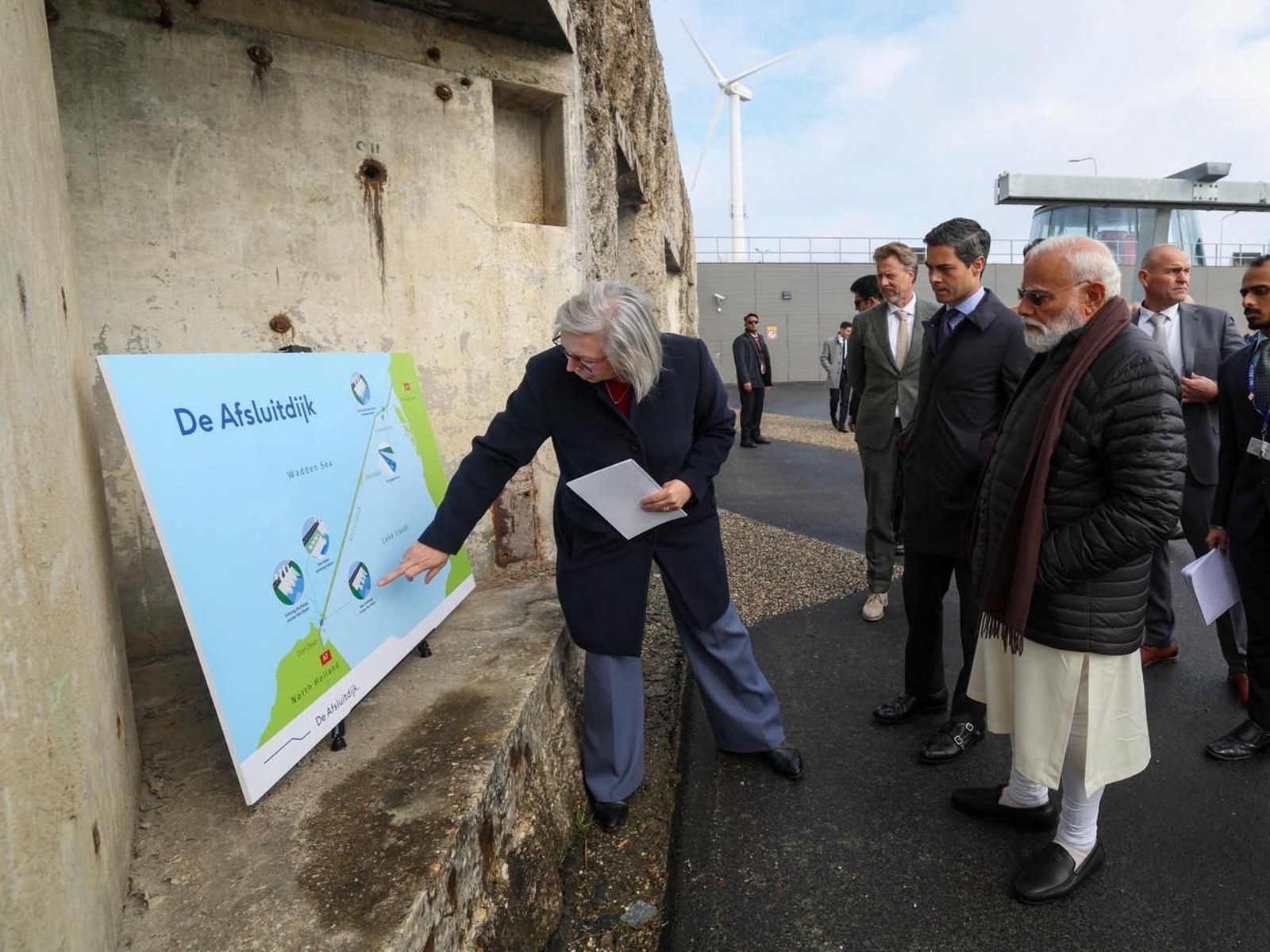

Prime Minister Narendra Modi’s vision for Gujarat’s Kalpasar Project has advanced significantly following his visit to the Netherlands, where he studied the Afsluitdijk, a renowned Dutch water management structure. During the visit, Modi highlighted the technology employed in the dam as highly worthy of study, noting the similarities between the Afsluitdijk and the Kalpasar Project.
In the presence of Prime Minister Modi, a Letter of Intent was signed between India’s Ministry of Jal Shakti and the Netherlands’ Ministry of Infrastructure and Water Management to facilitate technical cooperation on the Kalpasar Project, thereby opening new avenues to accelerate its implementation.
Gujarat has historically faced challenges with irregular rainfall and drought. The construction of the Sardar Sarovar Dam provided significant relief, but exclusive reliance on one project alone is considered a risk. Both Chief Minister and current Prime Minister Narendra Modi conceptualised the Kalpasar Project, which involves building a large dam across the Gulf of Khambhat to harness the waters of seven rivers flowing into the sea. The initiative aims to create an extensive freshwater reservoir, combining tidal power generation, irrigation, and transportation infrastructure development.
The project’s technical complexity and challenging nature have slowed progress since its marine survey launch in Bhavnagar in 2004, under Narendra Modi’s leadership. Nevertheless, government efforts to resolve these challenges have continued.
On March 30, Gujarat Chief Minister Bhupendra Patel discussed the Kalpasar Project and the establishment of an Indo-Dutch expert group, as well as a government-to-government partnership, with the Netherlands’ Ambassador Marisa Gerards during a meeting in Gandhinagar.
Upon completion, the Kalpasar Project is expected to provide irrigation to approximately one million hectares across 42 talukas in nine districts of Saurashtra. It is also anticipated to reduce the distance between South Gujarat and Saurashtra from 240 kilometers to 60 kilometers. The scheme is projected to generate around 1,500 MW of wind energy and 1,000 MW of solar energy, while promoting tourism and fisheries development.
Detailed Project Reports have addressed various aspects of the project, with the closure methodology—a critical element—being enhanced through collaboration with the Dutch maritime engineering firm Royal Haskoning.
The Afsluitdijk, nearly 80 years old, is a 32-kilometre barrier dam that separates the North Sea from a freshwater lake, protecting low-lying areas of the Netherlands from flooding. It serves as a global benchmark in flood control by blocking saltwater and creating a substantial freshwater reservoir, while also supporting shipping, transport connectivity, and renewable energy generation.
During his time as Gujarat’s Chief Minister, Modi envisioned the Kalpasar Project as part of his commitment to transforming Gujarat into a water-secure state, successfully implementing large projects like the Sardar Sarovar Dam. Despite political and environmental obstacles over decades, he maintained determination and resolve to realize such initiatives.
Prime Minister Modi has remained optimistic about the Kalpasar Project, and his recent inspection of the Afsluitdijk and the signing of the Letter of Intent reflect his dedication to overcoming engineering and technical difficulties.
A statement from India’s Ministry of External Affairs emphasized that the visit highlights the shared commitment between India and the Netherlands to collaborate on water management innovation, climate adaptation, and sustainable infrastructure.
“Prime Minister Narendra Modi’s visit and the signing of the Letter of Intent for the Kalpasar Project have opened new doors of opportunity for Gujarat. Through this collaboration, India will benefit from the Netherlands’s more than 90 years of expertise and management experience with the globally acclaimed Afsluitdijk dam project,” the release stated.
This cooperation builds on the “India-Dutch Strategic Partnership on Water,” established on March 29, 2022. The Netherlands’ advanced expertise in constructing dams in marine environments is expected to play a crucial role in realizing Gujarat’s ambitious Kalpasar Project.
Comments are closed.