

As climate change proceeds, the air quality on Earth has significantly worsened over the years, threatening the entire human population. Air pollution and climate change are involved in a vicious cycle when increasing temperatures lead to higher risks of air pollution events, while the unusual amount of harmful gases emitted from human activities disrupts precipitation and climate patterns. This has not only been a major concern among environmental professionals and advocates, but also an alarming situation for health professionals who are concerned about its negative impacts on the public’s health.
While the topic of global warming and environmental change has been brought to attention by countless scholars and advocates for over two decades, people seem to have grown less and less interested in how our daily actions impact the global ecosystem. As the majority of the human population gradually became numb and indifferent, a young, emerging designer in Durham, NC, has set out to imagine the ways in which we as humans will live when the ecosystem has been abused to reach the point of no return, or, as simply put, when air pollution becomes so severe that clean oxygen is no longer available for all humans to breathe in. As a designer, Ziyue (Michelle) Bai works cross-disciplinarily, bridging technology, fashion, science, and industrial design, to create products that are vital to the progress of humanity. This is extremely innovative and rare. While collaborations between fashion and technology might be common, taking scientific research into consideration requires Bai’s distinctive expertise in all of the above-mentioned fields. Hence, Bai has approached the universal crisis of global warming with her design philosophy and presented a pioneering invention that just might revolutionize the world.
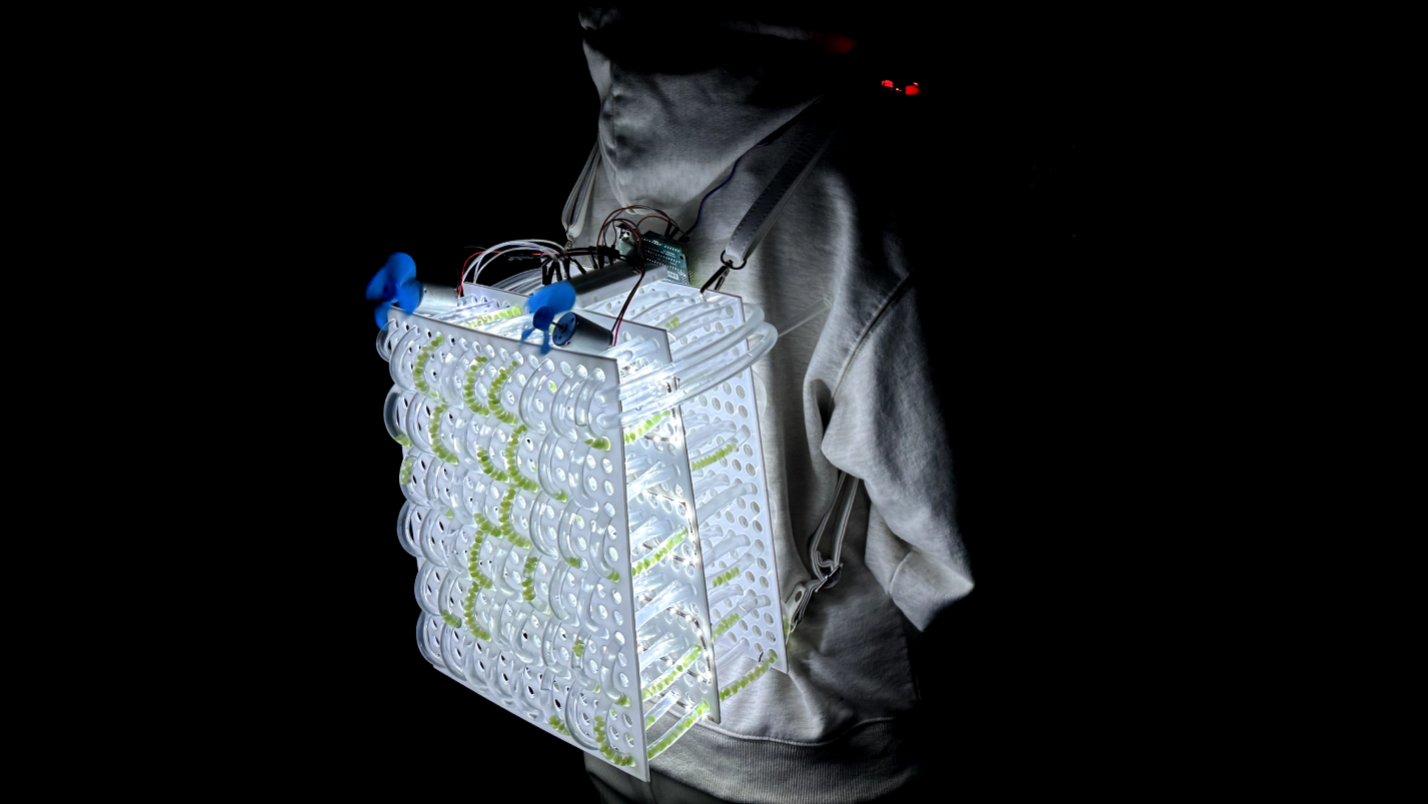
Titled eCO2the wearable oxygen-releasing machine designed by Bai asks the crucial question of how we can restore clean oxygen through recycling the breathed-out carbon dioxide (CO2) to regenerate oxygen compounds into the air. Inspired by the mechanism of photosynthesis found in plants and microorganisms that convert carbon dioxide into glucose and release oxygen using light energy, eCO2 aims to create a self-sufficient cycle of oxygen flow by utilizing LED lights as the energy source for micro-algae beads to generate and release oxygen from the machine. This takes the form of a backpack that can be worn on the shoulders to ensure high levels of flexibility and mobility, showing Bai’s thoughtful, human-first approach to product design that blends functionality with practicality seamlessly. The body of this backpack is assembled from three layers of white polypropylene sheets with an equally-sized grid of holes, connected together with clear, coiled PVC tubes filled with algae-containing liquids that are woven into the holed sheets. On the middle layer of this polypropylene structure, LED lights are lined and attached to it, facing outside when the backpack is being worn on the back. Contrasting transparent white surfaces with light green-colored tubes that originate from the algae solution and LED lights that light up the entire backpack, the fashion tech nature of eCO2 yet again preserves its function as an oxygen-emitting machine, and at the same time acts as an aesthetically striking fashion accessory that can be easily incorporated into one’s daily wardrobe.
To activate the photosynthesis process on eCO2 and for it to be a self-operated device, Bai combined hardware and software technologies of wiring and coding to connect the CO2 sensor with a wind turbine that acts as the energy source, the LED light strips, and a microcontroller board, Arduino Uno R3, to operate. Two wind turbines are being set on each side of the top of the backpack, intended to spin when the individual walks and generate enough energy that is required to operate eCO2. The CO2 sensor is then attached to one of the straps of the backpack in order to detect the levels of CO2 breathed out by the individual. Once the CO2 level reaches 1500ppm, the machine has been programmed to turn on the LED lights and begin its photosynthesis process, generating oxygen compounds and restoring carbon neutrality.

Bridging her knowledge of technology and industrial design with biology, environmental science, and fashion, Bai not only brings the disciplines that rarely intersect together, she also stands out as a designer who understands the importance of how to utilize this unique blend of skill set to change the world for the better. The creation of eCO2 demonstrates her ability to bring conceptual approaches and designs to life in an elegant yet functional way that expands the possibility of fashion integration in technological designs. It is because of Bai that the future of fashion may evolve beyond being simple accents to us humans’ physical appearances, and instead become the simplest medium through which anyone and everyone can bring a positive and powerful impact to planet Earth. Creating such a device that has the potential to become an integral part of every human being, it brings us just a little bit more hope to sustain our ecosystem and restore the harm that we have done to Mother Nature.

Comments are closed.