
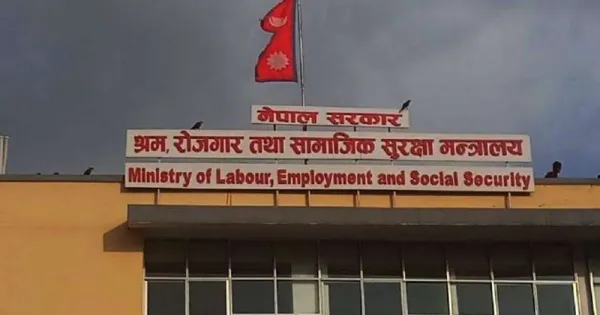

Kathmandu. The Government of Nepal has taken forward the labor agreement process with 16 countries with the aim of making foreign employment secure and systematic. The Ministry of Youth, Labor and Employment has sent the proposal to those countries, but till now no country has responded to it.
Ministry spokesperson Pitambar Ghimire said that a proposal for labor agreement has been sent to 16 countries through the Ministry of External Affairs. However, till now no country has responded to Nepal’s proposal. The government has sent a proposal with the aim of entering into labor agreements with the countries of Asia, Europe and Australia.
According to Ghimire, it has been more than a year since the ministry sent a labor agreement proposal to Vietnam, Australia, Thailand, Albania, Austria, Turkey, Malta, Maldives, Serbia, Cyprus, Luxembourg, Brunei, Poland, Bosnia and Herzegovina, Croatia and Belgium. None of these countries have responded to Nepal’s proposal so far.
Currently Nepal has bilateral labor agreements with only 13 countries, while Nepalese workers are employed in more than 170 countries of the world. A large number of Nepalese youth go for foreign employment to countries where Nepal does not have labor agreements.
Due to this, the risk of economic fraud and labor exploitation is increasing. To reduce this risk, the government is taking forward the process of labor agreements with new countries. Moreover, about 48 percent of Nepali citizens going to different countries for foreign employment take individual labor clearance.
There is a provision in the law of Nepal that the Government of Nepal can send workers through government bodies or entities wholly owned by the Government of Nepal by entering into treaties or agreements with the governments of countries that have established diplomatic relations. On the basis of these legal provisions, the government is taking forward the bilateral labor agreement and understanding process with the countries where Nepali workers go.
Ministry spokesperson Ghimire said, “We are constantly following up with the countries that have sent proposals for a labor agreement. A response is awaited from their side. It is not possible to say anything right now as to why the response has not come. The proposals have been sent with a desire to enter into a labor agreement.”
Bhuvansingh Gurung, President of Nepal Foreign Employment Traders Association, says that labor agreement is an important basis for ensuring the legal protection and rights of workers. According to him, labor agreement is very important in countries where a large number of Nepali workers go or are likely to go.
He said, “If there is injustice to the workers by the employer or company, then it becomes easier to find a solution by coordinating between the governments of both the countries. The bilateral agreement helps in providing employment to the skilled Nepali workers systematically.”
Gurung also says that labor agreements with major labor destination countries are necessary to protect workers from exploitation, low wages and unsafe working conditions. Additionally, labor agreements also play an important role in providing assistance and relief at the government level when problems arise abroad.

Comments are closed.