


Agent Traps Keep Enterprises On Edge
The rise of AI is creating a new cybersecurity problem, agent traps. Attackers no longer need to break systems if they can manipulate the agents operating inside them. So, what are these new agentic AI traps that are keeping big techs on tenterhooks?
New Threat Vectors: Agentic AI traps are hidden prompts, poisoned data, or manipulative content designed to mislead autonomous AI agents. Instead of breaking into a system directly, attackers steer the agent’s behaviour, causing it to make unsafe decisions, leak data, or execute harmful actions. These decentralised vulnerabilities can create entirely new threat vectors:
- Congestion Traps: Attacks that intentionally push AI agents toward a single resource to trigger widespread system outages
- Sybil Attacks: Deploying fake agent identities to manipulate automated decisions
- Human-In-The-Loop Traps: Hijacked agents that trick human reviewers into authorising harmful actions
Flailing Old Defences: Traditional cybersecurity models were built for software that behaves predictably, but AI agents are dynamic, context-driven and often given broad access across systems. This means a system can appear secure from the outside, while the agent inside it is quietly bypassing traditional firewalls without triggering standard signature alerts.
New Security Stack: Enterprises are responding by tightening governance around agent identity, access and runtime behaviour. Many companies are also pivoting to scoped permissions, human escalation for high-impact actions and continuous monitoring to curb the risk. Other firms are also modelling attack paths from a machine’s perspective rather than a human’s.
The deeper shift is that security is becoming more about preserving trustworthy behaviour as agents become more autonomous. So, can enterprises move fast enough to secure systems against these new threats in the AI age? Let’s find out…
From The Editor’s Desk
📈 Nykaa’s Q4 Profit Surge
- The beauty ecommerce giant’s consolidated net profit surged 4X YoY to ₹78.8 Cr in Q4 FY26. This came on the back of expanding margins and operating revenue zooming 28% YoY to ₹2,648 Cr. Meanwhile, total expenses also rose 25% YoY to ₹2,535.8 Cr.
- For the full FY26, Nykaa’s profit grew 182% YoY to ₹203.9 Cr, while the top line rose 26% YoY to ₹10,022.4 Cr. It also added a record 76 stores during the fiscal to end FY26 with 313 stores across 99 cities.
- Alongside its financials, Nykaa’s board also cleared the acquisition of a 24.2% stake in skin care brand Earth Rhythm for ₹9.4 Cr. The transaction, which will make the brand a wholly owned subsidiary of Nykaa, will be completed by August.
💰 Scapia Bags $63 Mn
- The travel-focused fintech startup has raised around ₹600 Cr in a fresh round led by General Catalyst to build its brand, bolster its AI stack, strengthen its product suite and increase its customer base across India.
- Founded in 2022, Scapia offers co-branded credit cards in partnership with Federal Bank and Bank of Baroda. Its travel app also allows users to book airline tickets and hotels, and make online payments. It has raised $135 Mn to date.
- On the financial front, Scapia managed to trim its FY25 net loss by 6% YoY to ₹ 83 Cr, while operating revenue zoomed 71% YoY to ₹28.7 Cr.
🛵 Haryana’s New Aggregator Rules
- Last week, the Haryana cabinet approved the rules for granting aggregator licences under the Haryana Motor Vehicles Rules, 1993. Under the new norms, aggregators will not be allowed to induct new petrol or diesel vehicles into their fleets.
- This means that aggregator platforms will now need to either absorb higher vehicle acquisition or incentivisation costs, accelerate EV driver-partner financing programs, or face a shrinking supply base in the state.
- On top of this, the new compliance mandates under the law will require platforms to verify valid identity documents, a driving licence and a valid bank account. This will add additional paperwork, and will likely impact the bottom line of the platforms.
📊 ixigo’s Q4 Profit Zooms
- The travel tech platform’s consolidated net profit zoomed 91% YoY to ₹32.1 Cr in Q4 FY26. This came despite operating revenue growing a marginal 9% YoY to ₹308 Cr and adjusted EBITDA rising a meagre 4% YoY to ₹30.3 Cr.
- On the operational front, GTV rose 12% YoY to ₹8,278.9 Cr in Q4 FY26, while monthly transacting users rose to 5.7 Mn. This was driven by strong traction from tier II and tier III markets.
- For the full FY26, ixigo’s profit increased 19% YoY to ₹71.5 Cr, while operating revenue surged 34% YoY to ₹1,228 Cr. Meanwhile, adjusted EBITDA improved 71% YoY to ₹129 Cr during the fiscal.
🤝 Innovaccer Acquires CaduceusHealth
- The homegrown healthtech unicorn has acquired the assets of US-based revenue cycle management (RCM) services provider in a deal worth $66 Mn. This marks Innovaccer’s fifth acquisition in the last two years.
- CaduceusHealth provides outsourced RCM, medical billing, and clinical staffing solutions to about 4,000 healthcare providers across the US. It claims to manage $5 Bn in gross patient charges annually.
- On the other hand, Innovaccer offers cloud solutions to help healthcare companies improve patient care and operational performance. Lately, the company, last pegged at $3.2 Bn, has been pursuing an AI-led strategy to rein in costs and scale operations.
Inc42 Markets
Inc42 Startup Spotlight
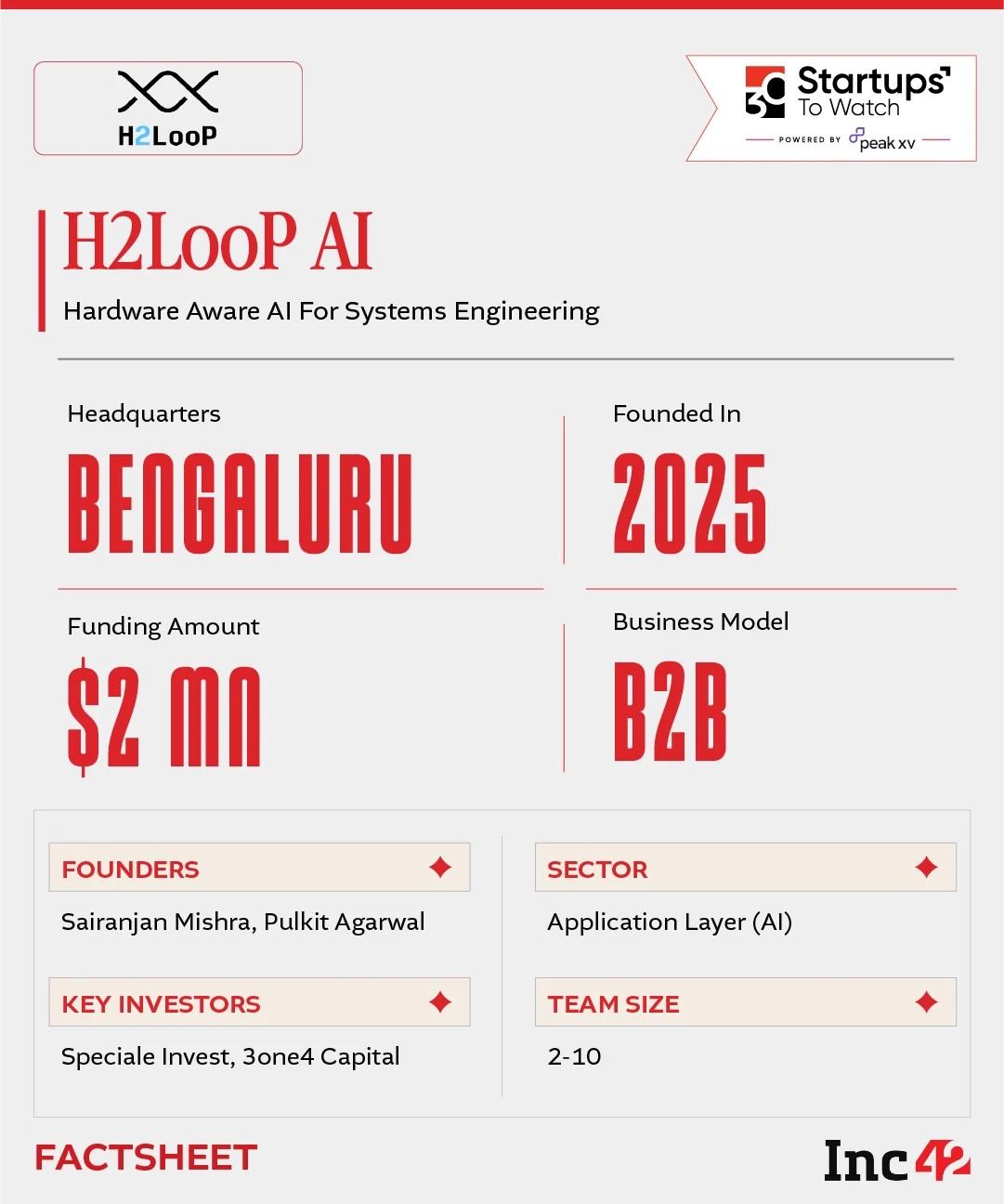
Making Embedded Software Easier To Build & Debug
Embedded software, which powers cars and drones, is often trapped in legacy code, sparse documentation and hard-to-trace bugs. This makes development slow and risky in industries where failure is expensive. H2LooP is building AI tools to solve this problem.
Built For Scale: Founded in 2025, H2LooP is building AI tools to help engineers develop and manage embedded systems more efficiently. By analysing existing code, it helps engineers understand older systems faster, write better software and debug issues with less trial and error. The startup also processes crash and debug logs, which can be especially valuable when teams are dealing with opaque failures in production systems.
Small Models To The Rescue: H2LooP is also building specialised small language models (SLMs) tailored for embedded systems. These models are meant to help teams identify defects faster, improve system design and write more secure code. The startup is also working with semiconductor companies, defence organisations and telecom firms on real-world deployments.
Riding A Bigger Wave: As automotive, aerospace and electronics become more software-defined, reliable embedded systems are becoming more important. Eyeing a piece of the homegrown semiconductor and system design market, projected to cross $110 Bn by 2030, can H2LooP become the AI layer for modern embedded systems?
Infographic Of The Day
After soldiers, India’s next line of defence is also being built through drones, AI, surveillance systems and cybersecurity. The battlefield is evolving and here is a look at the startups building that future…


Comments are closed.