
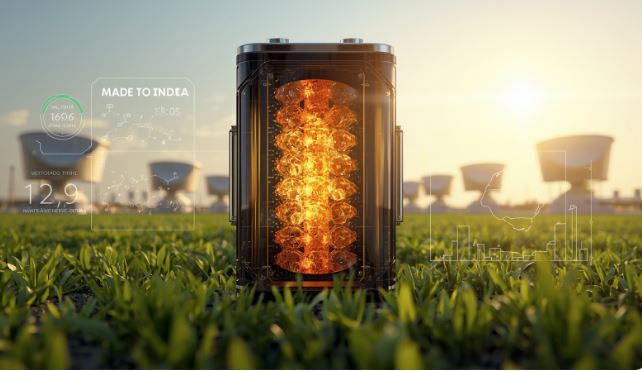

New Delhi, 22 May 2026: A major scientific breakthrough has come to the fore giving impetus to India’s Clean Energy Mission and ‘Atmanirbhar Bharat Abhiyan’. Indian researchers have developed a highly cost-effective and efficient ‘thermal energy storage material’. This new material will significantly improve the efficiency of thermal batteries that store waste heat from solar power plants and industrial units.
Scientists of ‘International Advanced Research Center for Powder Metallurgy and New Materials’ (ARCI), an autonomous organization of the Central Department of Science and Technology (DST) have achieved this feat. Dr. The ARCI team under the leadership of Mani Karthik has developed a very simple and cheap ‘co-precipitation’ method to prepare a special type of spinel nanocomposite phase change material (PCM) for thermal energy storage applications. With the help of this technology, spinel-type metal oxide nanoparticles with controlled particle size have been produced, which have excellent thermal stability.
Increased energy storage capacity compared to the base material
Laboratory tests have shown that adding just 1 percent of these spinel oxide nanoparticles to a common phase change material (PCM) increases its specific heat capacity by as much as 45 percent. During scientific research, the superior properties of this material have also been confirmed by high-resolution transmission electron microscopy (HR-TEM) and differential scanning calorimetry (DSC) profiles. When these nanoparticles are dispersed in the material, they form a stable oxide layer by increasing the surface area and surface energy, which increases the energy storage capacity compared to the base material.
The professional benefits of this research are also huge. Since this new material can store more thermal energy per unit mass, power plants can now operate with smaller storage tanks. Due to smaller size of the tank, there will be less use of construction material, which will significantly reduce both the capital cost and operational expenses of the energy sector industries. This research published in the world-renowned science journal ‘Materials Today Chemistry (Elsevier)’ will pave the way for compact and affordable next-gen energy storage solutions. This material, made with India’s own indigenous skills, will take the country to new heights in the green energy sector.

Comments are closed.