
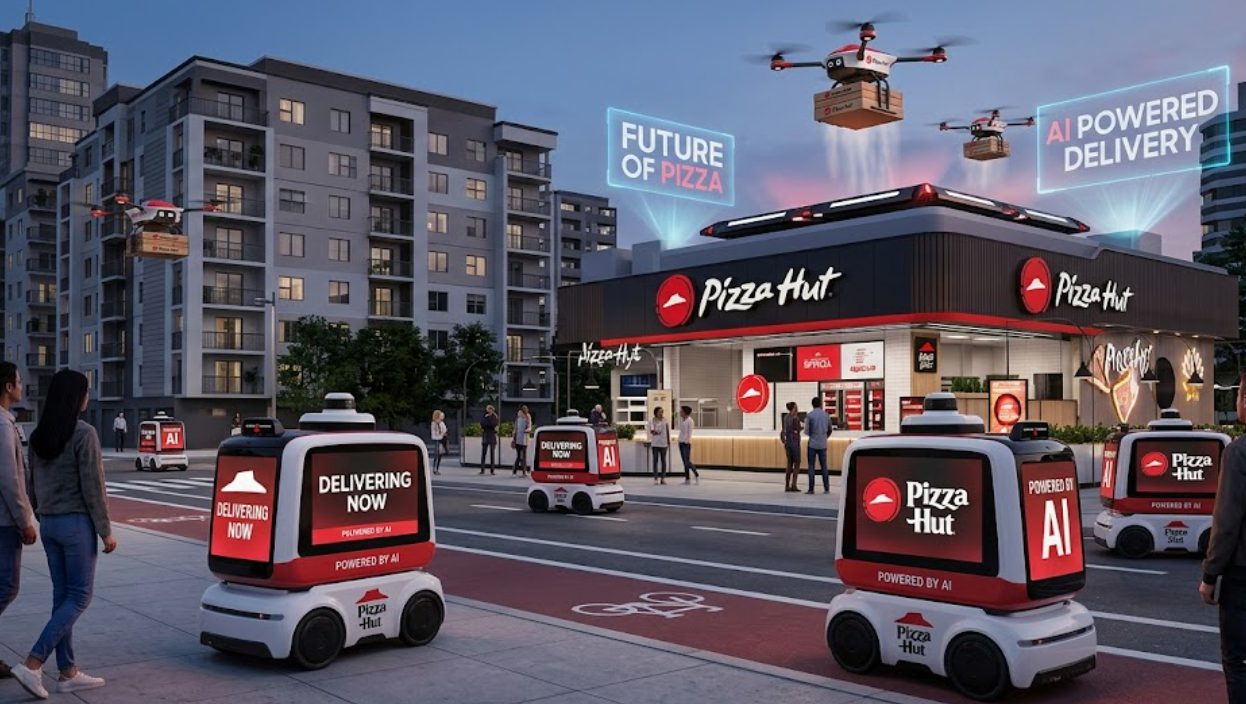

Artificial intelligence is rapidly transforming businesses across industries. From customer service chatbots to warehouse automation, companies are increasingly relying on AI tools to improve efficiency and reduce costs. But for Pizza Hutone ambitious AI rollout has reportedly created more problems than solutions.
A major Pizza Hut franchisee has now sued the company, alleging that its AI-powered delivery system caused severe operational issues, delayed deliveries, angry customers, and losses that could exceed $100 million.
Credits: Gadget Review
The AI System Meant To “Optimise” Deliveries
The controversy revolves around Dragontail, an AI-based delivery management platform introduced by Pizza Hut in 2024. The system was designed to streamline deliveries by tracking kitchen operations, predicting order readiness, and coordinating delivery drivers more efficiently.
Pizza Hut’s goal was simple: use AI to modernise pizza delivery and improve customer experience in an increasingly competitive food delivery market.
However, according to the lawsuit filed in the Texas Business Court on May 6, the technology allegedly had the opposite effect.
The lawsuit was filed by Chaac Pizza Northeast, a large franchise operator that manages around 111 Pizza Hut locations across New York, New Jersey, Maryland, Washington, D.C.and Pennsylvania.
Before Dragontail was implemented, the franchisee claimed that more than 90% of deliveries reached customers within 30 minutes. Customer satisfaction levels were reportedly high, and sales performance remained stable.
But once the AI system was introduced, the company alleges that operations quickly spiralled into chaos.
What Went Wrong?
At the centre of the complaint is the way Dragontail reportedly interacted with delivery drivers from DoorDash.
According to the lawsuit, the system gave DoorDash drivers real-time visibility into kitchen operations and pizza preparation times. Instead of immediately delivering completed orders, drivers allegedly began waiting for multiple deliveries to be prepared so they could combine trips and maximise earnings.
The lawsuit claims drivers sometimes waited “up to 15 minutes” before leaving stores, even when pizzas were already ready for delivery.
That delay may not sound dramatic at first, but in the fast-food business — especially pizza delivery — speed is everything. A pizza arriving 15 or 20 minutes late can easily turn a satisfied customer into a frustrated one.
The franchisee described the situation as causing “cascading operational breakdowns and customer dissatisfaction.”
Sales Reportedly Took A Major Hit
Chaac Pizza Northeast claims the delivery delays severely impacted customer trust and sales performance.
One of the most striking allegations in the lawsuit involves New York City operations. According to the filing, annual sales growth reportedly dropped from a positive 10.19% before Dragontail’s rollout to negative 9.78% afterward.
The company now estimates the damage at nearly $100 million.
Beyond the financial losses, the lawsuit also accuses Pizza Hut of failing to provide proper training and operational support for the new technology. The franchisee claims that despite repeated requests for help, Pizza Hut continued requiring stores to use the system.
The lawsuit seeks more than $100 million in damages, along with legal fees.
Pizza Hut Responds Carefully
In response to media reports, Pizza Hut said it is reviewing the claims and plans to respond through “appropriate legal channels.” The company has not commented publicly on the specific allegations.
The case could become an important example of the risks companies face when implementing AI-driven systems without fully understanding how they behave in real-world situations.
Credits: The Independent
A Bigger Warning About AI In Business
The Pizza Hut lawsuit highlights a growing challenge for companies adopting AI technologies: efficiency on paper does not always translate into efficiency in practice.
AI systems are often designed to optimise numbers and workflows, but they can sometimes create unintended human behaviour. In this case, the technology allegedly encouraged drivers to prioritise batch deliveries over speed, ultimately hurting the customer experience.
As businesses rush to integrate AI into everyday operations, this case serves as a reminder that automation alone cannot replace careful oversight, employee training, and real-world testing.
For Pizza Hut, what was supposed to be a futuristic delivery upgrade has instead become a costly legal and operational battle.

Comments are closed.