
India Prepares To Counter Pakistan’s Turkish Drones Mulling Over Mq 28 Ghost Bat Ucav Purchase

Amidst the possibility of Pakistan getting Turkey’s advanced combat drones, India is now taking steps towards rapidly strengthening its unmanned warfare capability. According to reports, India is seriously considering purchasing the MQ-28 Ghost Bat UCAV (Unmanned Combat Aerial Vehicle) developed in Australia and manufactured by Boeing. It is being considered as a strategic answer to Türkiye’s Bayraktar Kizilelma drone potentially acquired by Pakistan.
According to sources, Türkiye may advance the supply of its stealth capable AI-based multirole combat drone Kizilelma to Pakistan. If this deal is completed then there can be a big change in the unmanned warfare capability of Pakistan Air Force. In this background, India is focusing on updating its air war strategy as per future needs.
The MQ-28 Ghost Bat has been jointly developed by Australia’s Boeing and the Royal Australian Air Force. It is an “Unmanned Collaborative Combat Aircraft”, designed to work in conjunction with manned combat aircraft and airborne early warning platforms. Boeing calls it the Force Multiplier for Advanced Airpower Systems.
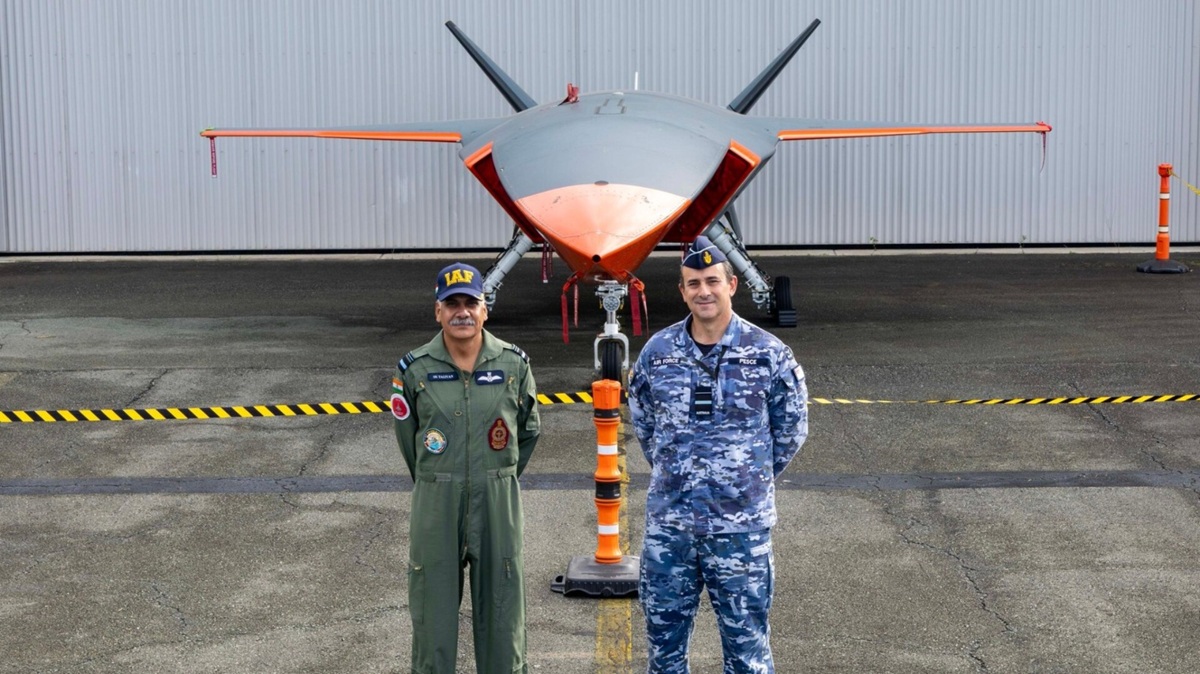
The biggest feature of Ghost Bat is its open-system architecture and modular design. In this, different payloads can be changed rapidly according to the mission. Its missionized nose section makes it suited for various missions such as electronic warfare, surveillance, air defense and precision strike.
This drone is capable of covering a distance of more than 2,000 nautical miles i.e. about 3,700 kilometers. Its maximum speed can reach Mach 0.9 and it can operate at altitudes of more than 40,000 feet. This 11.7 meter long platform weighs approximately 3,175 kg.
The Ghost Bat program has been developed in Australia for the past eight years. It is believed to be the first military combat aircraft designed and built in Australia in the last 50 years. More than 70 Australian companies have contributed to this project.
The project got a major success globally when in December 2025, Boeing and the Royal Australian Air Force successfully completed the first Autonomous Air-to-Air Combat Kill test using the AIM-120 Amram missile. In this test, the Ghost Bat detected, tracked and engaged an aerial target without direct human control. According to experts, this capability makes it among the most advanced UCAV platforms in the world.
By March 2025, its prototype had completed more than 100 test flights and more than 20,000 hours of digital simulations had been conducted to support it.
India’s interest was also clearly visible during the 12th Air Staff Talks between the Indian Air Force and the Royal Australian Air Force held in Canberra in May 2026. Photographs from the meeting showed an MQ-28 Ghost Bat behind Indian Air Force Air Vice Marshal Sanjeev Talian and his Australian counterpart Air Vice Marshal Steven Pace. Joint exercises, interoperability, training and future aerospace cooperation were discussed in the talks.
Ghost Bat can provide many strategic advantages for the Indian Air Force. Its autonomous capability enables aggressive mission planning while reducing risk to pilots. It can operate in conjunction with manned combat aircraft such as the Su-30MKI and future AMCA, thereby strengthening the manned-unmanned teaming concept.
Experts believe that if India inducts Ghost Bat, it will not only give it a technological edge, but will also strengthen the strategic partnership with Australia and Indo-Pacific security cooperation. Amid Pakistan’s efforts to acquire Turkey’s UCAV, India’s move is considered important towards maintaining regional balance and maintaining an edge in future unmanned aerial warfare systems.
Also read:
Delhi Gymkhana Club refuses to vacate the premises; Court will go against Centre’s ‘re-entry’ order
Mango Panna gives natural relief from dehydration and weakness in summer!
Big success for Oil India in Dandewala field, new natural gas reserves found at a depth of 950 meters.
Big step towards US-Iran agreement, Tehran ready to give up enriched uranium

Comments are closed.