
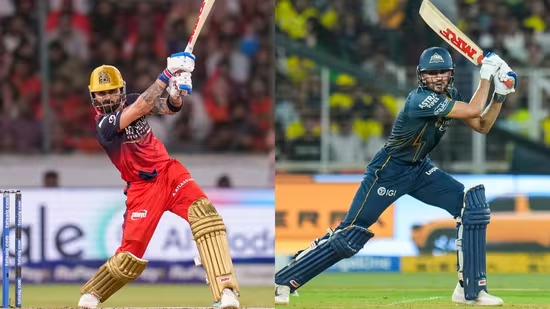

Seventy league matches have reduced IPL 2026 to its first great knockout hinge. Royal Challengers Bengaluru and Gujarat Titans meet in Qualifier 1 at Dharamsala, with a direct passage to the final on offer and one defeat still carrying the safety net of Qualifier 2. The cricketing frame is already large enough. The emotional frame makes it larger.
Virat Kohli against Shubman Gill is no longer just a batting comparison. It is the King against the Prince, but not in the lazy, ornamental sense. Kohli remains the grand old force of IPL batting, still shaping RCB’s innings with control, tempo and presence. Gill, now GT’s captain and primary run-maker, has moved from succession debate to present-tense authority. The numbers do not flatten that story. They sharpen it.
The case for Shubman Gill
Begin with the aggregate value, because Shubman Gill’s IPL 2026 has been bigger than batting alone. The WPA Impact Index gives him 2048.27 total impact points from 13 matches, placing him second overall in the season ledger. Kohli sits at 1361.53 from 14 matches. On per-match total impact, Gill’s 157.56 is substantially ahead of Kohli’s 97.25.
That difference is not accidental. Gill’s season carries two engines: batting output and captaincy value. His captaincy layer contributes 470.7 impact points, a category Kohli does not enter because he is no longer leading RCB. Even when the comparison is stripped down to player performance, Gill still stays ahead: 1577.57 to Kohli’s 1361.53. His batting score also leads, 648.66 to 561.45.
The raw batting ledger supports the same argument. Gill has 616 runs from 381 balls at a strike rate of 161.68. Kohli has 557 from 339 at 164.31. Kohli scores marginally quicker, but Gill has carried greater volume. His recent form adds weight to the case: 5, 84, 5, 85 and 64 in his last five innings. Two failures sit inside that sequence, but three major scores around them make the form profile steadier than it first appears.
This is Gill’s strongest claim entering Qualifier 1. He has not merely had good nights. He has given GT structure across the season.
The case for Virat Kohli
Virat Kohli’s argument begins where Gill’s dominance narrows: batting purity. His strike rate is higher. His average is stronger. His dot-ball percentage is lower. Gill has the broader season value, but Kohli’s batting has been cleaner in several decisive pockets.
The powerplay comparison is almost absurdly tight. Kohli has 291 runs off 176 balls in the first six overs at 165.34. Gill has 289 off 175 at 165.14. There is barely a sheet of paper between them on the scoring rate. The difference lies in control. Kohli’s powerplay dot-ball percentage is 24.43. Gill’s is 36.57. Kohli gives bowlers fewer quiet deliveries. Gill has the higher boundary-release rhythm, but he also allows pressure to collect more often.
The direct RCB-GT record also favours Kohli. In the two league-stage meetings, he made 81 off 44 and 28 off 13, giving him 109 runs off 57 balls at 191.23 against Gujarat this season. Gill made 32 off 24 and 43 off 18, finishing with 75 off 42 at 178.57. Both were dismissed twice. Kohli did more damage.
That is the strongest counterweight to Gill’s tournament lead. The Prince has owned more of the season. The King has already hurt this particular opponent more severely.
Also Read: Who will win IPL 2026? Title race down to four teams, but the biggest favourite may not be the most obvious one
Where Qualifier 1 turns
The match-up map gives both attacks a clear route. Gujarat must avoid feeding Kohli the full ball. He has punished full lengths across lines, especially when bowlers have missed into his scoring arc. The better plan is hard length outside off, forcing him to manufacture pace and access square boundaries rather than letting him flow down the ground.
RCB’s plan to Gill is equally obvious. His returns against outside-off good length and off-stump good length are far less destructive than his best zones. Bhuvneshwar Kumar has already kept him relatively quiet in the head-to-head sample. Suyash Sharma has dismissed him once. The aim should not be reckless wicket-hunting. It should be to make his first 15 balls heavy.
The death-overs split is another subtle separator. Kohli’s sample is small but sharp: 26 off 11 at 236.36, with no dismissals. Gill has 24 off 15 at 160, with four dismissals and a high dot-ball rate. Gujarat will want Gill’s major damage to arrive before the final four overs. RCB will be happier if he is forced to finish under compression.
Verdict
Gill has had the better IPL 2026. The impact model, volume, captaincy contribution and recent form all point in his direction. He has been GT’s batting spine and strategic centre, which makes his season more complete than a simple run tally can show.
Kohli, however, remains the more dangerous individual batting presence in this specific contest. His powerplay control, lower dot-ball rate and direct record against Gujarat give RCB a clear route into the match. If Gill starts cleanly, GT control the game. If Kohli survives Gujarat’s hard-length test, RCB can bend the night around him.
The season belongs to the Prince on numbers. Qualifier 1 may still belong to the King if Gujarat miss their first plan.
Method note and disclaimer
This analysis uses the WPA Impact Index calculated by a model designed exclusively by the author, combining batting output, phase context, ball-level impact and captaincy value where applicable. The model is designed to estimate performance influence, not predict certainty. Knockout cricket can be distorted by toss, venue behaviour, short samples, injuries and one extraordinary passage of play.

Comments are closed.