
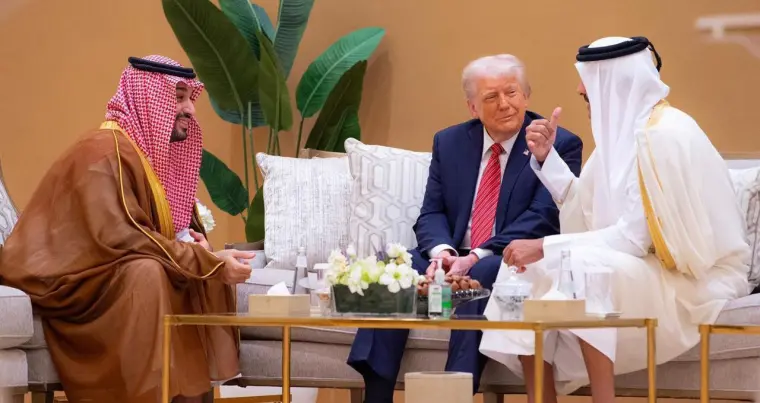

Donald Trump has appealed to Muslim and Arab countries to recognize Israel after the end of the Iran war. According to reports, America wants to create a new strategic alliance in West Asia by expanding the Abraham Accords.
Washington: Amidst the ongoing tension between America and Iran and a possible peace agreement, US President Donald Trump has started trying to give a new turn to the politics of West Asia. According to media reports, Trump no longer wants to stop at just a ceasefire or a limited peace agreement, but he wants more and more Muslim and Arab countries to give official recognition to Israel and become part of the so-called “Abraham Accords”.
This strategy has come to light at a time when talks are going on between Iran and America regarding the nuclear program, the Strait of Hormuz and regional security. The Trump administration is seeing this as the new US strategic order in West Asia.
Leaders of many Muslim countries participated in the high-level call
According to reports, Trump recently held a high-level conference call with leaders of several Muslim and Arab countries. Representatives of Saudi Arabia, United Arab Emirates, Qatar, Pakistan, Turkey, Egypt, Jordan and Bahrain were involved in this conversation.
It is being told that Trump told these countries that if the war with Iran ends, he hopes that Muslim countries will take steps towards normalizing their relations with Israel.
According to American officials, after Trump’s appeal, there was silence for a few moments in the conversation. Especially countries like Pakistan, Saudi Arabia and Qatar did not give any clear reaction immediately.
What is the Abraham Accords?
The Abraham Accords were initiated in the year 2020 during the Trump administration. Its purpose was to establish diplomatic relations between Arab countries and Israel.
Under this agreement, countries like United Arab Emirates, Bahrain and Morocco had established official relations with Israel.
The US strategy behind this initiative was to create an alliance in West Asia that would work together in the fields of security, trade, technology and defense cooperation and limit Iran’s influence.
Situation changed after Gaza war
However, after the long-term conflict and humanitarian crisis in Gaza, resentment against Israel has increased in Arab countries. The people of many Muslim countries have come out openly in support of Palestine.
Experts believe that for this reason the path to expanding the Abraham Accords has become more difficult than ever.
In particular, Saudi Arabia has made it clear that it will normalize relations with Israel only when there is concrete progress towards the resolution of the Palestine issue and an independent Palestinian state.
But the current government of Israel does not seem ready to recognize Palestine as an independent nation. This is the reason why there is caution in Arab countries regarding Trump’s initiative.
Why is it difficult for Pakistan to recognize Israel?
For Pakistan, recognition of Israel is not just a foreign policy issue, but a matter related to domestic politics and religious sentiments.
Pakistan has been a supporter of Palestine for a long time and the Palestinian issue is considered very sensitive among the people there. Pakistan has been officially saying that it will not recognize Israel until Palestine gets the status of an independent nation.
Political analysts say that if Pakistan changes this policy, there may be huge political opposition within the country.
Imran Khan has protested before also
Former Prime Minister Imran Khan had refused to join the Abraham Accords during his tenure. He had said that such a step would be against Pakistan’s two-nation policy and support for Palestine.
Imran Khan also claimed that his government was under international pressure to recognize Israel, but he did not accept that pressure.
His supporters believe that both Palestine and Kashmir issues are seen together in Pakistan’s foreign policy. In such a situation, if Pakistan changes its stand on Palestine, then its moral argument on Kashmir issue may also weaken.
Big goal of Trump’s strategy
According to analysts, Trump’s real strategy is to create a new pro-American security alliance in West Asia, which should include Israel and major Arab countries.
America believes that Iran’s growing influence could pose a challenge to regional stability. Therefore, the Trump administration wants Arab countries and Israel to work in a common security framework.
However, the complex politics of West Asia, religious tensions and Palestine issue remain major obstacles in front of this plan.
Trump’s big statement regarding Iran
Trump also recently said that in the future it is possible that Iran itself may become a part of the Abraham Accords. However, experts currently consider this possibility as very far-fetched.
Iran has been opposing Israel for decades and has made it clear several times that it will not recognize Israel. In such a situation, this statement of Trump has become the subject of new debate in international politics.
Diplomatic challenges may increase in West Asia
This new initiative of Trump can further complicate the politics of West Asia. While America is touting it as a path to regional stability and strategic cooperation, for many Muslim countries it can cause domestic political crisis.
Experts say that in the coming months it will become clear which countries support Trump’s initiative and which maintain distance from it.
At present, it is certain that the Iran war, Gaza crisis and efforts to expand the Abraham Accords have brought West Asia to a new political turning point, where every decision can have far-reaching effects.

Comments are closed.