
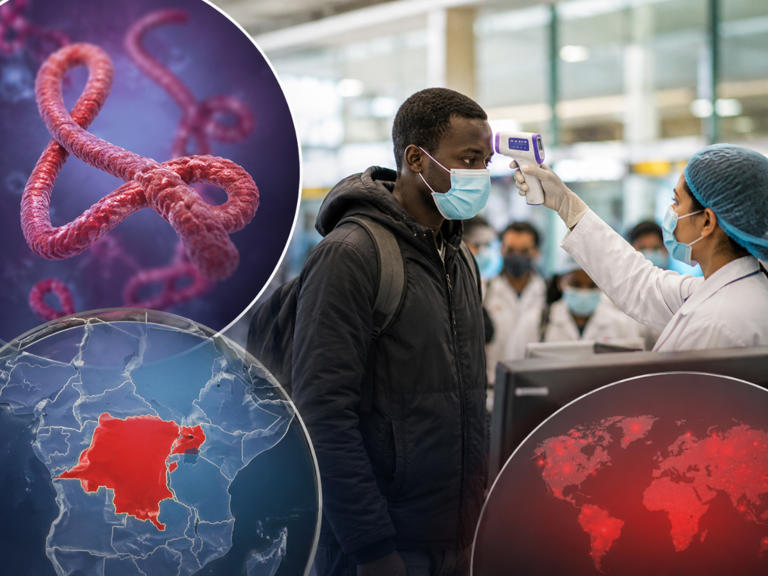
Suspected Ebola case reported in India: Former Chief Scientist of WHO alerts the country about ‘rare strain’, know how safe are we?

The world had not yet fully recovered from the horror of the pandemics of the last few years when another dangerous virus has increased the concern of global health agencies. A suspected case of Ebola infection has been reported in India. According to the information, after mild symptoms of Ebola virus were found in a woman who came to India from Uganda, she has been immediately admitted to the hospital, where doctors are continuously monitoring her health.
Apart from India, a rise in Ebola cases is also being seen in many countries of Europe and Africa. Two new cases of Ebola infection have also been registered in Milan city of Italy. Dr. Soumya Swaminathan, former Chief Scientist of the World Health Organization (WHO), has expressed deep sorrow and concern over this emerging crisis. He has termed this situation as ‘International Global Health Emergency’.
Biggest Challenge: Lack of test, treatment and vaccine
Zee News According to the report, Dr. Soumya Swaminathan said that the virus currently spreading is a very rare strain of Ebola. The most disturbing thing is that the world currently has neither any accurate diagnostic test available for this particular strain, nor any solid treatment option, nor any approved vaccine to prevent it.
Why did this virus remain hidden for weeks?
Making a big revelation, Dr. Swaminathan said that when the initial patients were examined with the common Ebola test, their report came ‘negative’. Due to not being caught in the investigation, this virus continued to spread silently among the people for several weeks. However, now scientists have completed its strain sequencing (genome test) and it has become clear that it is the type of Ebola. “Bundibugyo strain” Is.
Is there a big threat looming over India?
Dr. Swaminathan has clarified the situation so that there is no atmosphere of fear among the general public after the arrival of this suspicious case in India. He says that people should trust the accurate information being released by the Health Ministry and government agencies.
At present there is no situation of panic in the country. There is no immediate major threat to India regarding Hanta virus or Ebola. But, in this modern era of globalization and air travel, no country can keep itself completely isolated from the world. Therefore, instead of being afraid, the citizens of India need to be more careful, aware and medically prepared. He warned that in the future, new and old viruses will keep emerging again and again, for which our health system will always have to be upgraded.
Early symptoms of Ebola: typical viral-like signs
The symptoms of Ebola virus initially appear similar to those of any common flu or seasonal viral infection, due to which people make mistakes in identifying it. You can easily understand its symptoms from the table given below:
| Category | Major early symptoms of Ebola |
| physical problems | High fever, sudden headache and feeling of weakness. |
| digestive | Complaints of persistent nausea and vomiting. |
| effect on skin | Small red rashes appear on the body and back. |
Note: If any of these symptoms appear, instead of self-medication, it is very important to immediately contact the doctor and tell your travel history.
India will become a trouble-shooter: Serum Institute and Oxford are jointly making the vaccine.
Amidst this serious crisis, a very big and hopeful news has also come to light. According to Dr. Soumya Swaminathan, India’s medical and research capabilities can prove to be a game changer for the world in dealing with Ebola. India, through its ‘Indian Council of Medical Research’ (ICMR), can make a significant contribution in the rapid development of monoclonal antibodies, which will make it much easier to treat Ebola.
Along with this, the world’s largest vaccine manufacturing company Serum Institute of India (SII) And oxford university Has joined hands. Both the institutions are working together day and night to develop a new and effective vaccine against this particular ‘Bundibugyo strain’ of Ebola. It is expected that very soon this vaccine will complete clinical trials and come into the market, after which this new threat of Ebola can be completely eliminated.

Comments are closed.