
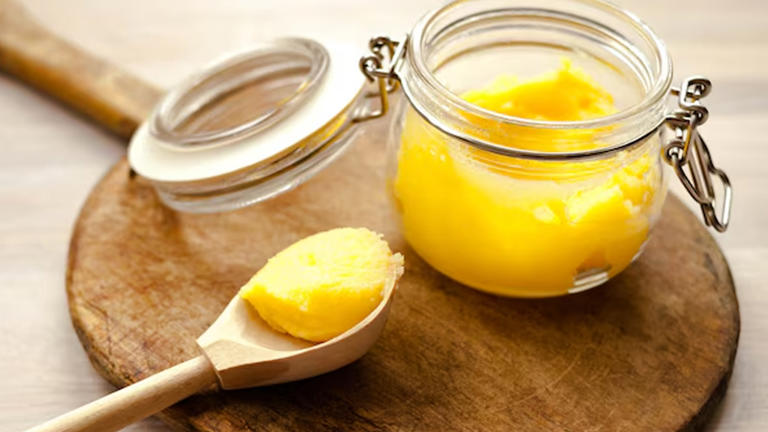
Purity isn’t just determined by color anymore! AI detects fake ghee with 99.6% accuracy; learn how be careful! Not every desi ghee that looks ‘yellow and golden’ is genuine; New method of adulteration revealed in IIT-BHU’s research – ..

In almost every household in India, Desi Ghee is considered not only as a means of enhancing taste but also as a treasure of good health and nutrition. But due to its rising prices and huge demand in the market, the business of fake and adulterated ghee always remains in the headlines. Till now, there were reports of mixing animal fat, dalda or palm oil in desi ghee, which people could easily recognize.
But now adulterators have found a completely new and clever way to cheat even lab tests. A recent research by IIT-BHU (Indian Institute of Technology, Banaras Hindu University) has exposed this new game, which has worried both scientists and common consumers.
‘Carrot pigment’ is dodging even lab tests
According to researchers at IIT-BHU, nowadays adulterated ghee is added to make it look yellow and grainy like real cow’s ghee. Carrot Pigment Is being mixed. The surprising thing is that after adding this pigment, when ghee is tested in normal laboratories, its results are exactly like real ghee.
This does not at all mean that adding carrot pigment makes ghee pure or healthy. In fact, this pigment affects certain quality parameters of ghee in such a way that traditional lab testing machines completely fail to detect adulteration. Now adulteration is not limited to cheap oils only, but efforts are being made to mislead scientific investigation under the guise of natural things.
Is this fake ghee mixed with carrots beneficial for health?
Carrots are generally considered very good for health because they contain beta-carotene and abundant antioxidants. But when it is mixed with fake ghee made from adulterated or refined oil, it only acts as a mask.
To make pure desi ghee, a large amount of pure milk and cream is required, due to which its production cost increases significantly. To reduce this cost and earn profit, adulterators resort to vegetable or palm oil and then add carrot pigment to make it look real. Since the main base of this ghee is completely adulterated and low-quality oils, despite having carrot pigment, this ghee is very dangerous for the health of the heart and the entire body.
Purity of Ghee: Traditional Thinking vs Scientific Reality
In this new era of adulteration, the ongoing confusion regarding the identity of ghee can be easily understood from the table given below:
Now resort to Artificial Intelligence (AI) to detect adulteration
Researchers have admitted that the traditional testing methods available to us have their limitations, due to which this new adulteration of carrot pigments was not being detected easily. To deal with this challenge, scientists have now turned to modern technologies.
Scientists are now using advanced models based on FTIR spectroscopy, machine learning, deep learning and artificial intelligence (AI). Researchers at IIT-BHU have developed a new AI model that can instantly identify even the smallest adulteration hidden in ghee. The most special thing about this new AI model is that it can expose adulterated ghee with an accuracy of up to 99.6%.

Comments are closed.