
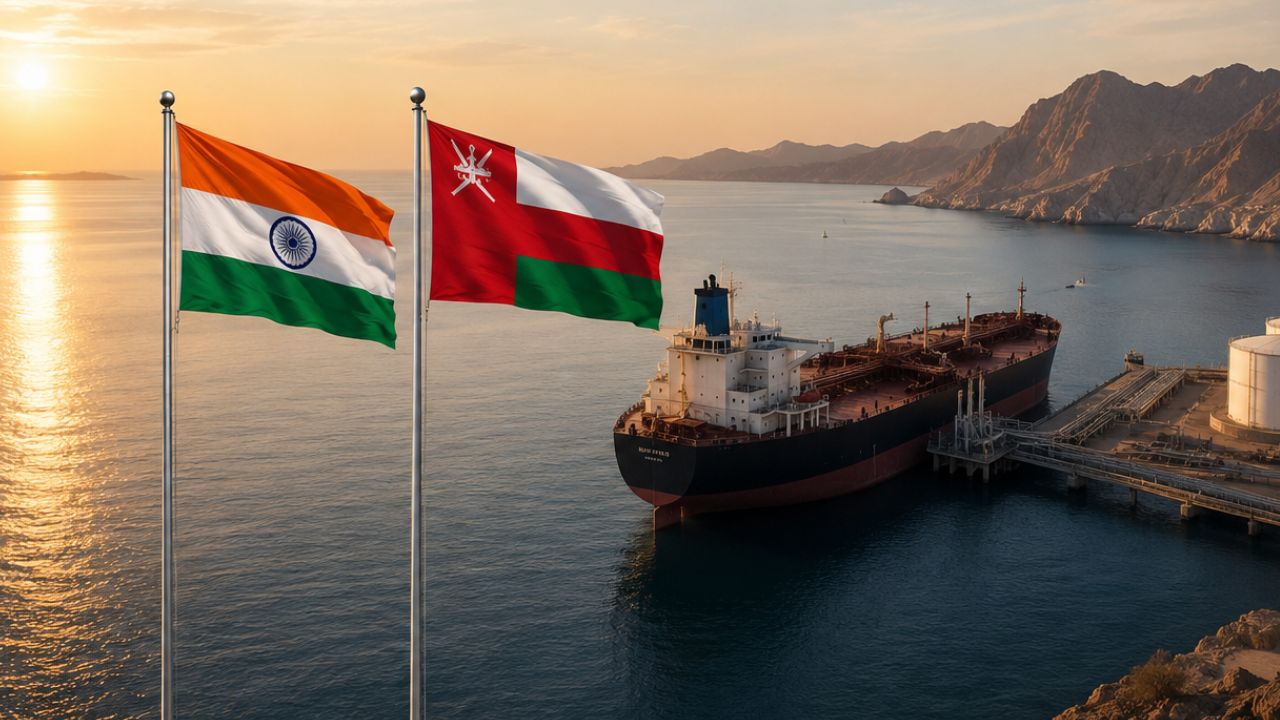
Will CEPA become an alternative to Hormuz? Understand how Oman and India can change their destiny

Due to increasing tension in the Middle East and the US-Iran war, the world’s busiest maritime trade route ‘Strait of Hormuz’ is completely closed. There has been a crisis on this route for more than three months, which is having a negative impact on the supply of energy and oil all over the world. Amidst this big trouble, India has found a very safe and new path for itself. The name of this route is ‘Oman’. A major trade agreement between India and Oman has come into force from June 1, 2026, which is called Comprehensive Economic Partnership Agreement (CEPA). According to the report of Global Trade Research Initiative (GTRI), this agreement will act as ‘Plan B’ for India whenever there is any war or crisis in the Gulf region. With this, India’s trade and oil and gas supply will continue without any interruption.
Whatever crude oil or gas comes to India from Gulf countries like Saudi Arabia, Qatar and UAE, it has to pass through a narrow sea route called ‘Strait of Hormuz’. One-fourth of the world’s maritime oil trade and one-fifth of total daily oil consumption is carried through this route alone. At present, due to the US-Iran war, this route has become very dangerous due to which the oil supply in India is being affected and the prices of crude oil are also increasing.
Also read: How did Taiwan stock market overtake India? story of chip revolution
In this difficult time, Oman has become the biggest help to India. The total population of Oman is only 55 lakhs and its GDP is about Rs 9,130 billion. Oman has never been a country that buys a lot of goods from India but its biggest strength is its coastline. Unlike other Gulf countries, Oman is not trapped inside the ‘Strait of Hormuz’. Oman has a very long coastline directly adjacent to the open Arabian Sea and the Gulf of Oman, just outside the conflict zone.
Help to India from Duqm port
GTRI founder Ajay Srivastava said that due to this special location of Oman, its two major ports ‘Port of Salalah’ and ‘Port of Duqm’ are always safe and open. Even if the Strait of Hormuz is completely closed in the future, big Indian ships can easily reach these two ports. That is why Oman will remain a reliable trade door for India even in times of crisis. This agreement is not just to increase business but is a necessary step to strengthen the supply of oil and gas in India.
Big jump in trade from Oman
When tension increased in the Gulf countries, India’s trade with other big countries decreased significantly. According to GTRI data, India was importing goods worth Rs 1,245 billion from those countries in April 2025, which came down to just Rs 813 billion in April 2026. Similarly, goods going from India to those countries also fell from Rs 365 billion to Rs 224 billion.
This did not happen with Oman. During this crisis, goods coming from Oman to India increased by a huge 246.4%. Earlier it was only 35 billion 69 crore rupees, which directly increased to about 124 billion 50 crore rupees. This happened because India purchased large quantities of crude oil and urea fertilizer from Oman during this period. However, goods going from India to Oman saw a small decline of 10.3%.
Benefits to Indian businessmen
Under this new trade agreement, Oman will immediately completely remove custom duty on about 98% of the goods coming from India. This accounts for 99% of India’s total exports in terms of value. In the financial year 2026, India sold goods worth about Rs 332 billion to Oman. India mainly sends refined petroleum products to Oman which included petrol worth Rs 64 billion 82 crore and naphtha worth Rs 61 billion 91 crore. Apart from this, India also sends calcined aluminum, iron, steel products, machines and rice to Oman.
According to Ajay Srivastava, more than 80% of Indian goods were already taxed at 5% in Oman, while on some goods this tax was up to 100%. Now with the complete abolition of this tax, Indian goods will become much cheaper in the Oman market and sales will also be good. However, due to Oman’s population and small market, India’s exports will be able to increase only to a limited extent, yet India will benefit greatly from it.
Benefits to Oman
This agreement is not only beneficial for India but is also very beneficial for Oman. Through this, Oman will be able to further strengthen its position in supplying energy products, fertilizers and industrial raw materials to India. In the financial year 2026, India had imported a total of goods worth Rs 597 billion 60 crore from Oman. The largest share in this was of crude oil which was worth Rs 132 billion 80 crore. After this, there was the share of Liquefied Natural Gas (LNG) which was worth Rs 99.60 billion and fertilizer worth Rs 70 billion was purchased.
Also read: Real power of the market, understand from free float market capitalization, why is it important?
Apart from this, India had also purchased methanol worth Rs 38 billion 59 crore and ammonia worth Rs 35 billion 19 crore from there. In return for this cooperation of Oman, India will also reduce or completely eliminate taxes on about 78% of the goods for Oman. This agreement is not just a normal transaction between the two countries but a means to permanently strengthen the continuous supply of raw materials and energy required for India’s industries. This important trade agreement between India and Oman was signed on 18 December 2025. This is India’s fifth Free Trade Agreement (FTA) to be implemented in the last five years.

Comments are closed.