
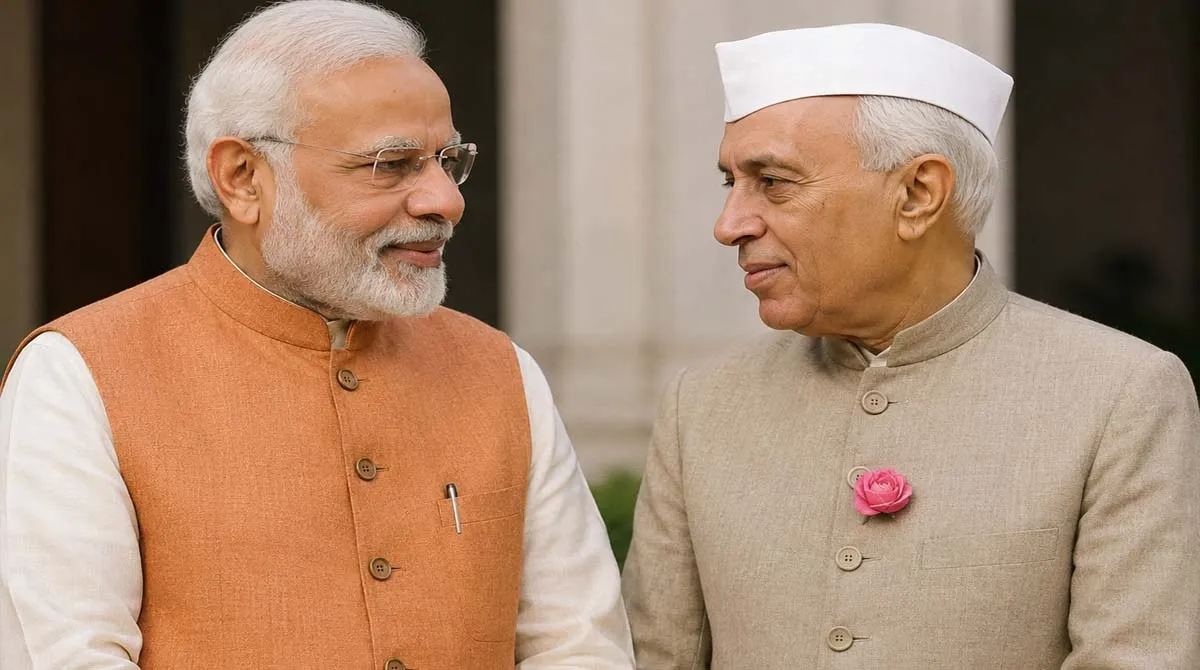
PM Modi Record: PM Modi will create history on June 10, Nehru’s 62 year old mega-record will be broken

Prime Minister Narendra Modi, who has made many big records in the political history of the country, has now come very close to making another mega-record. On June 10, PM Modi will become the first Prime Minister of the country with the longest continuous tenure. He took oath as Prime Minister for the first time on 26 May 2014. On June 10, a total of 4399 days of his tenure will be completed. With this, he will leave behind the historical record of 4398 consecutive days of the country’s first Prime Minister Pandit Jawaharlal Nehru.
What was Pandit Nehru’s old record?
In the democratic history of the country, the first Lok Sabha was formed on April 17, 1952 after the first general elections held after independence. After this, the first meeting of the newly formed Lok Sabha was held on May 13, 1952. On this day, Pandit Jawaharlal Nehru took oath as the elected Prime Minister and served the country continuously till May 27, 1964. This period, from May 13, 1952 to May 27, 1964, amounts to a total of 4,398 days, which was the longest continuous tenure ever.
Indira Gandhi’s record was lost long ago
The tenure of Narendra Modi, who took charge of the country in 2014, started from May 26, 2014, which will touch a grand record of 4,399 days on June 10, 2026. If we talk about the continuous tenure of other Prime Ministers of the country, then the continuous tenure of former Prime Minister Indira Gandhi was from 24 January 1966 to 24 March 1977, which is a total of 4077 days. Prime Minister Narendra Modi had surpassed this record of Indira Gandhi last year itself on July 25, 2025.
Big difference between challenges and circumstances
Pandit Nehru and PM Modi have led the country in completely different times and circumstances. When Nehru became the Prime Minister of the country, the total population of India was about 34 crores. At the same time, by the time PM Modi took power in the year 2014, the population of the country had increased to more than 131 crores, which was almost four times more in terms of complexity of governance. Today, India’s population has crossed 146 crores.
Along with the population, the nature of electoral politics has also completely changed. In the first general elections of 1951-52, only 53 political parties took part, whereas by 2014 this number increased to 464. This pace of electoral fragmentation reached a historic peak in the 2024 elections, where a total of 7445 political parties participated. Today, the strength and challenges of regional parties have increased considerably as compared to the Nehru era.
Moreover, there were about 17 crore voters in the first general election, which increased to more than 83 crore by 2014. With this speed, the country’s economy and global competition have also increased. Despite all these big challenges, PM Modi became the first non-Congress Prime Minister to complete his tenure with full majority for two consecutive terms. Additionally, he is also the second Prime Minister of the country after Nehru to win three consecutive Lok Sabha elections.
Social justice and the changing nature of the Council of Ministers
The work of these two Prime Ministers for such a long period is also being compared on the scale of social justice. According to data received from government sources, during the third term of Pandit Nehru (1957-1962) the representation of backward and deprived groups in the Union Council of Ministers was very low. At that time only three or four members were included from Scheduled Castes, while the representation of Scheduled Tribes (ST) and Other Backward Classes (OBC) was zero.
In contrast, about 60 percent of the members of the current Modi Council of Ministers belong to backward, Dalit and tribal communities. The current cabinet includes 27 members from OBC category, 10 from Scheduled Caste and five from Scheduled Tribe. At the same time, if we talk about women empowerment, the participation of women cabinet MPs in the year 1952 was only 4.4 percent (22 MPs), which has increased to a record level of 13.63 percent (74 MPs) in the year 2024.

Comments are closed.