
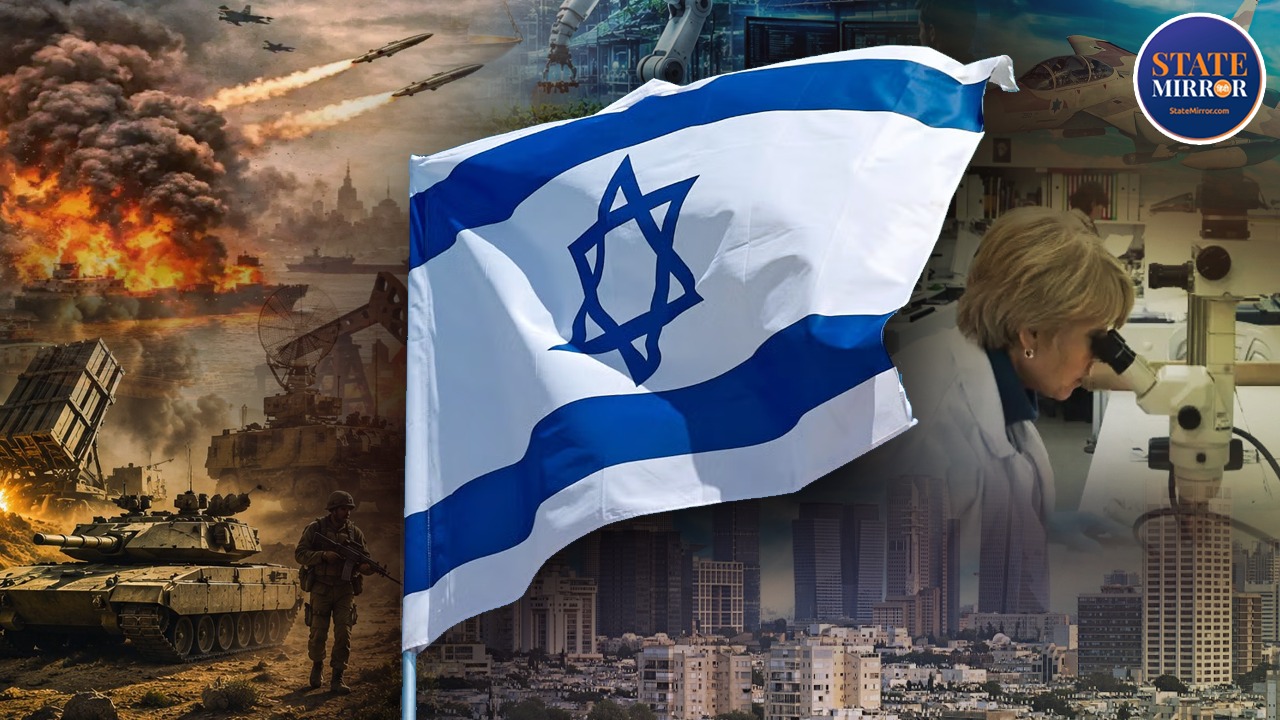

A small country, which was surrounded by conflicts since its birth, is today counted among the most advanced technological powers in the world. The story of Israel is not just of wars, but of the journey from survival to innovation. The country which once faced constant security threats, turned that challenge into its strength. For this reason, it is sometimes called “a country that eats the bread of war”, but this is only an incomplete view.
actually Israel By transforming defense needs into technological revolution, it has given a new direction to the world in cyber security, startup ecosystem and advanced defense systems. This is the story of that unique balance of conflict and development, where war became not the end but the beginning of innovation.
Israel’s economy is primarily based on high-tech innovation, cyber security, startup ecosystem and global investment. It is true that the defense sector plays an important role in this, but it is only a part of the entire economy. Therefore, the question becomes important whether Israel really runs on war or whether it is merely a political metaphor that reflects half the truth.
What does “a country that eats the bread of war” mean?
This is not an official term of Israel. It is used for countries that have a strong defense industry, that export military technology and weapons, and whose security sector plays an important role in national policy. In the case of Israel, this is said because there is a deep connection between defense technology and economy, but it does not mean that the entire economy is based only on war.
What is the basis of Israel’s economy?
Israel’s economy mainly runs on high-tech and startup based model, which is called “Startup Nation” in the world. Here technology startups, cyber security, pharmaceutical research, diamond trade and service sectors are the backbone of the economy. The defense industry certainly plays an important role, but it is a part of the overall economic structure, not the entire basis of it. Technological innovation and global investment are Israel’s economic strengths.
Iron Dome and symbol of technological power
Israel’s most famous defense technology is Iron Dome, which is capable of stopping missile attacks in the air. This system protects civilian areas by intercepting short and medium range missiles. Iron Dome has made Israel a leader in global defense technology and is considered a great example of modern military engineering. This technology has not only provided security, but also strengthened Israel’s position in the international defense market.
Cyber security: Israel’s new strength
Today Israel has become not only a country of arms but also a global center of cyber security. Here areas like banking security, data protection, government network security and digital intelligence are developing rapidly. Many military experts later start cyber startups, transferring defense experience directly into the technology industry. This sector is the fastest growing part of Israel’s economy and is determining its future economic direction.
Israel’s GDP and defense spending
According to International Monetary Fund (IMF) data, Israel’s total economy is worth around $719 billion, and its defense spending is about 7.8 percent of GDP. This ratio is considered quite high in developed countries, but despite this, the largest part of the economy comes from technology and services. This means that the defense sector is important, but it does not control the entire economy.
Historic surge in defense exports
According to International Trade Administration data, Israel’s defense exports have reached record levels in recent years. The country’s defense exports have reached approximately $19.2 billion, which is considered to be the highest level till date. The main reason behind this increase is the capability of Israeli military technology, which has already been tested in actual combat conditions. For this reason, its demand is continuously increasing in the international market.
How much cooperation does the US provide?
The United States provides approximately $3.8 billion (about $3.8 billion) in military aid to Israel annually. This amount is part of the 10-year Memorandum of Understanding (MOU) signed between the two countries in 2016, under which $ 3.3 billion is provided every year from 2019 to 2028 for military weapons and $ 500 million for missile defense systems.
Defense industry captured by big players
The country’s three major companies have the biggest contribution in Israel’s defense exports. These include Israel Aerospace Industries, Rafael Advanced Defense Systems and Elbit Systems. These three companies together control about 85% to 90% of the country’s total defense exports. These companies also have a strong order book globally, whose total backlog has reached approximately $90 billion. This shows that demand for Israel’s defense industry is going to remain strong in the coming years.
Israeli arms share in the global market
The geographical distribution of Israel’s defense exports also reflects its global influence. According to statistics, about 36% of Israeli weapons and military technology is exported to Europe. Apart from this, 32% goes to the Asia-Pacific region, where many countries depend on Israeli technology to strengthen their defense capabilities. About 15% of exports are to West Asia and North Africa (MENA region). This distribution makes it clear that Israel’s defense industry is in a strong position not only regionally but globally.
Defense Economy: From the Beginning to Now
The beginning of Israel’s defense economy is considered to be with the formation of the country in 1948, when security was its biggest need. In the early years it was completely dependent on imported weapons and limited domestic production, but gradually it developed a strong indigenous defense industry. In the 1970–80s, Israel made major advances in missile systems, aircraft upgrades, and electronic warfare. Today the situation is that Israel is among the most advanced defense technology countries in the world. Israel Aerospace Industries, Elbit Systems and Rafael Advanced Defense Systems are its backbone. Presently its defense exports have reached billions of dollars and the defense sector has a significant contribution in GDP, which makes it a high-tech security economy.
What is the real picture?
Calling Israel “a country that eats the bread of war” is a simple but incomplete truth. The reality is that its economy is not based on war but on a security-driven innovation model, where defense industry, cyber security and high-tech startups together create a strong economic structure. Security challenges do not weaken it, but inspire it to move forward in the direction of technological development, and this is its biggest feature.

Comments are closed.