
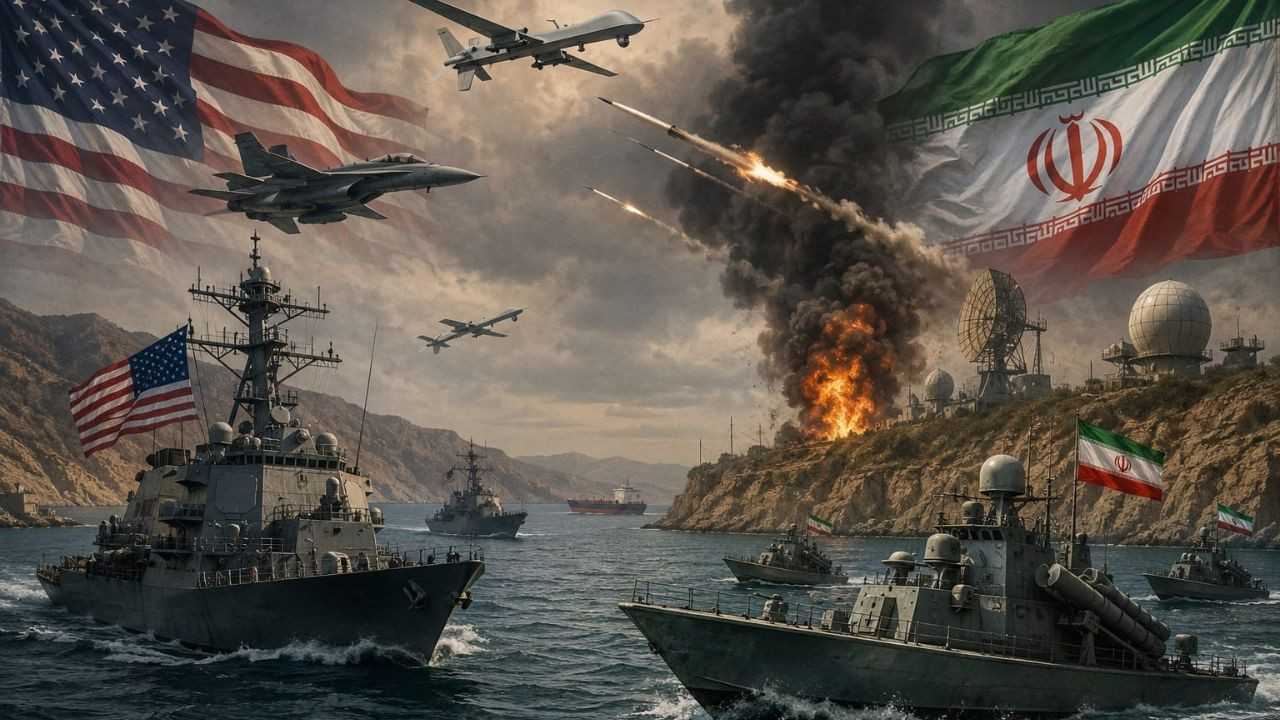
Explosions echoed from State of Hormuz to Tehran, American airstrike destroyed Iran’s radar sites

New Delhi:Hopes of a peace agreement between America and Iran seem to be on hold once again. The armies of both the countries have once again come face to face in the strategically very sensitive waterway ‘Strait of Hormuz’. Contradictory claims are being made by Washington and Tehran regarding the latest military confrontation. Which has taken the tension in the Middle East to its peak.
Armies face to face in maritime border
According to Iran’s semi-official news agency ‘Mehr’, the Iranian Navy fired several rounds as a ‘warning’ in view of the suspicious activities of American warships near Hormuz. This action was taken near Larak Island located off the coast of the strategic port city of Bandar Abbas.
Iran’s answer
On the other hand, the US Central Command has rejected Iran’s claims and confirmed retaliatory action. According to US defense officials, Iran had fired several suicide drones with the aim of targeting international maritime traffic. The US Army, acting in self-defense, shot down four Iranian attacking drones in the air.
bombing radar sites
Soon after, the US Air Force bombed Iranian coastal surveillance radar sites located on Goruk and Qeshm Islands to avert future threats. Iranian media has completely rejected any US attack in Bandar Abbas area.
Setback to ceasefire efforts
This latest clash has taken place at a time when diplomatic talks were going on between the two countries to take the ceasefire forward. Earlier this week, an Iranian drone attack on Kuwait’s main airport caused heavy damage to the passenger terminal. In which a civilian had died. The atmosphere had deteriorated since this incident.
Trump made a big claim
Amidst the tension, US President Donald Trump made a big claim in a TV interview that Iran’s strength has weakened due to continuous military action and now it has only 21 to 22 percent missiles left. Trump told reporters, one way or another, we will win and end the conflict.
Equation complicated by Lebanon crisis
The biggest obstacle to regional peace efforts is the ongoing conflict between Israel and Lebanon. The Trump administration had claimed a ceasefire between the two sides. But Iran-backed Hezbollah has rejected this and started new attacks. The Israeli army has taken control of a large part of South Lebanon.
Iran has now placed a new condition that the talks on opening the Strait of Hormuz and implementing the ceasefire will proceed only when Israel completely stops its attacks on Lebanon.

Comments are closed.