
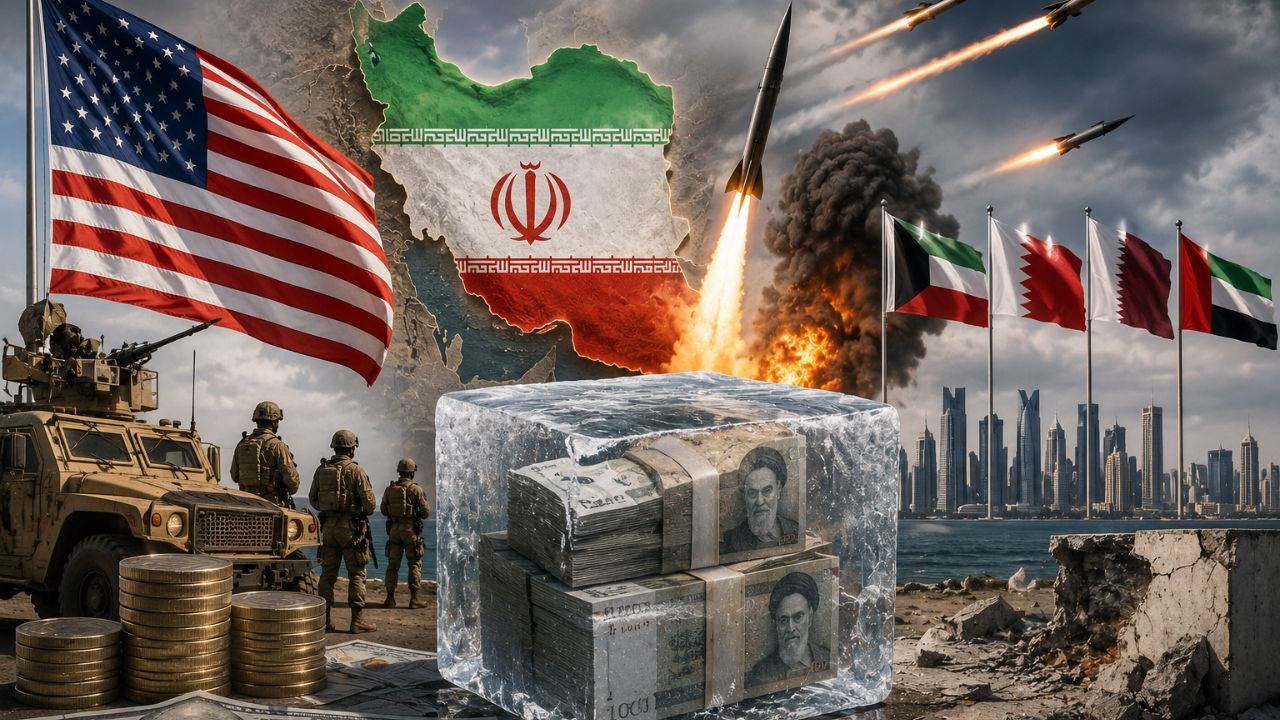
America’s eyes on Iran’s assets worth billions of dollars! Will US compensate for the losses of Gulf countries?

New Delhi: A new and important information has come to light amid the ongoing tension between America and Iran. According to reports, Washington is now considering the use of Iranian assets that have been blocked under sanctions for years. It is being told that these funds can be used to help those Gulf countries which have been harmed in the recent Iranian attacks. According to a Reuters report, a source close to the matter said that the US is working on the possibility that some Iranian assets abroad could be used to rebuild the Gulf countries and compensate for the losses.
According to the source, US Finance Minister Scott Besant has instructed officials to make a detailed assessment of the damage caused by the Iranian attacks. It is also being investigated whether seized or banned Iranian assets can be used to meet these expenses. However, it has not yet been made clear which properties will be included in this scheme.
Diplomatic efforts may be affected
This proposal has come at a time when talks are going on between America and Iran on many sensitive issues. Iran has long been demanding access to its billions of dollars of funds stuck abroad. Experts believe that if America actually uses these assets to compensate for the losses of other countries, then it can have a direct impact on the ongoing dialogue between the two countries. This is also likely to create new tensions in already complicated relationships.
Despite the ceasefire, military actions continue
Although the ceasefire between America and Iran is in force, many incidents in recent times have raised questions about its strength. The US Army targeted some coastal military bases of Iran in the early hours of Saturday. US officials say that this action was taken in response to drone activities that were considered a threat to maritime security.
In response, Iran fired missiles towards American military bases in Kuwait and Bahrain. According to Kuwait, several missiles passed over populated areas, although no casualties were reported. As a precautionary measure, warning sirens were sounded in Bahrain and people were asked to move to safe places.
Claims of both countries are different
Iran’s Revolutionary Guard claimed that it had targeted American targets. The US Army says that most of the missiles were stopped en route and there was no major damage. These incidents have made it clear that despite the ceasefire, tension in the region has not completely ended. The situation still remains very sensitive.
Pakistan’s active role in mediation
Efforts are also being made to keep the lines of communication open amid tension. Pakistan is currently playing the role of an important mediator between the two countries. Pakistan Home Minister Mohsin Naqvi recently reached Tehran. According to media reports, he has gone to meet the Iranian leadership with a message from Pakistan’s top political and military leadership. It is believed that this visit is part of an effort to further the dialogue between the two sides.
Iran’s main demands remain intact
Iran still wants access to its frozen foreign funds. Apart from this, it is demanding relief in restrictions related to oil export and protection of its economic interests. Sources close to the Iranian leadership say that the release of billions of dollars of assets frozen abroad could be an important part of any comprehensive agreement.
Concern increased in Lebanon also
Regional tensions are not limited to the Gulf countries only. The situation in Lebanon also remains worrying. Recently, many army soldiers were killed in an attack in southern Lebanon. This incident has made the security situation in the Middle East more complex. It has also been indicated that it will not be easy to reach a permanent peace agreement.
Experts believe that the US’s consideration of using Iranian assets is a big political message. But as economically important as this step is, it can also prove to be diplomatically sensitive. On one hand, efforts for dialogue and mediation are continuing, while on the other hand, military activities are showing no signs of stopping. In such a situation, it will be important to see in the coming days whether both the countries move towards reducing tension or the situation turns towards conflict again.

Comments are closed.