
Even before the second round of talks between US-Iran, Israel started attacks again, Trump said – we will decide

Washington. The second phase of talks between America and Iran could not even begin and Israel has started attacking again. Israel said that after the ceasefire came into force, Iran had attacked first and it has been responded to. According to the information, Iran had attacked the southern suburbs of Beirut on Sunday. Israel alleged that Iran-backed Hezbollah had opened fire in northern Israel. The same has been answered.
No impact on peace talks – Donald Trump
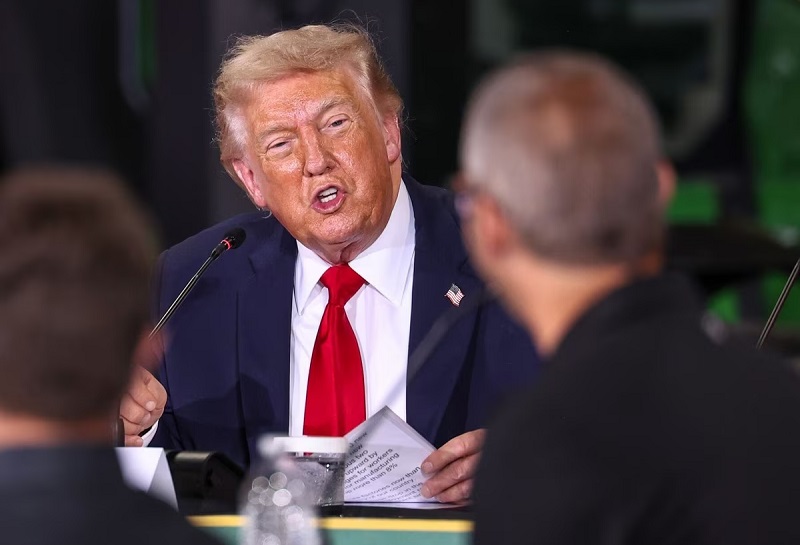
American President Donald Trump has said that Israel’s attack on Iran will not affect the talks. He said that Israel has nothing in its hands. Donald Trump has taken a tough stance on Israel and asked it to stop attacking Lebanon. Last week, Donald Trump got angry at Netanyahu on the phone. Benjamin Netanyahu himself has not issued any statement regarding the attack.
Pakistani Home Minister has reached Tehran
Has reached Tehran with a special message from Pakistan Home Minister Asim Munir. He will meet Supreme Leader Mojtaba Khamenei. The US military on Saturday claimed to have shot down two more Iranian drones, which it described as a threat to international maritime traffic in the strategically important Strait of Hormuz.
Clashes are taking place even amidst ceasefire
Despite agreeing to a ceasefire in April, tensions between the US and Iran have not ended. The two countries have not been able to reach any final agreement to end the war that has been going on for several months. Thousands of people have died in this conflict and the global energy crisis has also deepened. Despite the ceasefire, there have been several military clashes between the two sides. The US military on Friday attacked radar centers and drone command and control facilities located on Goruk and Qeshm islands. In response, Iran launched missile and drone attacks in the direction of Kuwait and Bahrain. Kuwaiti and Bahraini security forces foiled these attacks.
Earlier, the US Army had also targeted Iran’s coastal surveillance radar bases after continuous attacks in the region. This week, the passenger terminal of Kuwait’s main airport was also damaged in an Iranian drone attack. One person was killed, several were injured in the incident and airport operations had to be temporarily halted. However, Iran has denied any role in this incident.
Ongoing negotiations to permanently end the conflict have been going on for several weeks, but no concrete results have been achieved so far. The increasing conflict between Israel and Hezbollah in Lebanon has further complicated the situation. According to a regional official, Iran wants to ensure a separate ceasefire in Lebanon, only then will it fully return to the negotiation process. US President Donald Trump has said that talks are continuing to advance the ceasefire, although at the same time the US military is also attacking Iranian military bases.
Centcom said Iranian coastal radar sites were targeted after several drones heading towards the Strait of Hormuz were shot down. The US military also claimed to have intercepted additional Iranian missiles and drones fired towards Kuwait and Bahrain overnight. There is no report of any casualty of any American soldier in these incidents. Iran’s state broadcaster IRIB claimed that the Islamic Revolutionary Guard Corps (IRGC) had retaliated against a US airport and other US targets. Tehran described the US attacks as a “clear violation” of the ceasefire and said its response was “vigilant, decisive and proportionate”.
Kuwait’s Defense Ministry said its air defense system neutralized seven ballistic missiles that entered its airspace. Bahrain has claimed to have shot down three missiles and several drones. Both countries reported no casualties, but strongly condemned the attacks. Several regional countries, including the United Arab Emirates, Egypt and Saudi Arabia, also criticized the Iranian attacks, saying they posed a serious threat to the security and stability of the Gulf region.
The talks are still stuck on several major issues. The most important among these is to free Iran’s frozen assets and decide on a time to give relief in sanctions. Tehran wants immediate access to billions of dollars of assets after the first phase of the deal, while Washington says any financial relief would be tied to Iran’s commitment to its obligations, particularly giving up its stockpile of highly enriched uranium. Both sides also do not agree on the framework under which financial assistance should be given. The proposals include arrangements such as a special fund for humanitarian use, release of assets through third parties and a reconstruction fund supported by Gulf countries.
Apart from this, issues like relaxation of restrictions on export of Iranian crude oil, maritime security of the Strait of Hormuz and regional security arrangements also remain unresolved.

Comments are closed.