

11
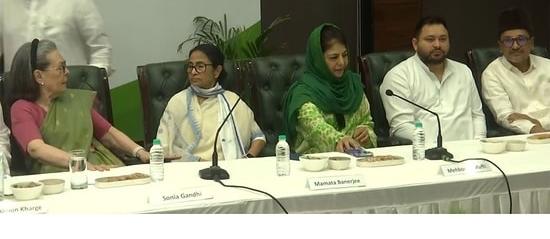
New Delhi: The opposition INDIA (Indian National Developmental Inclusive Alliance) bloc held its crucial meeting today at the Constitution Club of India in New Delhi, but the gathering was marked by notable absences and a telling virtual appearance that underscored deepening fault lines within the coalition.
The INDIA bloc’s first formal meeting came around one month after the comprehensive loss suffered by Trinamool Congress, one of its most significant allies, in West Bengal.
As per the list shared by Congress leaders, 23 political parties were represented at the Constitution Club, with Congress general secretary Jairam Ramesh confirming their participation and describing the gathering as a meeting of the “INDIA janbandhan.”
There were notable omissions compared to the last such gathering.
The DMK publicly declared that it would not participate in the INDIA bloc meeting. In a post on X, the party said: “The Dravida Munnetra Kazhagam will not participate in the ‘India’ alliance meeting in Delhi on June 8, where the Congress is taking part.”
The DMK’s decision stems from Congress’s move to end its long-standing alliance with the party and extend support to actor-politician Vijay’s Tamilaga Vettri Kazhagam (TVK), which formed the government in Tamil Nadu. The party stated that its decision was influenced by the sentiments of its cadre, who remain upset over what they view as Congress’s betrayal following the Tamil Nadu Assembly elections.
Similarly, the Aam Aadmi Party has formally quit the INDIA alliance. Senior AAP leader Sanjay Singh stated that the alliance was formed just for the 2024 general elections and that AAP has since contested the Haryana and Delhi Assembly elections alone.
Shiv Sena (UBT)’s decision to participate only through a screen, rather than travelling to Delhi, is being widely read as a pointed signal of dissatisfaction with the alliance’s direction under Congress leadership.
From Jharkhand, the Hemant Soren led JMM also chose to send its Rajya Sabha MP Sarfaraz Ahmed instead of the CM himself attending it. It is understood that the alliance members are not on the same page regarding the upcoming Rajya Sabha polls.
Congress leader Jairam Ramesh stressed the unity of the INDIA alliance, saying that “like India, the INDIA janbandhan continues to stand united through its diversity.”
The strain on the INDIA bloc is compounded by a striking pattern. Nearly every major regional party that anchored the alliance has since lost power in its home state.
AAP governed Delhi for over a decade and held Punjab when the alliance was formed. It has since lost Delhi to the BJP, and its formal exit from the INDIA bloc marks the most emphatic break yet.
TMC was firmly in power in West Bengal when it joined the alliance and is now engaged in an existential battle, with MLAs and MPs turning rebels.
Similarly, the RJD was in power in Bihar under Tejashwi Yadav when the alliance was formed. However, Nitish Kumar’s switch to the NDA ended that government, pushing the RJD into opposition. In the elections held later, it could muster wins in fewer than 30 seats.
DMK was the ruling party in Tamil Nadu when it joined the bloc. It has since lost that government to TVK, the very party Congress chose to back over its old DMK ally.
Shiv Sena (UBT) and NCP (SP) were both partners in Maharashtra’s Maha Vikas Aghadi government when they joined the INDIA bloc. However, BJP-engineered splits produced the rival Shinde and Ajit Pawar factions, driving both out of power in the state.
In the South, the Left was in power in Kerala under the CPI(M)-led LDF when the INDIA alliance was formed. However, the recent election verdict ended 50 years of Communist rule, with the CPI(M)-led LDF losing power, marking the first time since 1977 that India has no Left chief minister anywhere in the country.
For each of these parties, joining the INDIA alliance brought national visibility but little electoral reward, with power slipping away in the intervening years.

Comments are closed.