

The launch of E85 flex fuel (85% ethanol, 15% petrol) in India has created much confusion among car buyers. After all, E85 currently costs around Rs 20 less per litre than regular E20 petrol. At first glance, it looks like an easy way to cut fuel expenses.
But there are two important factors that prevent that.
- The lower pump price does not tell the full story. Because ethanol contains less energy than petrol, flex-fuel vehicles consume significantly more fuel (typically 25-30%) to travel the same distance. As a result, many car owners could actually end up spending more on fuel every month despite paying less per litre.
- Rs 82 per litre is just the current price. At a time when there are no actual E85 cars in the market. What will the price be when first 2% of new cars need E85? Or 5% or 10%? Demand for Ethanol will go up, and that may cause flex-fuel prices to be much higher.
Let’s consider a commuter who drives 60 km every day.
Assume the car delivers 15 kmpl on E20 petrol.
- Daily distance: 60 km
- Fuel required: 4 litres
- E20 price: Rs 102.12/litre
- Daily fuel expense: Rs 408
- Monthly fuel expense: Rs 12,240
Now assume the same vehicle’s flex-fuel version delivers 27% lower fuel efficiency, reducing mileage to around 11 kmpl.
- Daily distance: 60 km
- Fuel required: 5.45 litres
- E85 price: Rs 82.12/litre
- Daily fuel expense: Rs 447
- Monthly fuel expense: Rs 13,410
Despite E85 being Rs 20 cheaper per litre, the owner spends around Rs 1,170 more every month on fuel because the vehicle needs significantly more fuel to cover the same distance.
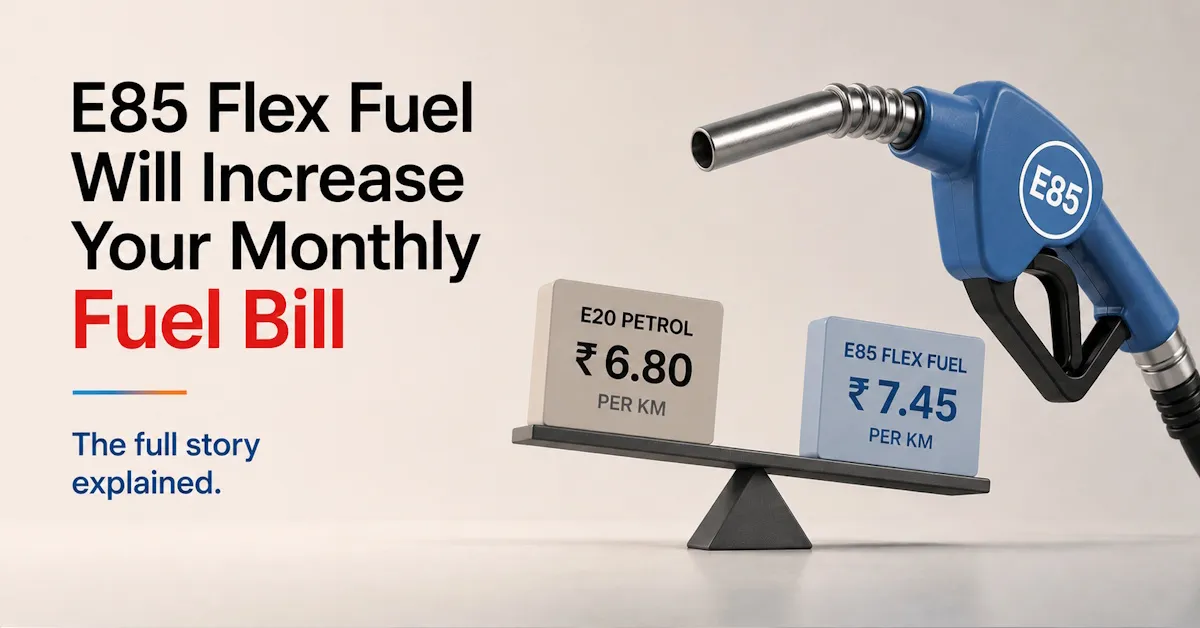
Looking at fuel prices alone can be misleading. What matters is the cost to travel each kilometre.
- E20 petrol: Rs 6.80 per km
- E85 flex fuel: Rs 7.45 per km
Under current Delhi fuel prices, E85 is actually more expensive to run than E20.

For E85 and E20 to deliver identical fuel bills, E85 would need to cost roughly Rs 75 per litre.
At that price:
- Daily fuel expense would fall to about Rs 408
- Monthly fuel expense would match E20 at around Rs 12,240
In other words, E85 needs to be roughly Rs 27 cheaper per litre than E20not just Rs 20 cheaper, for owners to break even. Any meaningful savings would require an even lower retail price.
There are none in the market you can buy. They are coming, but will people buy a car that runs on an entirely new fuel? Only very slowly over time. EVs have been around for almost 20 years – remember maini Reva and Mahindra e2O? EVs are now reached only 5% of car sales per month in 2026. Expect the same slow progress with E85 flex fuel.
So as of now, the price of E85 flex fuel is irrelevant to car buyers.
E85 Flex Fuel compatible cars will be about 7-10 % pricier than non-flex fuel cars. This is an additional cost that needs factoring in. For instance, a E20 compliant petrol hatchback priced at Rs. 10 lakh will be priced at about Rs. 10.7 to 11 lakh when configured to run on flex fuel.
This additional cost will also have to be borne by the vehicle owner. While such an added cost is palatable in case of CNG, which is more cost effective to operate than petrol, will the vehicle owner be willing to shell out more for a car that actually delivers less fuel efficiency?
This is something that only makes sense if the price of E85 Flex Fuel is significantly cheaper than E20 petrol. A mere 20 % differential will not work. E85 flex fuel has to be about 35-40 % cheaper to offer the higher vehicle purchase price and account for lower fuel efficiency. This brings us to the pricing of E85.
That is the question. No one can say. But Ethanol is an agricultural produce, and a lot of it need to be produced to make enough E85 fuel for cars. And that usually means high demand, and so higher prices. So the current pricing of E85 may go up over time as demand increases.
At today’s prices, an E85-compatible vehicle could actually increase your monthly fuel expenditure compared to a regular petrol car running on E20. But as we said earlier, there are no E85 compatible cars – so you can relax.
There are 5-6 crore ICE (petrol, diesel) vehicles on the road today in India. Despite being available for 20 years, CNG makes up only 85 lakhs out of those 5-6 crores. EVs have been around for some 15 years and they are still only at 4-6 lakhs total till now. How many years do you think E85 cars will take to get to EV and then CNG numbers? A long time!
So for now, either buy an ICE car and ignore E85 controversies (as a buyer), or bite the bullet and buy an EV hoping that charging issues would get sorted in the next couple of years. About E85, wait till enough E85 vehicles appear in the market – and then decide.
Comments are closed.