
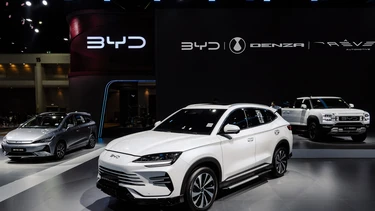

Chinese electric vehicle giant BYD is aiming much higher than just leading the EV market. The company now wants to become the world’s largest automaker within the next five years, challenging Toyota’s long-held dominance.
Speaking at BYD’s annual shareholder meeting in Shenzhen, founder and chairman Wang Chuanfu said the company has a clear goal.
“BYD will truly become the number one automaker globally in terms of scale in five years,” he told investors.
The statement reflects the confidence of a company that has grown at a remarkable pace over the past few years. BYD has already overtaken Tesla in electric vehicle sales and continues to expand aggressively outside China.
Europe Becomes a Key Growth Market
To support its global ambitions, BYD is strengthening its presence in Europe.
The company recently announced plans to invest nearly £1.8 billion in charging infrastructure across the region. The investment will focus on its new five-minute flash-charging technology, which aims to reduce charging times and make EV ownership more convenient.
BYD is also moving ahead with local manufacturing. Stella Li, the company’s executive vice-president, confirmed that production at its new factory in Hungary is expected to begin later this year.
The facility will help BYD avoid tariffs imposed by the European Union on Chinese-made electric vehicles and strengthen its position in one of the world’s most competitive automotive markets.
Li also revealed that the company is searching for a second manufacturing location in Europe.
A Long Road to the Top
Despite its rapid growth, BYD still has ground to cover.
Toyota sold around 11.3 million vehicles globally in 2025, retaining its position as the world’s best-selling automaker. BYD sold 4.8 million vehicles during the same period.
However, the Chinese company is growing much faster than many traditional rivals. Overseas sales surged 80% year-on-year in May, crossing 160,000 units. BYD is targeting 1.5 million international sales this year, up from 1.05 million last year.
Expansion Brings Greater Scrutiny
BYD’s rapid rise has not been without challenges.
The company has faced questions over labour practices and environmental concerns linked to its Hungarian factory project. At the same time, geopolitical tensions continue to create hurdles.
This week, the United States added BYD to a list of Chinese companies it considers linked to China’s military sector. Beijing dismissed the move, saying the designation lacked factual basis.
Even so, BYD’s ambitions remain unchanged. As demand for electric vehicles grows and the company expands its manufacturing footprint, it is increasingly positioning itself as a serious challenger not only to Tesla, but also to Toyota’s global leadership.
For an automaker that was once known mainly inside China, the race for the industry’s top spot has already begun.

Comments are closed.