
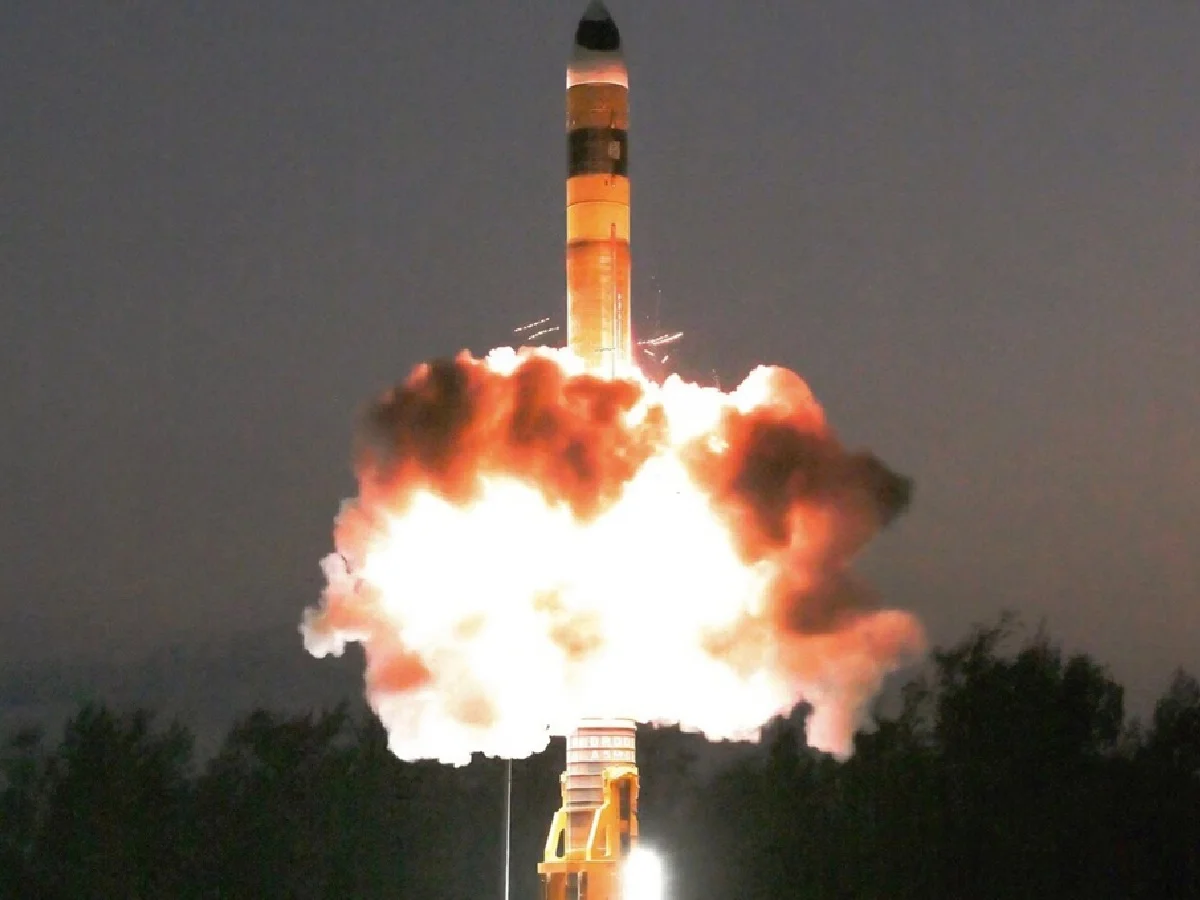

Read, Digital Desk : India’s long-range missile program is not merely restricted to Pakistan and China; it aims at becoming a “global power” by developing missile systems that reach out to the western countries, stated a former Pakistani defence official.
A senior Pakistani defence official stated that India’s long-range missile program is indicative of its aspirations to go beyond the South Asian region. The statement came from the advisor to the National Command Authority Lieutenant General (Retd.) Mazhar Jameel during a seminar on Pakistan’s nuclear weapons held by the Centre for International Strategic Studies (CISS) in Islamabad on Thursday.
“India’s strategic forces program is not restricted to Pakistan or China and aims at developing the missile systems with an intercontinental range. This could enable India to emerge as a global nuclear power that can strike at will at major western capitals as well,” claimed General Jameel, former director general, Strategic Plans Division.
He added that the western governments needed to pay more attention to the Indian military modernization. Jameel stated that Pakistan’s restraint during May’s conflict with India was “a deliberate and well considered decision,” and any future action would be met by a “decisive and comprehensive” response.
What kind of long-range missiles does India possess?
India has manufactured some sophisticated long-range missiles to boost its nuclear deterrent power and its own strategic security. All the Indian long-range missiles are focusing on multiple warhead missiles that could strike deeper into China.
Agni-5 (Agni-V)
It is the deadliest Indian missile developed to date and is technically referred to as an intermediate-range/intercontinental ballistic missile (ICBM) although officially rated as having a range of 5,500 kilometers. Experts claim that its maximum range is between 5,500 and 8,000 kilometers which would enable it to reach any part of China including Beijing and Shanghai.
In 2024, through the “Mission Divyastra”, India tested the MIRV (Multiple Independently Targetable Re-entry Vehicle) capability of Agni-5. With the technology India would be able to fire multiple nuclear warheads simultaneously against different targets in different locations, which would reduce any western country’s defensive capacities and would provide the “ultimate strategic leverage”. The missile can be launched from a canistered vehicle that allows it to be launched within minutes after it is ready and also from road based launchers.
Agni-IV
Before the development of the Agni-5, Agni-IV was India’s longest-range missile in use and continues to remain one of the most strategic missiles the Strategic Forces Command (SFC) relies upon. It is estimated to have a range of over 4,000 kilometers and a 20-ton warhead fitted with the latest avionics, a ring laser gyroscope and a fifth-generation on-board computer. Like the rest of the missiles on this list it is a nuclear capable missile.
Agni-6 (Agni-VI) – in the advanced development stage
India’s next ultimate Brahmastra is an fully integrated intercontinental ballistic missile (ICBM). A notice for potential testing of the missile along the Odisha coast appeared in the newspapers in June 2026. Its range is speculated to be between 8,000 to 12,000 kilometers, with the capacity of carrying up to 10 nuclear warheads simultaneously (MIRV) and could carry a nuclear warhead mid-air (MaRV). It is designed to avoid major anti-ballistic missiles like the THAAD and the Russian S-500 systems.
K-series (submarine-launched missiles (SLBMs))
The “second strike” nuclear capability of the Indian forces is maintained by K-series of missiles launched from Arihant-class nuclear submarines.
K-4: The range is said to be over 3,500 kilometers, it is designed to be launched from an underwater submarine, and hence is difficult for opponents to detect and target.
K-5 and K-6 (under construction): The K-5 missile is speculated to be capable of covering a range of 5,000 kilometers while the K-6 missile will be developed to have an intercontinental range of over 6,000 kilometers to a maximum of 8,000 kilometers.

Comments are closed.