
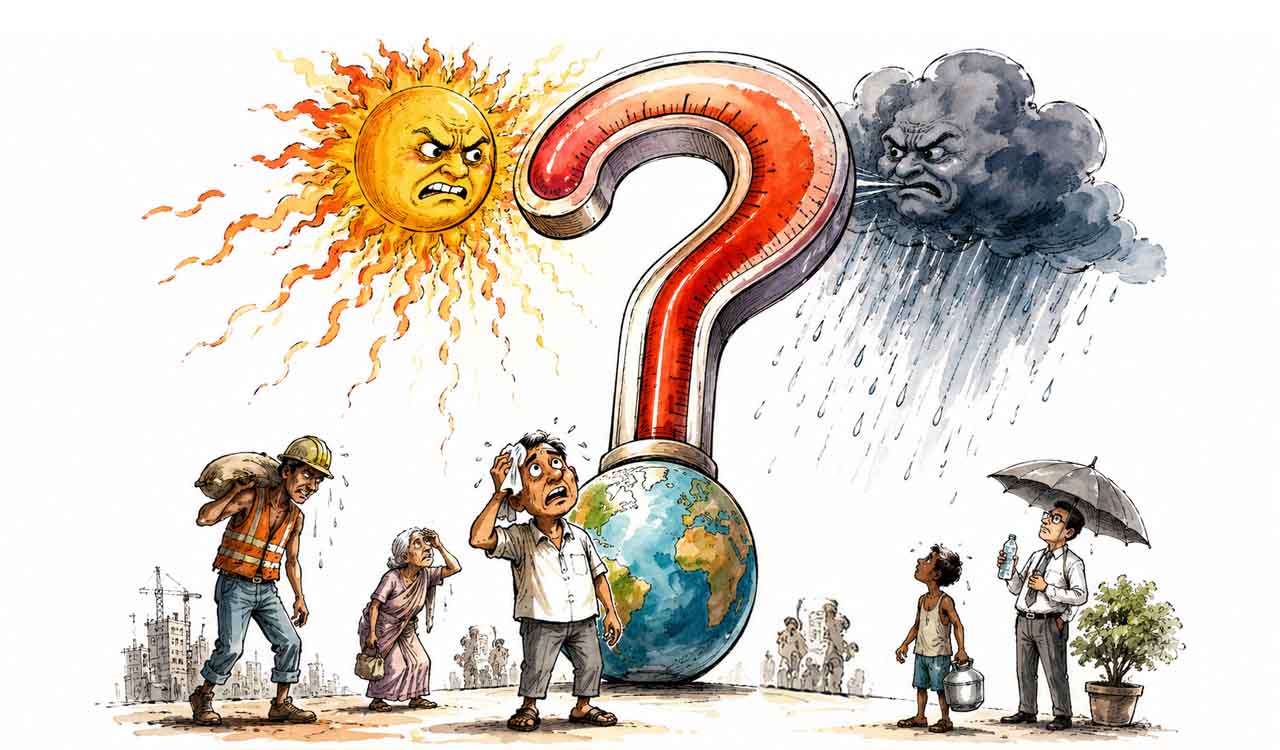

Heatwaves become disasters not because of temperature alone, but due to social vulnerability, inequity, and inadequate preparedness
Published Date – 12 June 2026, 10:27 PM
Illustration: GuruG
By Arvind S Susarla, S Shaji
This summer, it is worth repeating that there is ample research showing that people’s exposure to natural phenomena such as heat waves or earthquakes can lead to disasters. This simple but crucial understanding has been known for decades, yet disasters continue.
How can societies reduce the number of disasters? One can begin to address this question by examining stories in the mass media, which, for most people, most of the time, remains the main source of information and an indirect means of experiencing events, such as earthquakes, floods, volcanoes, or heatwaves.
Types of Messages
Nowadays, mass media stories predominantly indicate three types of messaging. First, stories that discuss the rise in temperature readings at various meteorological locations, and note that such a rise is unprecedented, perhaps the highest in recent memory or recorded history of temperature. Further, they note that high temperatures continue for several days, unlike in the past, and remain high for a longer period during the day.
The second message in the stories on heatwaves revolves around the health consequences of direct exposure to the sun, particularly for individuals. Individuals are advised to stay hydrated to avoid physiological strain and failure. Here, there is an added emphasis on gender- and age-specific precautions.
The need for identifying causes or assigning blame for prevailing conditions of heatwave is the third message conveyed in the stories. They range from the invisible and difficult to grasp experiences of climate change to infrequent occurrences of distinct phenomena, labeled by meteorologists as The Child
Additionally, there is a mention of observable and proximate reasoning, such as widespread and quick expansion of the built environment that is accompanied by reduced green cover, heat island effects, unchecked vehicular pollution, dust pollution, and proliferation of air-conditioners use that makes matters worse.
Ambiguous Messages
For laypersons, the messages are ambiguous because heatwaves are characterised in numerical and often probabilistic terms. Not much is said about how individuals, households, and institutions can avoid the potential risks of high temperatures in their specific contexts. Advisories, issued from time to time, apply uniformly to all and are agnostic to the variability within societies. Improving upon the advisories is challenging, especially when they are to be made relevant to the public.
Reducing heatwave risks requires policymakers to look beyond meteorological data and identify who is most vulnerable, under what circumstances, and how resources can be deployed more equitably
Messages in the stories are merely informational, which perhaps increases ‘worry’ among individuals and households, rather than providing any assurance of the ability to deal with the risk. In sum, one finds valorisation of the natural phenomena in the messages of mass media reports. One also observes a similar valorisation in the magnitude of investments towards improving the scientific understanding of a phenomenon.
For instance, agencies such as the Ministry of Earth Sciences, the Department of Science and Technology, and, more recently, the Anusandhan National Research Foundation invest several orders of magnitude more in understanding a phenomenon than the Indian Council of Social Science Research (ICSSR) does. It is rather puzzling why there is continued emphasis on understanding a physical phenomenon without the corresponding or complementary understanding of where, how, and why people and phenomena become interconnected.
The technical and accurate meteorological knowledge on duration and rise in temperature readings, per se, is inadequate to mitigate societal consequences linked with heatwaves. To put it pithily, phenomena originate in nature, but disasters do not.
Linear Relationship
Traditionally, a linear relationship is assumed between the magnitude of the phenomena and the outcomes. For instance, as the reading on the Richter scale goes up, the corresponding losses will be higher; they correlate linearly, and hence will be disastrous. Therefore, it makes sense to invest in understanding the phenomena of concern.
However, empirical evidence in support of this assumption is weak. For example, two earthquake events with identical readings on the Richter scale, 7.0, produce vastly different losses — the 2016 earthquake at Kumamoto, Japan, resulted in about 50 deaths, whereas the 2010 earthquake in Haiti reported around 2,00,000 deaths.
Similarly, in Odisha, the super cyclone in 1999 resulted in the deaths of around 10,000 persons, whereas the number of deaths was much lower when super cyclone Amphan occurred in 2020. To be sure, a better explanation of the super cyclone phenomena per se is not what explains such vastly different outcomes, but an improved understanding on how best to use the technical information will be a better explanation for the outcome.
To take a hypothetical example, all things being equal, an earthquake of high magnitude occurring at a location far away from humans will result in fewer deaths than with a much lower magnitude earthquake but at a location that is densely populated. These instances support the need for theorising disasters, beyond emphasising, say, ‘meteorological science of heatwaves,’ and seek significant input from scholars in social sciences, humanities, and communication to effectively prevent or lessen the number of disasters.
In the case of heatwaves, arguably, the question to be addressed vis-à-vis disasters is: how fair is a heatwave? In answering the question, one begins by acknowledging that heatwaves do not affect all in the same way, and focuses on who is vulnerable and under what circumstance. Answering this question requires examining how societies, policymakers, and decision-makers define fairness; to whom considerations of fairness should apply; and when and how inequities associated with heatwaves can be identified.
Questions to be posed include: will the criterion of fairness be applied to the distribution of the outcomes (number of injuries and deaths, for instance), or the processes by which decisions are arrived at (is there public participation in arriving at the decision, for example), or both. These questions, along with an understanding on ‘vulnerability of systems and people’, will give a reasonable understanding of: where, why, and how one must marshal resources to meaningfully tackle episodes of heatwaves.
The adage that a heatwave is a ‘natural disaster’ is passé. There is a need to produce robust knowledge outside of technical information on the phenomena, and reframe the primary question that decision-makers ask in relation to disasters, which will then allow us to tackle the worst of the heatwave.
(The authors teach at School of Social Sciences, University of Hyderabad)

Comments are closed.