
Chinese student goes from vocational school to Peking University PhD after 12-year journey

Posing for a photo with his bachelor’s degree, master’s degree and doctoral admission letter, his grandfather told him, “From now on, the road will be easier.”
He smiled but believed there were still greater challenges ahead. This summer, the young man from Lankao County in Henan Province will return to Beijing to begin the PhD in medicine at one of China’s most prestigious universities, Jiupai News reported.
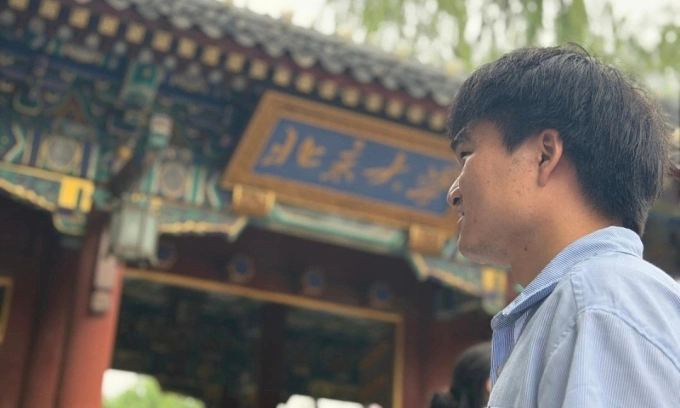
Zhang Huanteng stands in front of Peking University in Beijing, China. Photo from X/@ |
In recent months, Zhang has frequently received messages from strangers online, some vocational school students seeking advice on university entrance exams and others preparing for postgraduate studies. Some ask him a simple question: “Do I still have a chance?”
He often responds by sharing his own story, an inspiring one.
In the summer of 2014, he had failed to gain admission to a high school he had hoped to attend. His score was only enough for a local county school, according to Theirs. After learning the results, the then-15-year-old spent hours lying in bed that day before updating his QQ status to: “Tsinghua, Peking University, here I come.”
But reality soon got in the way: his family was among the poorest in the village. His mother had lived with a disability since childhood and suffered from poor health, while his father did various odd jobs to support the family, including selling ice cream, collecting scrap, and farming.
His childhood was spent in a small house on the edge of the village, with meals that rarely included meat and memories of his father borrowing small amounts of money from neighbors to buy him an eraser. Despite having little formal education themselves, his parents believed studying was the only path to a better life.
Several months after the exam, Zhang enrolled in a vocational secondary school because of the family’s financial difficulties and advice from relatives that he should learn a trade and begin earning money as soon as possible. He agreed but often felt guilty, believing he had disappointed his parents.
At vocational school, Zhang decided to continue pursuing higher education. While classmates relaxed after class, he taught himself the regular high school curriculum using old textbooks borrowed from relatives.
Every morning, an hour before classes began, he stood outside the classroom memorizing classical Chinese poems and English vocabulary.
After learning that gaining university admission through the regular academic route would require mastering most of the high school curriculum independently, he chose to spend an additional year preparing for the entrance examination.
To fund his studies, his parents sold an old elm tree that had stood in front of the family home for decades. The tree had long served as a gathering place where family members ate meals and rested after work. Years later, Zhang said he still remembers the spot whenever he returns home.
On the first day of cram school, his classroom was packed with nearly 90 students and the teacher had to place an extra desk in the corner for him. Three months before classes began, Zhang had already taught himself much of the high school curriculum, including literature, English, mathematics, and biology.
A year later, he achieved a university entrance exam score higher than many students who had spent three years in regular high schools. He was subsequently admitted to Chongqing Medical University, another step toward the goal he had written in his QQ status years earlier.
His decision to study medicine stemmed from hardships within his family. His grandmother was bedridden and his mother frequently ill. He believed that, by studying medicine, he could one day help his family better understand disease and treatment.
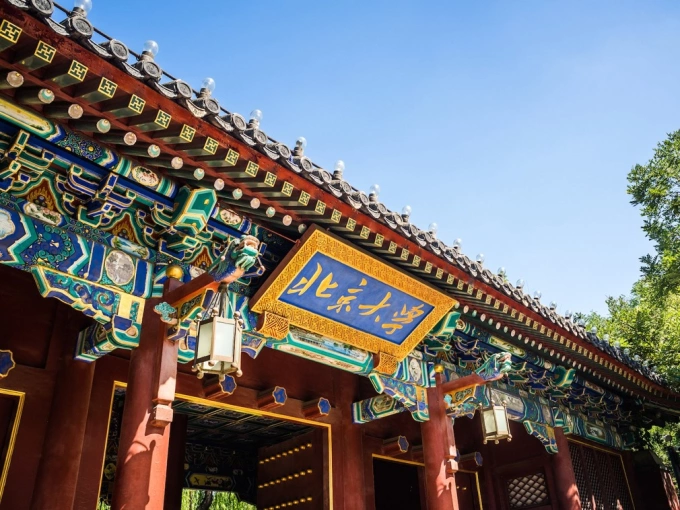 |
An entrance at the Peking University in Beijing, China. Photo from the university’s website |
After passing the university entrance examination, he immediately took a job at an electronics factory to earn money to pay the tuitions. He spent more than 10 hours a day standing beside an assembly line and sometimes struggled to stay awake that he nearly fell into the machinery. In two months, he saved more than 10,000 yuan (US$1,390).
Throughout his undergraduate years, Zhang spent most weekends in the library. Although he lived in Chongqing for several years, he rarely visited the city’s attractions, devoting most of his time to studying. His next goal was admission to the Peking Union Medical College, one of China’s most competitive medical institutions.
For eight months of exam preparation, he studied from 6 a.m. to 10 p.m. daily. On the day he received the admission result, he called his father and said: “Dad, I got in.”
There was a moment of silence on the other end of the line. “Good, good, good…,” his father repeated.
Zhang burst into tears.
Entering the new academic environment, he realized many of his peers were more accomplished, more experienced, and came from better backgrounds. One senior student once told him: “Just keep working hard. Don’t ask about where people come from.”
The words stayed with him for years.
In 2023, his former vocational school invited him to give a speech to students. Many asked how they could change their future, questions that reminded him of his younger self.
Zhang, however, does not view his story as an extraordinary tale of overcoming the odds. “There is no secret formula. Many times, I was also unsure of what lay ahead. But if we wait until everything becomes clear before we start, we may never take the first step.”
A 2022 White Paper on Vocational Education Development by the Chinese government said more than 70% of vocational education students came from rural areas. But increasingly, vocational students are choosing to continue their studies after graduation.
Last year, Zhang completed his master’s degree and was admitted to a PhD program at Peking University. His journey from vocational secondary school to Peking University has attracted widespread attention on Chinese social media.
Many describe it as a remarkable comeback story, but he disagrees. “This is not a comeback story at all. I am simply returning to the trajectory that was always meant to be mine,” QQ quoted him as saying.
Comments are closed.