


In an interview, Sheren discussed Vietnam’s ESG real estate landscape, the Coastal Quang Ngai project and the challenges of developing sustainable urban communities.
Michael Sheren, HAUS chairman. Photo courtesy of Michael |
How do you assess the ESG real estate trend in Vietnam after working on two projects, HAUS Da Lat and Coastal Quang Ngai?
I spent many years working in New York and London, where I saw growing investor interest in markets that demonstrate a commitment to sustainable development.
Vietnam is one of Asia’s fast-growing economies, supported by a relatively young population and an expanding middle class. These factors create conditions for long-term real estate development.
The country also has potential for ESG-oriented projects due to its natural resources and opportunities in renewable energy.
What has stood out to me during my visits to Quang Ngai is the local community. I have spoken with many young people about their aspirations and future plans, and those conversations reinforced my view that sustainable development should be centered on people and communities.
I hope that local residents will play an important role in the future development of the Coastal Quang Ngai community.
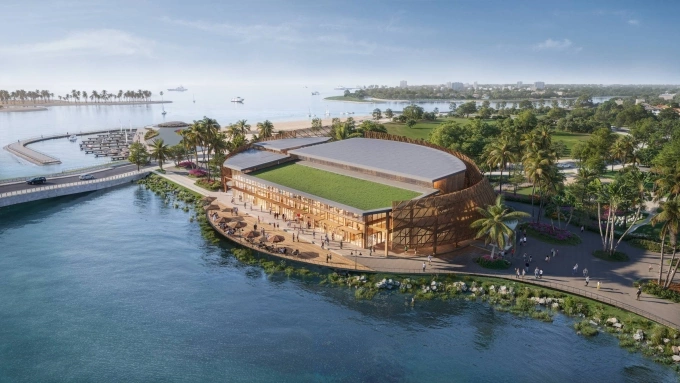 |
Community Exhibition Space Design (Design Exhibition) at Coastal Quang Ngai. Photo courtesy of HAUS |
How is Coastal Quang Ngai approaching the goal of building a sustainable community?
Coastal Quang Ngai covers 94 hectares and is planned for approximately 4,000 residents. According to the master plan, the project will include educational, healthcare, recreational and community facilities.
From an environmental perspective, the development incorporates features such as rainwater management systems, renewable energy solutions and infrastructure designed to support climate resilience.
One of the project’s central features is the Design Exhibition space, which is intended to serve as a venue for community, cultural and educational activities.
In our view, a sustainable community is one that balances living standards, environmental considerations and social connections. That approach influenced planning decisions, including maintaining a relatively low construction density and allocating space for public and green areas.
What is the biggest challenge in developing an ESG urban project in Quang Ngai?
One challenge is balancing sustainability goals with affordability.
Developers need to ensure projects meet ESG objectives while remaining accessible to a broad range of residents, including local buyers and people relocating to the area.
Our view is that sustainable development does not necessarily require significantly higher costs. With appropriate planning and technology, projects can incorporate environmental features while maintaining long-term operational efficiency.
 |
Coastal Quang Ngai is developed based on natural resources and indigenous culture. Photo courtesy of HAUS |
What drew you to partnering with HAUS?
Many companies today incorporate ESG principles into their business strategies, but implementation varies.
What attracted me to HAUS was the company’s effort to integrate sustainability considerations into project planning and development.
At Coastal Quang Ngai, for example, sustainability objectives are reflected in areas such as climate adaptation, renewable energy integration and water management.
The company has also collaborated with a number of international partners. At HAUS Da Lat, these include KKAA, Copper Beech, Isometrix Lighting and Design, 1508 London and Chiva-Som. For Coastal Quang Ngai, the company has worked with Sweco, a European engineering and planning consultancy.
Where do you see HAUS positioned on the sustainable real estate map in five to ten years?
I believe the real estate sector is moving toward higher expectations in terms of project quality, environmental performance and community impact.
From my perspective, projects such as Coastal Quang Ngai can contribute to discussions about sustainable urban development in Vietnam.
If developments like this help encourage broader adoption of sustainability standards across the industry, that would be a positive outcome for both the sector and local communities.
Comments are closed.