
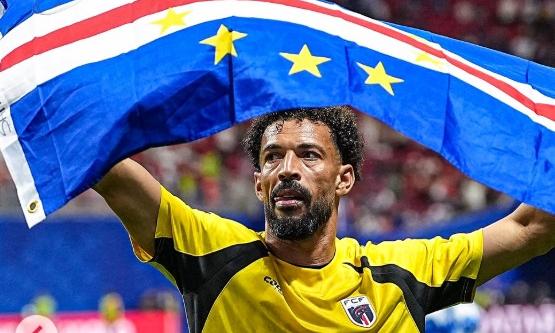

Josimar Dias couldn’t help but cry as the final whistle blew at the Atlantic Stadium in Atlanta. The 40-year-old Cape Verde goalkeeper, known simply as Vozinha, had just done the unthinkable: He held Spain, the 2010 world champions and one of the favourites at this tournament, to a 0-0 draw in Cape Verde’s first-ever World Cup match!
Spain had dominated possession, unleashed 27 shots, and even brought on young superstar Lamine Yamal in the second half. None of it was enough. Vozinha stopped them all. He made seven crucial saves, each one met with roars from thousands of Cape Verdean supporters in the stands, who treated every stop like a goal.
He was named player of the match. Within hours, his Instagram following had leapt from 50,000 to more than 2.4 million as the footballing world stopped to take notice. Only Northern Ireland’s Pat Jennings, who made 10 saves at the age of 41, has produced a comparable goalkeeping performance at a World Cup.
Who is Vozinha?
What made the night all the more extraordinary was the journey that had brought him to it. Vozinha did not turn professional until he was 25, making his debut for Angolan club Progresso in 2012 — an age when most international players are already established stars.
Growing up in Mindelo, Cape Verde, he was among the best keepers on the island but was repeatedly overlooked due to his height. Like many Cape Verdean talents before him, he eventually left for Portugal in search of opportunity, and his career took him through Angola, Moldova, Cyprus, Slovakia, and back to Portugal, where he currently plays for second-division side Chaves.
Also Read: Cape Verde secures stunning 0-0 draw with Spain in its World Cup debut
He joined the national team the same year he turned professional, and admitted there were moments when he considered walking away. “I continued because of this dream,” he said after the Spain match. “I work all my life for this, for this moment.”
At 40 years and 12 days old, he became the oldest player to appear in a nation’s debut World Cup match, surpassing a record set just days earlier by Curaçao’s Eloy Room. Only Egypt’s Essam El Hadary was older when making his own World Cup debut.
The name and the man
His very nickname carries a story. “Vozinha” is Portuguese for “little grandmother”, a taunt given to him by older kids who would beat him at football and laugh that he was going home to complain to his grandparents.
Years later, he adopted it as his own after joining a club where another player shared his first name, Josimar. That name, too, has history: his father had wanted to name him Valdano, after the Argentine footballer Jorge Valdano, but authorities in Cape Verde refused. Instead, he was named after the Brazilian defender Josimar, who rose to prominence at the 1986 World Cup. Decades on, Vozinha would carve out his own chapter.
Also Read: FIFA monitor demands removal of video review official over alleged ‘white power’ hand sign
Teammates describe him as a driven, demanding presence. Defender Pico Lopes said he “lives and breathes Cape Verde,” keeping players on time in training and pushing the group to raise their standards. Steven Moreira, another defender, said the squad teases him about his age but called him a “big legend” after Atlanta, adding that the performance proved age was no barrier to greatness.
Tears for those who couldn’t be there
When the final whistle blew, Vozinha hunched over near his goal and wept. He was thinking of his grandparents, who had raised him and passed away in recent years, and of his mother, who could not make the journey to the United States. Cape Verde is among 50 countries whose citizens face financial bonds of up to $15,000 to secure a US visa under restrictions imposed by the Trump administration. Though the requirement was suspended last month for ticket-holders from Cape Verde and four other World Cup nations, critics said the announcement came too late for many families, including Vozinha’s mother.
What it means for Cape Verde
For a nation of just over half a million people, the third smallest ever to qualify for a World Cup, an archipelago of islands sitting nearly 600 km off the west coast of Africa, no larger in population than the city of Sheffield, this was a result of historic magnitude. Generations of Cape Verdean footballers had dreamed of a moment like this without ever reaching it. They finally did.
(With agency inputs)

Comments are closed.