
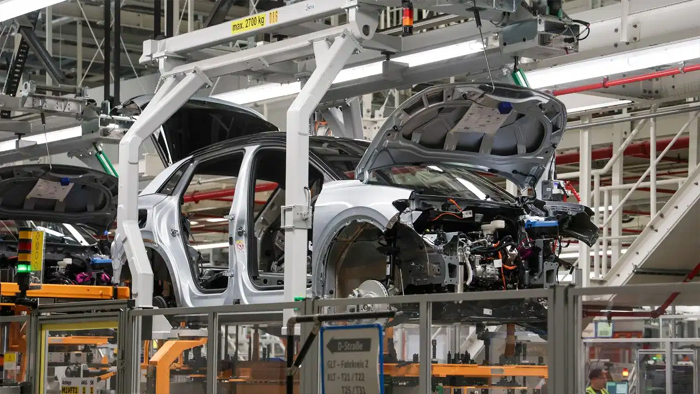

Tamil Nadu: The demand for EV is continuously increasing in India also. People are now preferring vehicles that are less expensive and better for the environment. On the other hand, companies are also bringing new electric models into the market. For the first time in May 2026, the share of battery-powered vehicles crossed 10%, which shows that EVs are gradually becoming the choice of common people. Meanwhile, it is not possible that there is talk of EV revolution in India and Tamil Nadu’s name does not come up.
Today, Tamil Nadu produces more than 50% of the total electric two-wheelers in the country and about 40% of the total EV production. For this reason, this state has become India’s largest electric mobility manufacturing hub. Tamil Nadu, which has been a strong center of the automobile industry for many years, is now rapidly moving towards electric vehicles. This change has attracted domestic and foreign companies. Recently, Vietnamese company VinFast has also announced investment in the state.
In Tamil Nadu, companies like TVS Motor, Ola Electric, Ather Energy, Greaves, Raptee Energy and Royal Enfield are manufacturing electric two-wheelers. Whereas companies like Hyundai, BYD and VinFast are producing electric cars. Apart from this, Switch Mobility and Montra Electric are also making the state a major hub for electric buses, trucks and last-mile mobility vehicles. Not only this, institutes like Chennai based Mahindra Research Valley and IIT Madras are strengthening EV research and engineering. Experts say that Tamil Nadu has today become the EV hub of India on almost every scale of production.
Tamil Nadu may be the largest EV center in the country, but the state now faces a new challenge. It is not enough to just make vehicles, but it is also necessary to become self-reliant in important parts of EV technology. Currently, India has to depend on imports for many important parts like battery cells, power electronics and advanced vehicle software. According to the ET report, cities like Pune and Bengaluru are ahead of Tamil Nadu in EV component development and engineering. Tamil Nadu still needs a lot of work, especially in the field of Battery Management System (BMS), vehicle software and firmware development.
According to the report, another problem is that the government has focused more on attracting big investors and Global Capability Centers (GCC). Whereas MSMEs and medium-scale suppliers, considered the backbone of the auto industry, have not received adequate assistance. Due to this, the local component supply chain could not become as strong as it should have been. Battery cell manufacturing is considered to be the biggest weakness of the EV industry. Although companies like Ola Electric are investing in this sector, this industry is still in its initial stage. Ather Energy also believes that there are huge opportunities in the field of battery manufacturing, cell production and related raw materials.
The good thing is that India’s capacity in areas like motor controller, inverter, onboard charger, DC-DC converter and traction motor is continuously increasing. Companies like Sona Comstar are making important contributions in this direction. Experts believe that Tamil Nadu should no longer be limited to setting up factories only. The state will also have to focus on software development, semiconductor, battery technology, recycling industry, raw material supply and development of MSME companies. If Tamil Nadu develops strong technological capabilities in areas such as batteries, semiconductors, advanced electronics and vehicle software, it can become the largest EV and deep-tech hub not only in India but in entire Asia in the coming years.

Comments are closed.