
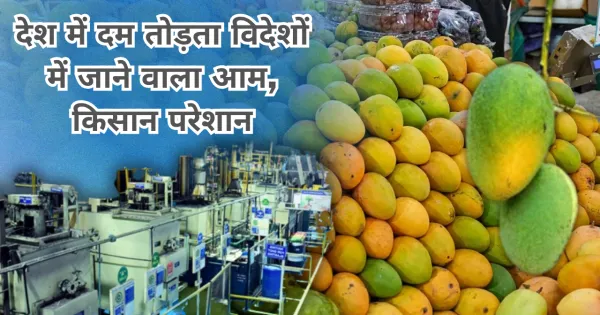
Mango going abroad is dying in the country, farmers are worried… Know what is VHT which became the reason for loss

Lucknow: This year is proving to be very difficult for the producers and exporters of the world famous Malihabadi mango. Due to excessive use of chemical pesticides and failure to meet international standards, first big countries like Japan and then America refused to accept the consignment of Indian mangoes. Along with this, exports to Gulf and European countries are also on the verge of being affected, due to which gardeners are facing huge financial losses.
Why did Japan ban
A team from Japan had come to inspect the Vapor Heat Treatment (VHT) Center located in Rahmanpur, Uttar Pradesh. During the inspection, the team found flaws in the cleanliness system and pest control process there, due to which they appeared dissatisfied. After this, Japan decided to ban the import of mangoes from India.
water on farmers’ hard work
Bishan Pal Singh, a prominent orchardist in the Mal area of Malihabad, who has been exporting mangoes to America and Japan for the last two decades, is facing huge losses this time. He told that to keep the crop safe, special protective bags were put on the small mangoes growing on the trees, on which lakhs of rupees were spent.
According to mango sellers, high quality mangoes which used to sell for up to ₹150 per kg in Japan, are now being sold at ₹28 to ₹35 per kg in local mandis due to the closure of foreign markets.
Padmashree Kalimullah Khan expressed concern
Kalimullah Khan, honored with Padma Shri for developing new varieties of mango, has expressed concern over this situation. He says that the use of fake and highly toxic pesticides has increased in the market, which is not only damaging the quality of crops but is also dangerous for human health. He said that countries like Japan are very strict regarding food safety, hence they have adopted a tough stance.
Impact on premium Indian mangoes
The biggest impact of this decision has been on those premium Indian mangoes, which are in special demand in Japan. These include Alphonso, Kesar, Langra and Banganapalli. Kesar mango from Gujarat remained at the forefront among the Indian mangoes exported to Japan in the year 2025-26. According to a report, the total export of fresh and processed mangoes stood at about $1.54 million (about Rs 14.73 crore), of which Kesar mango accounted for about $0.2 million (about Rs 2 crore).
However, according to the Agricultural and Processed Food Products Export Development Authority (APEDA), India exported about 29,938 metric tonnes of fresh mangoes in the financial year 2024-25, with a total value of $56.5 million (about Rs 537 crore). India’s major export markets included UAE, US, UK, Kuwait and Qatar, while Japan was not among the top buying countries. Despite this, Indian mangoes retain their premium status in Japan.
Main reasons for export crisis
1. Excessive use of pesticides: After unseasonal rains and hailstorm, pesticides were used in large quantities to protect the crops from insects, due to which chemical residues in the fruits were found to be higher than international standards.
2. Drawbacks in VHT Process: When the Japanese delegation inspected the pack houses in Malihabad and Maharashtra, deficiencies in the vapor heat treatment process were found.
3. Global Conditions: Rising geopolitical tensions between the US and Iran made air and sea freight costlier, affecting exports.
What is Vapor Heat Treatment (VHT)
Before normal export of mangoes to foreign countries, the fruits undergo vapor heat treatment process. In this, mangoes are kept in a special hot air chamber for a specified time, due to which the ‘fruit flies’ and their larvae present in the fruits are destroyed and the effect of pesticides is also reduced.
Ban has already been imposed
This is not the first time that Japan has banned Indian mangoes. An earlier ban was imposed in the 1980s due to ‘fruit fly’, which was lifted in 2006 after technological improvements.
India’s share in global production
India produces about 40 to 45 percent of the world’s total mango production. Mango is cultivated in about 2.8 lakh hectare area in Uttar Pradesh, which produces about 70 lakh metric tonnes every year. Malihabad, Mal and Kakori are its main centres. In the year 2024-25, India had exported about 30 thousand tonnes of mangoes to countries like UAE, Britain, Kuwait and Qatar, in which Japan’s share was about 2 thousand metric tonnes.
Now farmers fear that if the situation does not improve, other countries may also take similar strict measures.

Comments are closed.