

Virendra Pandit
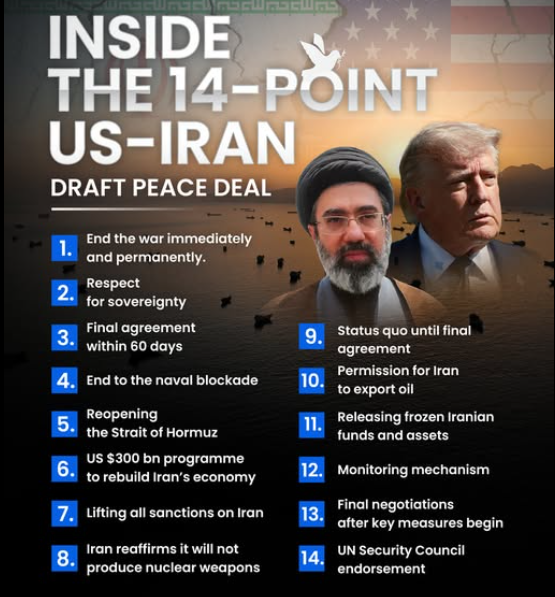
New Delhi: After much fire and brimstone since the US and Israel unfolded their 111-day-long war against Iran on February 28, President Donald Trump on Thursday electronically signed a 14-point interim peace deal with his Iranian counterpart Masoud Pezeshkian, which many in Washington lamented as the Republican leader’s ‘abject surrender.’
The two countries said the deal to end the conflict has come into force, but there is still no clarity over its effective implementation. Earlier, Washington and Tehran had said they would sign the deal in Switzerland on Friday (June 19).
Mohammad Bagher Ghalibaf, former Islamic Revolutionary Guard Corps (IRGC)’s Brigadier-General and Parliament Speaker since 2020, said the peace talks delivered more results than war, the media reported on Thursday.
Trump and Pezeshkian electronically-signed a memorandum of understanding (MoU) aimed at ending the nearly four-month-long conflict between the United States, Israel and Iran. The agreement has already taken effect.
It includes commitments to end military operations on all fronts, prevent Iran from developing or acquiring a nuclear weapon and fully reopen the Strait of Hormuz, a key global shipping route.
Many world leaders, including India’s Prime Minister Narendra Modi, have welcomed the peace deal.
Israel-Hezbollah
Having already declared that Tel Aviv had nothing to do with the Washington-Tehran peace deal, Israel continued targeting Iran’s proxy Hezbollah’s hideouts in Southern Lebanon and killed one person, despite the Jewish country’s supposed inclusion in the US-Iran interim agreement that it would vacate occupied areas in Lebanon.
A full Israeli withdrawal from southern Lebanon is unlikely in the near term, and could take “four to five months” to conclude. Broader regional issues would still need to be addressed.
Trump’s warning
As expected, shortly after signing the deal, Trump warned Iran that he would “bomb the hell out of them” if they violate the agreement.
“I don’t want them to. I want them to honor the agreement,” he told reporters.
Calling the people of Iran “smart,” Trump said the deal would usher in peace in West Asia (the Middle East) and lower oil prices.
A video showed French President Emmanuel Macron, seated next to Trump, and US Secretary of State Marco Rubio, who was standing behind the US President, and other guests, applauding.
Moments before signing the deal, Trump, holding a pen in one hand, told the leaders sitting with him at the G-7 event in France: “This was not easy – that I can tell you.” He then signed the paper and held it up for the guests.
The Iranian Embassy in India also posted pictures of Pezeshkian holding the signed peace.
The MoU calls for an immediate cessation of military operations, including in Lebanon, and commits both countries to pursuing a final agreement within 60 days. It also includes provisions for the removal of the US naval blockade, safe passage of commercial vessels through the Strait of Hormuz, phased sanctions relief, the release of frozen Iranian assets, and a US-backed economic development program for Iran worth at least USD 300 billion.
The memorandum also states that Iran has reaffirmed it will not develop or acquire nuclear weapons and envisages future discussions regarding enriched uranium stockpiles under the supervision of the International Atomic Energy Agency (IAEA).
“Time to test”
Iranian Foreign Ministry spokesperson Esmaeil Baqaei confirmed the signing of the peace deal with the US, saying it is now “time to test” the implementation of the agreement.
“The text of the Islamabad Memorandum of Understanding was finalized with the signatures of the presidents — now it is time to test the implementation of the agreement,” he said.
Iran’s chief negotiator, Ghalibaf, told his country’s state-run press tv that they are engaging diplomatically with the US from a “position of strength.”
Key points:
- Iran says the MoU is now in force: Foreign Ministry spokesperson Esmaeil Baghaei said Tehran and Washington have finalized and electronically-signed the MoU, paving the way for talks on a final deal within the next 60 days.
- Iran warns it will closely monitor US compliance: Baghaei said Tehran will watch Washington’s implementation of the memorandum “without any leniency” and will not fulfill its commitments if the US fails to meet its obligations. He reiterated that Iran’s missile program is not open for negotiation.
- Nuclear talks may extend beyond 60 days: Kenneth Katzman, a senior fellow at the Soufan Center, said negotiations between the US and Iran over Tehran’s nuclear program are likely to take longer than the 60-day timeline outlined in the memorandum. Describing the talks as “very detailed” and “very exhaustive”. He added that issues such as uranium enrichment, stockpiles of highly enriched uranium, verification measures and inspections will require extensive work by technical experts.
- Republican backlash: Several prominent Republicans, including former Vice President Mike Pence, and former UN ambassador Nikki Haley and Senator Bill Cassidy, criticized the deal with Iran. They argued that it does not do enough to curb Tehran’s nuclear ambitions and object to the USD 300 billion reconstruction plan for Iran. Some Republicans compared the agreement with former President Barack Obama’s 2015 nuclear deal, which Trump unilaterally withdrew from during his first term.

Comments are closed.