
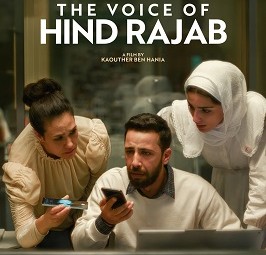
The Voice of Hind Rajab review: The Gaza child that the Indian audience almost didn’t get to hear

The most wrenching performance in The Voice of Hind Rajab was never performed. At the centre of Tunisian filmmaker Kaouther Ben Hania’s docudrama sits a real recording: the shaking voice of a five-year-old girl captured on the last afternoon of her life. Everything assembled around it is staged. The friction between the two — actors straining toward a child who is already beyond their reach — is what makes the film almost unbearable.
The facts are a matter of record. On 29 January 2024, five-year-old Hind Rajab was trapped in a car in Gaza City, hemmed in by the bodies of her aunt, uncle and four cousins, after Israeli fire tore through the vehicle as the family tried to flee. She was the only one left alive. For hours, she stayed on the line with volunteers at the Palestine Red Crescent Society, asking, over and over, for someone to come for her. The ambulance that was finally dispatched never reached her; its two paramedics were killed, too. Hind was found dead days later. The recordings of those calls, released afterwards, went around the world. Ben Hania built her film around them.
What she does with that audio is at once her boldest gamble and her most contested. She locks the camera inside the Red Crescent’s drab West Bank office and refuses to leave it. Juan Sarmiento G.’s widescreen camera works with her, nosing between the packed desks and glass-walled cubicles until the room itself starts to feel like a held breath. The calls arrive in waves: other voices, drawn from the same trove of real recordings, ring in from across Gaza so that panic is the air the film breathes from its first minute. The shelling, the tank, the riddled car stay outside the frame, reaching us only as static and gunfire bleeding through a phone. There is no reconstruction of the attack, no wound for the camera to linger on. There is the room, the people in it, and the voice filling it.
The horror of procedures
As a docudrama, it runs on procedure and the procedure is where the horror lives. The first call comes from Hind’s teenage cousin Layan, who barely gets out that a tank is firing before the line goes dead. When the volunteers ring back, it is Hind who answers, alone now among the bodies. Omar (Motaz Malhees) is the one who reaches her, although he is too undone to be of much comfort. Then, it falls to Rana (Saja Kilani) to keep the girl talking while Omar rounds on Mahdi (Amer Hlehel), the coordinator, to get an ambulance moving. The cruelty of the matter is that it cannot simply be sent.
Also read: How Titan Story director Robbie Grewal recreated JRD Tata’s ultimate startup story for the screen
Hind, it turns out, is stranded barely eight minutes from the nearest crew, but Omar still spends the rest of the film unable to dispatch it. A safe route has to be brokered first, through the Red Cross and the Israeli military’s own clearance unit, which means pleading for passage from the same army firing on the street. The film’s most harrowing stretches are also its stillest: a cursor crawling over the map, an ambulance creeping down scarred streets, while Mahdi spells out, with unbearable composure, that you cannot ask the people doing the killing to guarantee a child’s safety, and then trust the answer.
In that, the film builds a peculiar kind of dread: the suspense that comes with knowing precisely how it ends and being made to sit through every minute regardless.
The fight to be heard
Last year, Tunisia selected The Voice of Hind Rajab as its entry for Best International Feature at the Oscars, and in January 2026, it landed a nomination: the only African film in the category, and a third Oscar nod for Ben Hania after The Man Who Sold His Skin and Four Daughters. It had arrived at the Venice Film Festival last year to a standing ovation timed at 23 minutes, won the Grand Jury Prize, and accumulated an improbable row of executive producers along the way: Brad Pitt, Joaquin Phoenix, Rooney Mara, Jonathan Glazer, Alfonso Cuarón. That is a great deal of Hollywood wattage to point at a Palestinian story. The film played even in Israel.
Also read: Main Vaapas Aaunga: Imtiaz Ali reaches back to Partition to say what Hindi cinema might be unable to in 2026
But it almost didn’t play in India. The Voice of Hind Rajab was set to open in India ahead of the Oscars in March, until the Central Board of Film Certification declined to clear it. Its distributor, Manoj Nandwana, was quoted in news reports as saying that he was told plainly that a release would harm India’s relationship with Israel — that it came weeks after Narendra Modi’s visit to Tel Aviv was even more telling.
And now, three months later, comes the reversal: The Voice of Hind Rajab opens across India today (Friday, June 19). The film asks almost nothing of its audience except that they listen to a child. That this had to be fought for at all tells you everything the film cannot.

Comments are closed.