
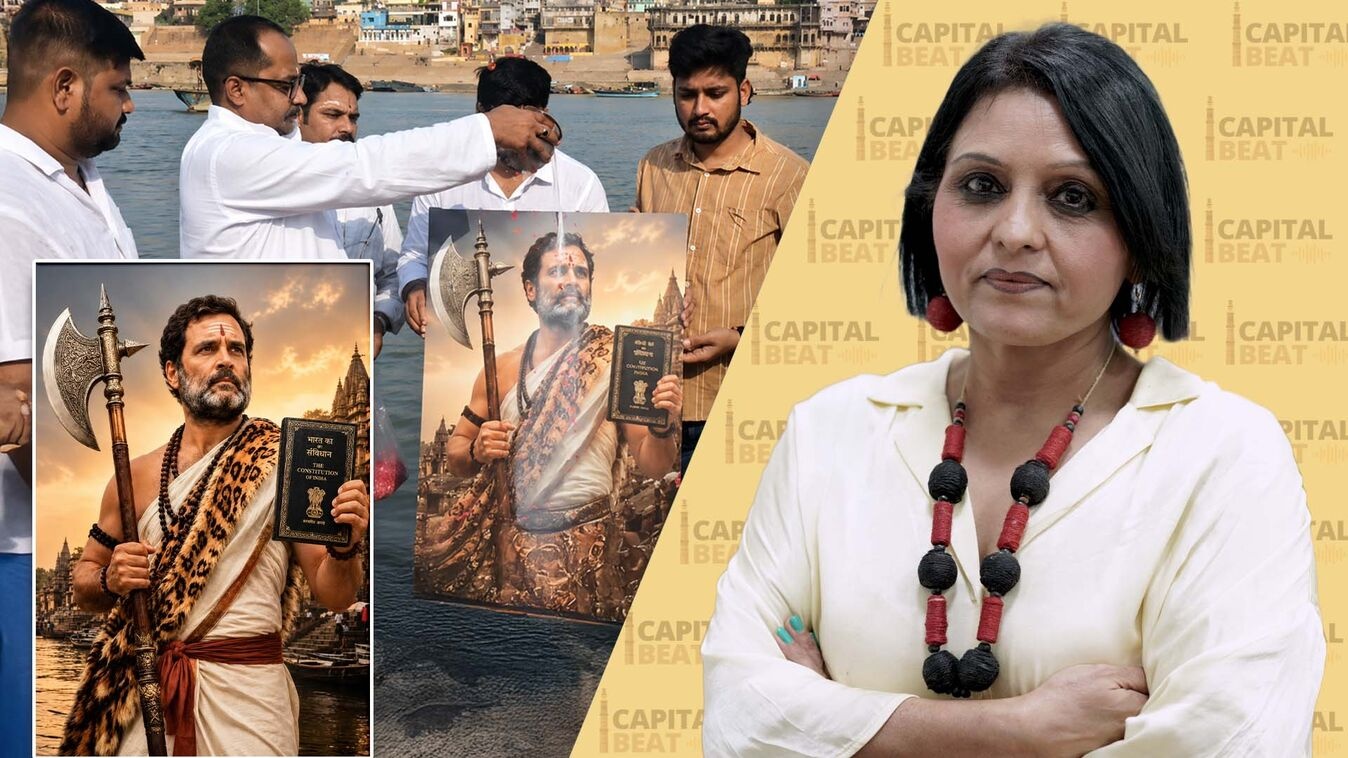

“This single act has done more damage to what Rahul Gandhi stands for than anything else,” senior journalist Shahira Naim said while discussing the controversy surrounding Youth Congress workers depicting the Leader of Opposition as Lord Parashuram, a warrior sage, during his birthday celebrations in Varanasi, Uttar Pradesh, on Friday (June 19).
Also read: Rahul reaffirms ties with Stalin despite Congress-DMK rift in Tamil Nadu
The controversy erupted after images and videos showed Youth Congress workers performing rituals on the banks of the River Ganga with a poster portraying Rahul as Lord Parashuram, holding a battle axe in one hand and a copy of the Constitution in the other. The visuals quickly went viral, triggering sharp criticism from the Bharatiya Janata Party (BJP) and prompting questions about the Congress’s secular identity.
Naim was present alongside political analyst and author Sharat Pradhan, senior journalist Sunita Aron and academic Tanvir Aeijaz of Ramjas College during a discussion hosted by The Federal on whether the symbolism reflected soft Hindutva, political miscalculation, or an attempt to connect with voters ahead of the 2027 Uttar Pradesh Assembly elections.
Contradicting Rahul’s politics
Aron argued that the event appeared disconnected from the political messaging Rahul has been pursuing in recent years.
According to her, the Congress leader has consistently focused on issues such as education, healthcare, development and constitutional values. She questioned whether the organisers had considered whether the leader himself would have approved of such symbolism.
She recalled that Youth Congress workers in the past marked occasions through blood-donation drives and social service activities. In contrast, she described the Varanasi event as a misplaced attempt to send a message using religious imagery.
Aron also acknowledged that the organisers may have intended to symbolise Rahul’s commitment to protecting the Constitution and fighting injustice, but said the message could have been conveyed in a more innovative and secular manner.
Hero worship debate
Pradhan was even more critical of the event, arguing that the ritual was completely at odds with the Congress’s culture.
While defending Rahul’s right to visit temples and practice his faith, he distinguished between personal religious expression and symbolic deification.
Also read: Why Rahul Gandhi, flaws and all, remains the Opposition’s best bet
He said portraying a political leader as a deity was unlikely to be appreciated by the Congress leader himself and suggested that some local leaders may have organised the event in an attempt to gain favour within the party.
Pradhan questioned why senior Congress leaders had not reacted publicly to the controversy. However, he also pointed out what he described as a double standard in political discourse, arguing that similar acts involving Prime Minister Narendra Modi often attract less criticism from BJP supporters.
According to him, BJP leaders were attempting to use the controversy to portray Congress as disrespectful towards Hindu sentiments while ignoring similar examples involving their own party.
Election calculations
Naim viewed the controversy through the prism of Uttar Pradesh politics.
She argued that the symbolism of Lord Parashuram, a figure strongly associated with Brahmin identity, sat uneasily with Rahul’s recent efforts to build a broader social coalition that includes Dalits, backward communities and other marginalised groups.
She said the imagery appeared to contradict the inclusive politics that Rahul has been advocating over the past few years.
In her view, if the organisers were genuinely associated with the Youth Congress, they had failed to understand the ideological direction Rahul has been attempting to establish within the party.
She even suggested the possibility that the event could have unintentionally damaged the Congress’s image as a secular party committed to social justice and constitutional rights.
Congress in a catch-22
Ajaz argued that the controversy had placed the Congress in a difficult position.
He noted that India remains a deeply religious society where political mobilisation frequently intersects with caste and religious identities. In that context, he said, such symbolism could potentially carry political benefits despite generating controversy.
Also read: Rahul impressive in Kota, but can he convert Gen Z cheers into votes? | Capital Beat
Ajaz stressed that the Congress has never been anti-religion, even while identifying itself as a secular party.
He also argued that the event differed fundamentally from instances where religion is used to promote hatred or social division. According to him, the Varanasi ritual did not contain an element of communal polarisation.
At the same time, Ajaz said Rahul himself would probably not have approved of being portrayed in such a manner, given the emphasis he places on constitutional values and social justice.
Constitution symbolism
One aspect that attracted particular attention during the discussion was the image of Rahul holding both a battle axe and the Constitution.
Ajaz interpreted the symbolism as an attempt to project the leader as someone committed to defending constitutional values while simultaneously countering allegations that he is anti-Hindu.
According to him, the Constitution’s presence in the imagery reflected Rahul’s political messaging over the last several years, during which constitutional protection has emerged as a central theme of his campaigns.
The panellist argued that the symbolism sought to reassure voters that support for constitutional values and respect for religion need not be contradictory.
Viral visuals
Many of the panelists noted that the controversy gained prominence largely because of social media.
Aron described the gathering as relatively small and argued that, in an earlier era, such an event would likely have gone unnoticed.
Instead, viral images transformed a local celebration into a national political controversy.
Pradhan contended that BJP leaders amplified the issue by aggressively attacking the organisers and presenting the event as an insult to Lord Parashuram.
Also read: Rahul Gandhi calls PM Modi ‘compromised PM’ after US strikes kill 3 Indian seafarers
He argued that the Congress should avoid responding publicly because any reaction could prolong the controversy and hand political opponents an opportunity to frame the party as anti-Hindu.
A fleeting controversy?
As the discussion concluded, most panellists agreed that the episode was unlikely to have a lasting electoral impact.
Aron described it as a “flimsy act” that neither Hindus nor Muslims were likely to view as politically significant.
Pradhan similarly argued that maintaining silence was the best strategy for the Congress, while Naim suggested that the party should simply move on rather than allow the controversy to dominate public discourse.
Ajaz offered a different interpretation, saying the intensity of the BJP’s response demonstrated Rahul’s growing political relevance. According to him, the episode reflected anxiety within the BJP about Rahul’s ability to connect with multiple social groups.
Despite differing assessments of the controversy’s significance, the panel broadly agreed on one point: portraying Rahul as Lord Parashuram did not align with the political image and ideological messaging that the Congress leader has sought to cultivate in recent years.
The content above has been transcribed from video using a fine-tuned AI model. To ensure accuracy, quality, and editorial integrity, we employ a Human-In-The-Loop (HITL) process. While AI assists in creating the initial draft, our experienced editorial team carefully reviews, edits, and refines the content before publication. At The Federal, we combine the efficiency of AI with the expertise of human editors to deliver reliable and insightful journalism.

Comments are closed.