
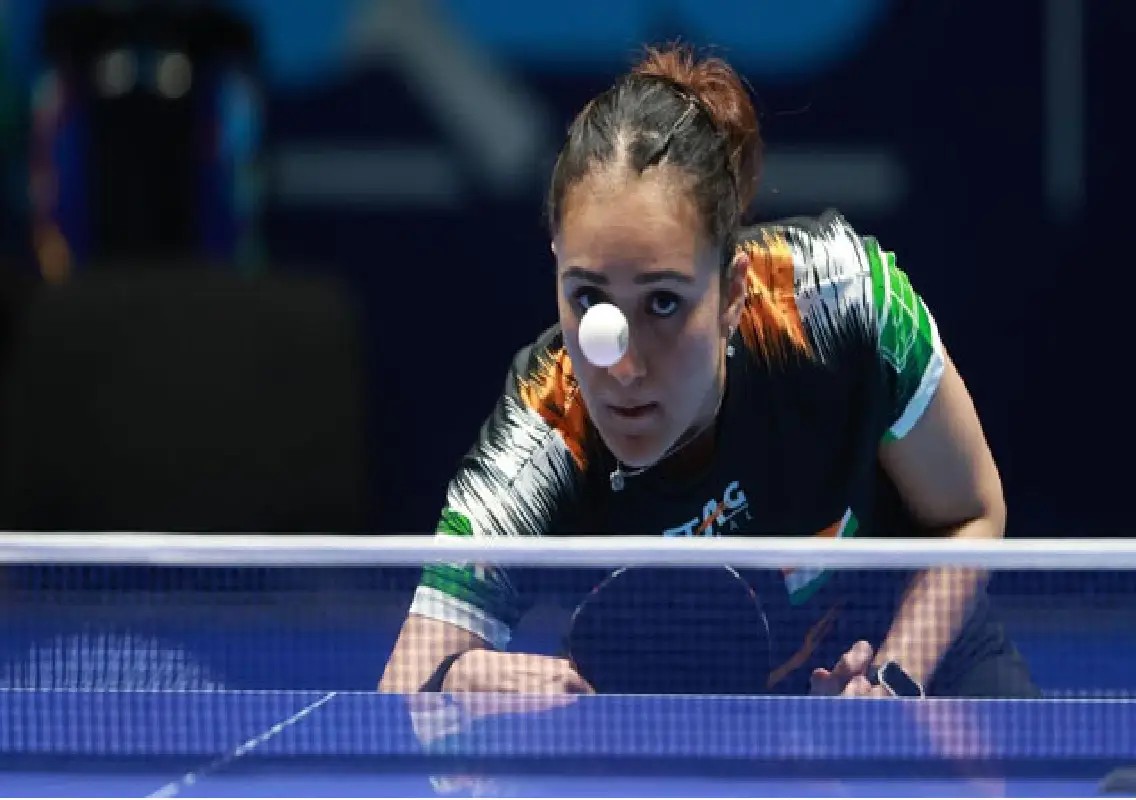

New Delhi: India’s leading table tennis player Manika Batra has expressed disappointment over her exclusion from the country’s main squad for the 2026 Asian Games, raising concerns about the transparency and consistency of the selection process adopted by the Table Tennis Federation of India (TTFI).
The 31-year-old paddler, one of India’s most decorated table tennis players, was named among the reserve players for the continental event, alongside Swastika Ghosh. The 2026 Asian Games are scheduled to be held in Nagoya and Aichi from September 19 to October 4.
In a statement issued on Thursday, Batra said she was “deeply dishearteningly” affected by both the outcome and the manner in which the selection criteria appeared to have been interpreted and implemented.
Batra seeks clarity on selection decision
New Delhi-based Batra stated that no specific reason had been communicated to her regarding her exclusion from the main squad despite her consistent performances on the international stage.
The former Commonwealth Games gold medallist said the lack of a clear explanation had raised concerns about the application of the federation’s selection policy.
“My exclusion from the Asian Games 2026 squad is deeply disheartening, not only because of the outcome, but because of the manner in which the selection criteria appear to have been interpreted and applied. No specific reason has been communicated to me,” she said.
Batra has formally sought a detailed explanation from the Table Tennis Federation of India regarding the decision.
Domestic rankings cited as key factor
The player’s omission is understood to be linked to her absence from the current domestic rankings.
According to reports, Batra missed national competitions because of her participation in international tournaments and commitments abroad. As a result, she did not accumulate sufficient ranking points in domestic events that form a significant component of the selection process.
The selection policy introduced in 2023 allocates:
- 50 per cent weightage to national rankings
- 40 per cent weightage to world rankings
- 10 per cent discretionary weightage to the selection committee
Batra questioned how these criteria were applied and whether the discretionary component had been exercised consistently across all candidates.
Concerns over transparency and fairness
The Indian paddler argued that if discretion forms part of the selection framework, its use should be transparent, uniform and properly documented.
She stated that any variation in the application of discretionary provisions naturally invites questions regarding fairness and equal treatment of athletes.
According to Batra, athletes deserve clarity regarding the factors considered during selection, particularly for prestigious events such as the Asian Games.
Her comments have reignited discussions about balancing domestic performances with international achievements when selecting national squads.
International achievements highlighted
Currently ranked World No. 51, Manika Batra remains India’s second-highest ranked women’s singles player behind Sreeja Akula, who is ranked World No. 45.
Batra argued that years of success at the international level should not be overshadowed solely by domestic ranking considerations.
The 2018 Asian Games mixed doubles bronze medallist noted that world rankings operate under a rolling points system and can fluctuate regularly, making them an imperfect indicator of current form.
She said it was difficult to understand how domestic rankings alone could outweigh sustained performances against top international opponents.
Over the years, Batra has emerged as one of India’s most successful table tennis players, contributing significantly to the sport’s growth and visibility in the country.
TTFI defends selection process
Earlier on Thursday, the Table Tennis Federation of India defended its selection procedure, maintaining that the squad had been chosen in accordance with established guidelines.
The federation stated that both national and international rankings were considered while finalising the team.
According to TTFI, the process was designed to ensure that India’s highest-ranked and most consistent performers were given the opportunity to represent the country at the Asian Games.
The federation has not yet indicated whether it will provide a more detailed explanation regarding the application of the selection criteria in Batra’s case.
Debate intensifies within table tennis community
The controversy has sparked widespread discussion within Indian table tennis circles, with athletes, coaches and fans debating the balance between domestic participation and international achievements.
Many observers believe the case highlights broader questions about selection policies and the need for greater transparency in decision-making processes involving elite athletes.
Attention is now focused on whether the federation, the Indian Olympic Association or the Sports Ministry will review the concerns raised by Batra.
Conclusion
Manika Batra’s exclusion from India’s main squad for the 2026 Asian Games has triggered debate over the transparency and implementation of selection criteria in Indian table tennis. While the TTFI maintains that the process followed established guidelines, Batra has sought a detailed explanation, arguing that fairness, consistency and recognition of international achievements must remain central to team selection decisions.
Comments are closed.