
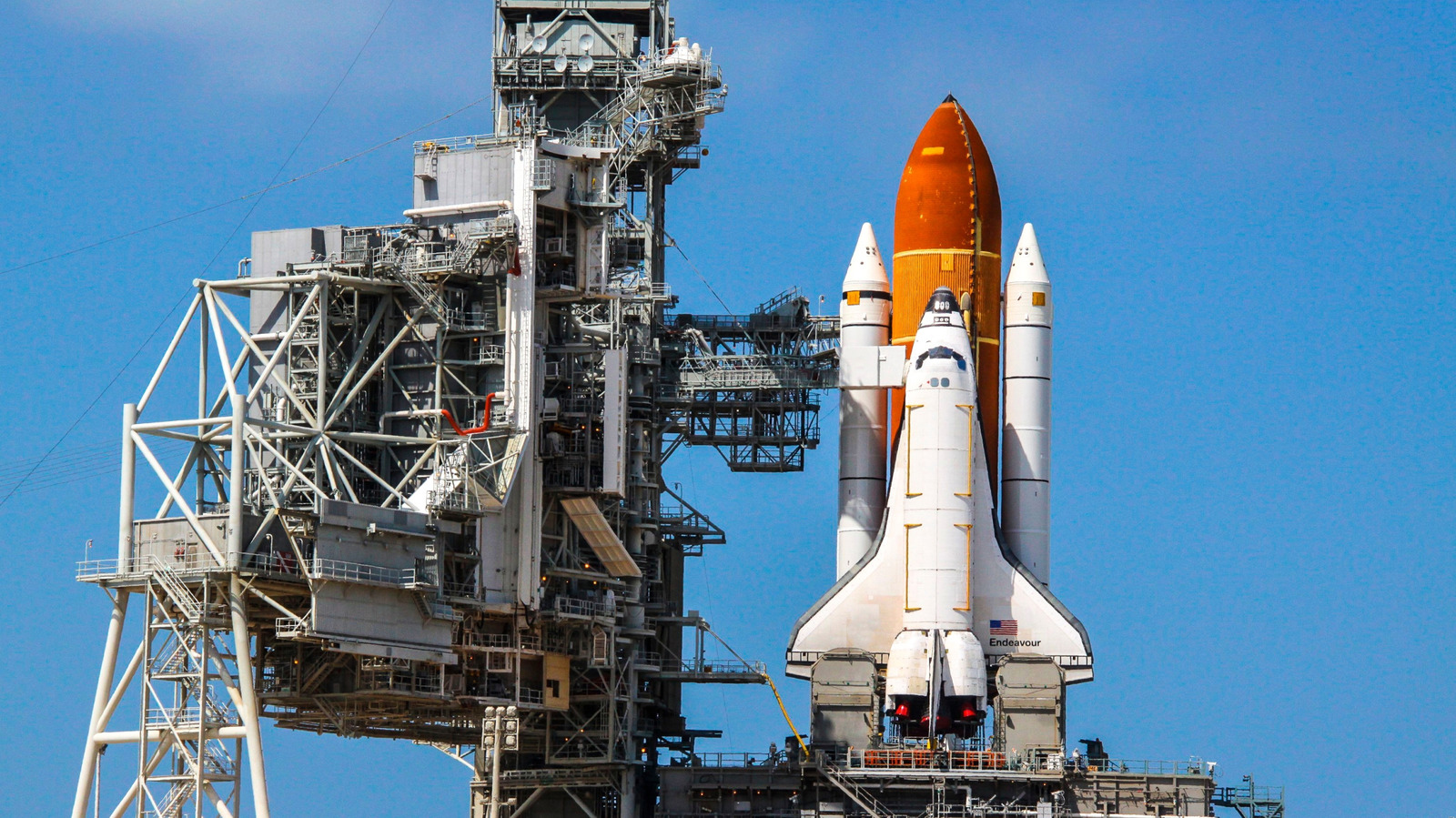

The Space Shuttle was NASA’s primary manned launch vehicle for three decades from its maiden flight in 1981 until it was retired from service in 2011. Yet, fifteen years later, the agency still hasn’t replaced the manned spacecraft with anything similar.
At first glance, this seems like a strange decision — the Space Shuttle had made the hop into space on 134 occasions and had 20,952 Earth orbits under its belt. However, despite the lack of a ready-made replacement — it would be nearly a decade before the next crewed space flight launched from US soil — there were good reasons why NASA stopped using it.
It comes down to three main factors — cost, turnaround time, and safety. At this point, it’s worth remembering that the shuttle was originally touted as a low-cost, fast-turnaround, reusable spacecraft. While it partially succeeded in the latter instance, it was expensive, and the fast-turnaround times never materialized.
Additionally, while it made over 130 successful flights, it was a fundamentally unsafe design. The fatal design flaws behind the Challenger disaster and the earlier Columbia disaster are a tragic testimony to this. Both disasters can be at least partially attributed to safety compromises and a lack of safety analysis at the design stage.
Operational costs and turnaround times
It was never meant to be this way. In the late sixties, there was plenty of optimism that the cost of spaceflight was going to drop to the point where it would be feasible that we’d all be booking budget flights into orbit the same as flights to New York. If the price was right, there was even talk of an orbiting space hotel being built by the Hilton family.
The reusable spacecraft being developed at the time were seen as an important steppingstone for NASA as it looked to cut payload costs from $1,000 a pound for the Saturn V rocket, to less than $50 per pound (1969 prices). However, despite these early predictions, shuttle launches were far from cheap. When the program was initially proposed, it was hoped that the cost of a launch would be about $350,000. In truth, it never came close; by the time the craft came to fruition each mission was costing around $450 million.
Part of the shuttle’s design brief was also an ability for quick turnarounds in between flights. NASA had projected a flight schedule of up to 95 missions a year — or about a flight every four days. The quickest the shuttle was ever readied for another mission was 54 days. After the Challenger disaster, the fastest reuse stretched to 88 days. These high costs and slow turnarounds meant the Space Shuttle was never the commercial success that NASA had hoped it would be.
Safety concerns
Perhaps surprisingly, the number of people who’ve actually died in spaceflight isn’t that high. Disregarding training accidents and fatalities from ground-based incidents, there have been 22 deaths in actual spaceflight, and only three of these occurred above the Kármán line — the acknowledged boundary that defines outer space.
Unfortunately for the Space Shuttle, the program has accounted for almost two-thirds of this figure, with a total of 14 souls perishing in two tragic accidents. A large part of this dreadful history can be attributed to design decisions early on in the process. First, there was the decision to discontinue the risk analysis used in the Apollo program. According to a paper by Harry W. Jones from the NASA Ames Research Center, a decision taken because the results of such analysis were considered “unacceptably pessimistic.”
Built-in safety features like crew escape systems were never factored into the original design, either. This was a consequence of NASA’s assumption that the shuttle would operate with a safety standard close to that of passenger jets.
The vehicle’s thermal protection system was also a vulnerability. A point tragically demonstrated in the Columbia accident — a disaster that ultimately doomed the Space Shuttle. The shuttle used thousands of silica and carbon-carbon tiles to protect the spacecraft during re-entry. How the shuttle’s tiles worked was clever, but they were incredibly fragile, and recurring damage was normal and accepted. It was damage to the leading-edge wing insulation that doomed the Challenger and its crew.
The shuttle was a remarkable piece of engineering, but it was never perfect. Ultimately, safety concerns, cost, and slow turnaround times sealed its destiny.

Comments are closed.