
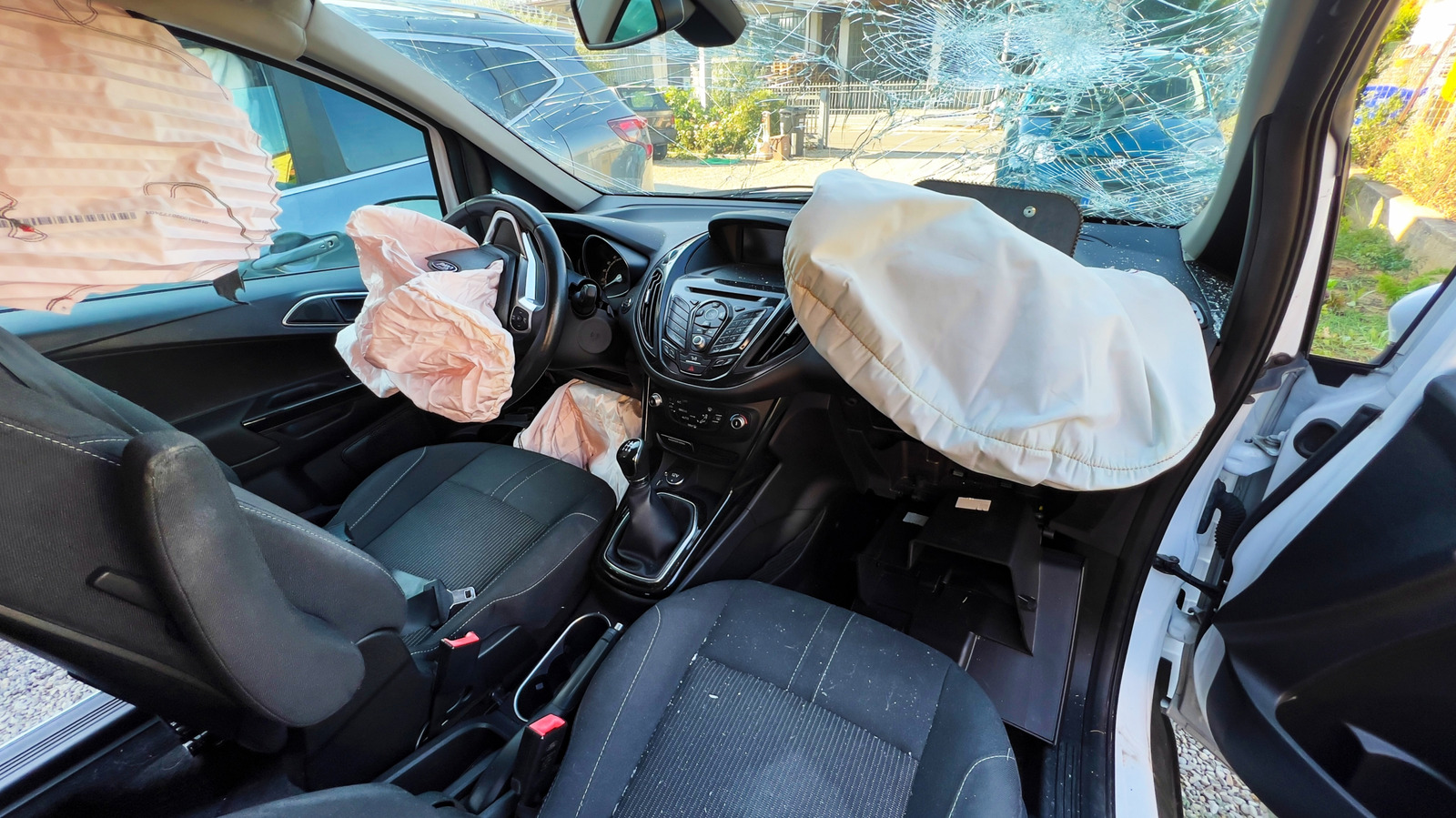

Front airbags have been required in new passenger vehicles since the 1999 model year. While side airbags aren’t specifically mandated, auto manufacturers install them to meet other federal safety requirements regarding side protection. The National Highway Traffic Safety Administration (NHTSA) claims that airbags saved over 70,000 lives in the U.S. since their implementation, so they work. But how do they work?
Airbags, which have recently become targets of theft, are part of the vehicle’s passive safety system designed to help keep passengers safe during an accident. On average, an accident happens in roughly 200 milliseconds — less than 1/5 of a second. So, the system needs to detect, react, and deploy faster than that to be effective — usually just 10 to 30 milliseconds, which is quicker than you can blink. The deployment of an airbag has been described as “engineered violence” because it essentially contains and directs a literal explosion.
First of all, the term “airbag” isn’t accurate since they don’t actually use “air” per se. Today’s systems use guanidinium nitrate with a copper nitrate oxidizer to produce nitrogen gas. When guanidinium nitrate is ignited, it breaks down into nitrogen gas, water, and carbon. The copper nitrate oxidizer is included to help reduce the temperature of the expelled gas. Older airbag systems once used ammonium nitrate, a chemical that didn’t play nicely with humidity and moisture, and ended up causing several injuries and even some deaths. Guanidinium nitrate isn’t affected by moisture.
Front and side airbags operate differently
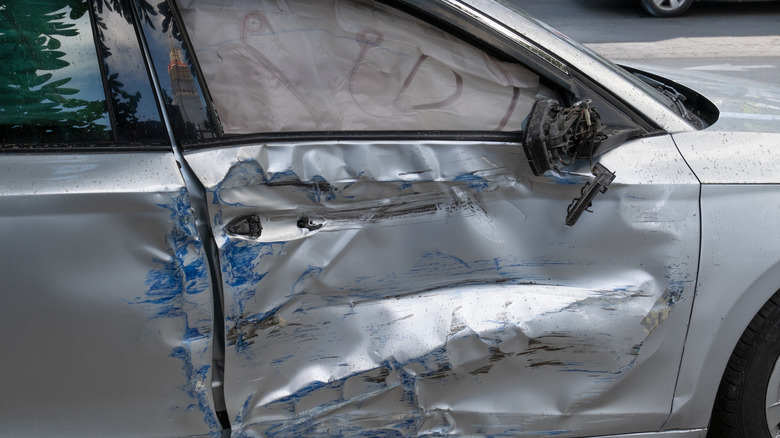
Airbags are designed to deploy at various speeds depending on the scenario. If a car hits something narrow (think tree or pole), bags can deploy at just 8 mph. Impacts involving larger objects (such as other cars) can cause bags to unfurl at 18 mph. But the technology and methods used in the front passenger compartment are different than those used in other parts of the car.
Front airbags use small electronic accelerometers that can detect when a car suddenly decelerates, which is technically what occurs when it’s involved in a crash. Using a technology called MEMS (micro-electro-mechanical systems), the onboard impact sensors determine — in the proverbial blink of an eye — changes in the vehicle’s speed, how fast the car was going, what hit it, and whether the occupants were wearing seat belts. Passengers wearing seatbelts are considered safer, so airbags won’t deploy unless the speed exceeds 16 mph. However, those not wearing them are at greater risk, so the system typically triggers bag deployment at speeds between 10 and 12 mph.
Side airbags are a bit different because they have much less space to work with. Whereas impacts from the front or back must first crumple through either the engine compartment or the trunk area, there’s far less space an incoming vehicle or obstacle needs to go through when coming in from the sides. They do use accelerometers mounted inside the door, but they also use pressure-based sensors that measure how far and how fast the door deforms as it’s hit.
Getting triggered takes on a whole different meaning
In rollovers, additional sensors detect side-to-side motion and tilt to determine whether the vehicle is about to tip. Side curtain airbags, using compressed helium (or argon) or a combination of chemical propellants and compressed gas, inflate within 20 milliseconds and remain inflated longer than standard front airbags. Still, all these sensor detections culminate in the explosive “engineered violence” we mentioned earlier.
Once the circuit is activated, an electric current passes through a heating element, igniting the previously mentioned guanidinium nitrate. The resulting explosion releases nitrogen gas (not air) into the nylon bag, which is coated with talcum powder to prevent it from knotting up as it inflates. As it expands, it blows off the plastic cover that was keeping it out of view. All of this happens in as little as 10 milliseconds. Yes, cars can still be driven with blown airbags, but they really shouldn’t be.
Between 1990 and 2008, the NHTSA believes that frontal airbag inflation during low-speed crashes caused over 290 deaths. Of those, almost 90% involved cars made before 1998; over 90% were children and infants, and over 80% of the occupants were either not wearing seat belts or not properly restrained. Today, serious injuries caused by airbag deployment are far less frequent than they used to be. And thanks to changes in federal requirements and technological advancements, faulty airbags and recalls have also declined. The NHTSA has a database where you can check to make sure there’s nothing wrong with your vehicle’s airbag system.

Comments are closed.