
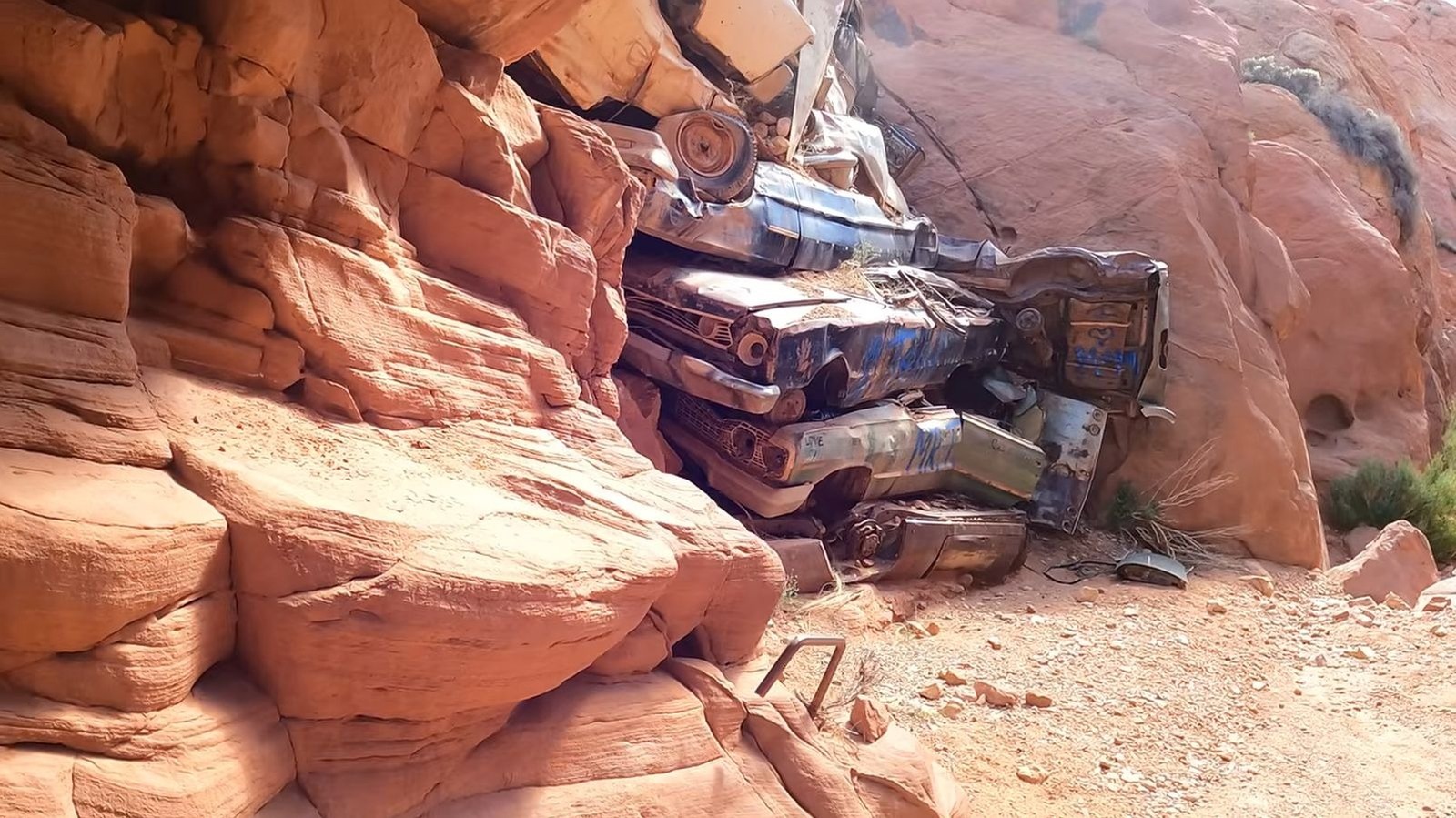

Utah is famous for all sorts of things, such as being home to the “Mighty 5” national parks – Arches, Bryce Canyon, Canyonlands, Capitol Reef and Zion – chock-full of hidden slot canyons, fossil beds, cliff dwellings, and petroglyphs. The Mormon Pioneer National Heritage Area is made up of five “districts,” four of which can be found along U.S. Route 89, also known as Utah’s Heritage Highway, and runs from Spanish Fork to Kanab. If you ever find yourself heading east out of Kanab on Route 89, at about the 24.5-mile marker, you’re going to want to pull over and check out another interesting (and free) attraction of sorts — one that’s far more modern than the nearby petroglyphs and fossils.
Sitting just off Route 89 is Catstair Canyon, one of the many slot canyons that dot the Beehive State’s landscape. It’s home to a construction project that started sometime in the 1960s, where a bunch of old, junked cars were crushed, filled with rocks, dirt and gravel, then strapped together to form a giant wall. Today, it’s known by a few names, including the Catstair Rip-Rap. Locals call it “Detroit Rip-Rap” due to all that heavy metal that originally came from the Motor City itself — Detroit, the car capital of the world, not to be confused with the No. 1 car city in America.
What is a Rip-Rap?
In the construction industry, a rip-rap is a type of retaining wall used to control erosion along slopes, embankments, or anywhere with a shoreline. After years of sometimes torrential rain had continually undercut Route 89, something needed to be done to stop the prolific erosion in the Catstair slot canyon below, while simultaneously shoring up the highway above. A typical rip-rap is made from large, random chunks of rock, boulders, or concrete. The Detroit/Catstair version was built using different makes and models from Detroit rather than with natural ingredients. Ultimately, the cars did the trick, reducing the rainwater’s erosive power by absorbing and dispersing it through the canyon.
Remnants of Detroit’s finest aren’t the only human-made thing in the vicinity. The pictographs and petroglyphs etched into the nearby rock walls tell a tale from long ago that’s only known to the Indigenous peoples who once freely roamed these lands. Of course, that happened long before these cars showed up.

Comments are closed.