
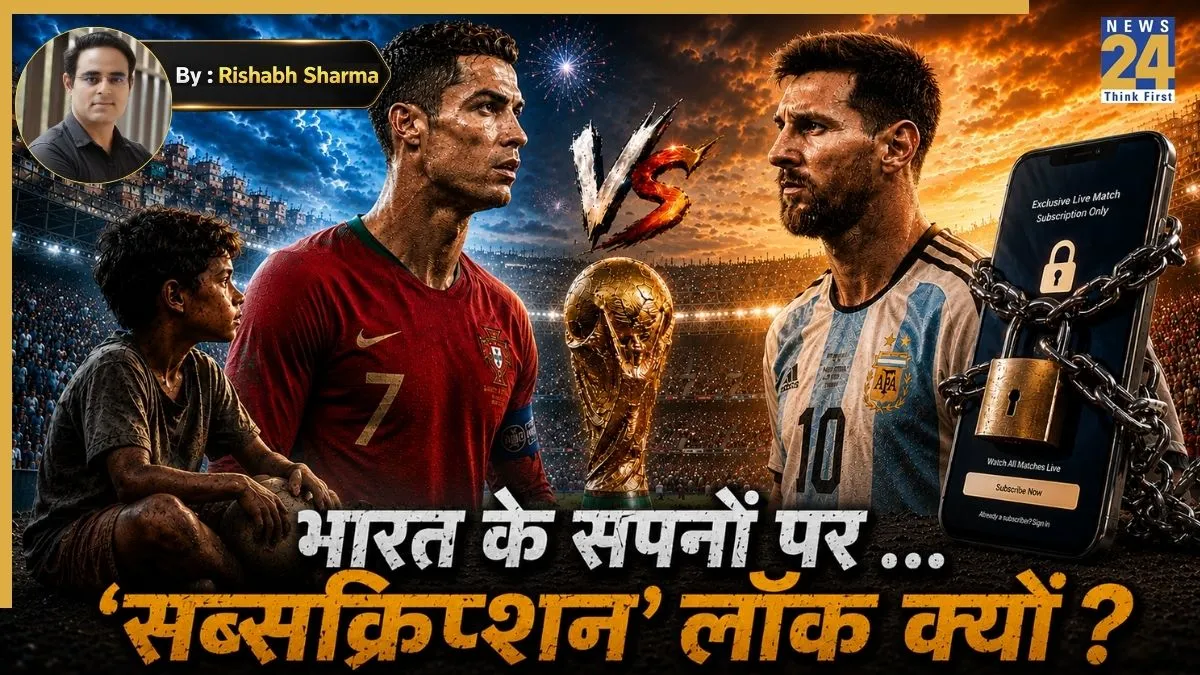
The claim of ‘Multi-Sports Nation’ and the reality of expensive screens, why subscription lock on Messi-Ronaldo’s dreams?

FIFA World Cup 2026: The conversation between two boys in the metro this morning revealed the harsh reality of the ever-changing sports market. One boy was talking with great interest about Messi’s goals and the players’ technique during the FIFA World Cup 2026 match between Argentina and Austria, but the other interrupted him with a helpless smile. He said, ‘Man, I am not able to watch the World Cup this time, the subscription plan of Zee5 is out of the budget.’ This is not just a story of two friends, but the story of millions of middle class fans of the country. Today, when new records of technology and reach are being made in the FIFA World Cup being played in America and Mexico, at the same time a large section of the Indian audience is standing helpless in front of this ‘expensive security’ installed on the screen.
The beginning of the end for free streaming in India!
This change in the sports broadcasting market has not happened overnight. Media reports a few days ago suggest that Zee Entertainment has signed a huge deal with FIFA from 2026 to 2034. Business market experts are calling it ‘Zee5’s $40 Million FIFA World Cup Gamble’ or ‘Zee5’s $40 Million FIFA Gamble’. There is no doubt that Zee has acquired the digital rights of FIFA World Cup on the basis of huge money, but at the same time it has given a big shock to crores of Indian viewers.
In the last few years, Indian audiences had fallen into the bad habit of watching everything for ‘free’ on smartphones, first because of Jio-Cinema and then because of Hotstar. Then both the companies merged and JioHotstar was started. Gradually, the company implemented the ‘Free Vs Paid Streaming’ model to compensate for its old losses. Now Zee has also hit a six on the very first ball, perhaps this is a profitable mathematics for the corporate. But for common fans this is no less than a big shock.
Last minute deals and incomplete research
Whether one believes it or not, but the truth is that football fever in India truly dominates the common fans only during the FIFA World Cup. On which platform the World Cup will come to India, this was a question to which no one had the answer till a few days before the start of the tournament. Almost in the last week, Zee’s deal with FIFA was signed, but considering the Indian market, the research on its subscription plan could have been better.
Actually, its impact on the football fans present in the big cities of the country will be less, but the worst impact of this change will be on the football culture of our country which has not yet flourished properly. Such is the popularity of cricket in India that even a global game like football seems to be struggling in front of it. In such a situation, hiding the game behind a paywall further limits its reach.
Ignoring small town football fans!
Already the level of our national football team is not at the international level so that we can play the World Cup. In such a situation, the only way to keep football alive was to watch the world’s great players live on TV and mobile screens. But now when Zee-5 has launched a plan of around ₹ 1699 annually for two devices and ₹ 799 for three months, then who is thinking about the fans in small cities and towns?
That boy coming from a village in Kerala or who sweats all day long on the clay fields of Patiala in Punjab, Bhagalpur in Bihar and Kolhapur in UP, who dreams only by watching Ronaldo or Messi in football, is his dream now locked behind an expensive premium package? It is important to think here whether a customer recharging data from ₹ 199 to ₹ 299 cannot be a spectator of the FIFA World Cup?
Shackles of rules and half-baked broadcast
In this entire game, our government broadcaster DD Sports is also completely helpless in front of the rules and budget. According to sports broadcasting guidelines, Doordarshan cannot show the entire tournament for free. It will be able to show only a few selected matches like the opening match, semi-finals and final for free. Now the thing to think about is whether any youth gets inspiration for sports only from knockout matches? Unless he sees the big upsets of the group stage and the struggles of the smaller teams of the world live, how will his understanding of the game increase?
The most dangerous impact of this change is going to be that the chain of a new generation of football in India will be broken. Technically, we may not have been able to make our football team world class, but by making the medium of watching sports so expensive, we have definitely made it ‘elite class’.
Also read- Zimbabwe team announced for test against Bangladesh, Sikandar Raza out, captaincy given to this player
It is important to change thinking for a better future!
India currently claims to call itself a ‘multi-sports nation’. But we must not forget that our new champions do not come from the rich clubs of big metropolises, but from small towns growing up amidst deprivation. Sports is not a corporate luxury product that only the rich can buy, it is a social heritage. In my opinion, if the government really wants to develop a sports culture in the country, then the scope of the ‘Sports Broadcasting Signals Act’ will have to be extended not only to television but also to digital and OTT platforms.
Unless these global events of national importance are freed from the paywall and made ‘free-to-air’ digitally, we will never be able to play the World Cup on the field and half of our India sitting in front of the screen will be left only waiting for the game to be freed from the shackles of profit.
Also read- IND vs PAK: India again broke Pakistan’s pride, defeated all four on the hockey field.
The post Claim of ‘Multi-Sports Nation’ and the reality of expensive screens, why subscription lock on Messi-Ronaldo’s dreams? appeared first on obnews.
Comments are closed.