
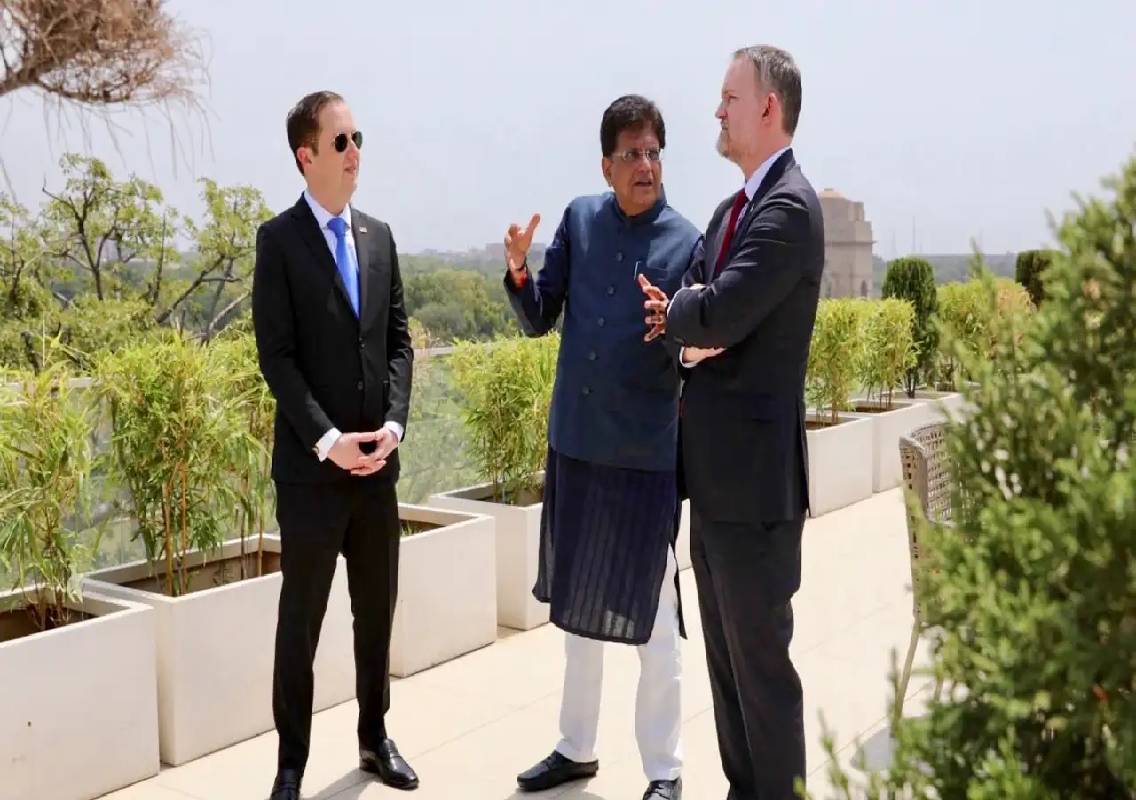

New Delhi: India and the United States have resumed high-level trade discussions as both countries seek to finalise a bilateral trade agreement amid significant changes in the US tariff regime. Union Commerce and Industry Minister Piyush Goyal met United States Trade Representative Jamieson Greer in the national capital on Tuesday to discuss the future of trade relations and the proposed pact.
The meeting comes at a crucial time, with Washington’s temporary 10 per cent tariff on imports from trading partners set to expire on July 24. Both sides are now working to recalibrate earlier understandings reached under a trade framework that has since been affected by changes in US trade policy.
High-level meeting held in New Delhi
Welcoming the US delegation, Goyal expressed optimism about the ongoing discussions and highlighted the importance of strengthening economic ties between the two countries.
In a post on social media platform X, the minister said he looked forward to productive discussions on the bilateral trade agreement between India and the United States.
The American delegation included US Trade Representative Jamieson Greer and US Ambassador to India Sergio Gor, along with senior officials involved in trade negotiations.
The talks are aimed at resolving outstanding issues and identifying a path forward for a mutually beneficial trade arrangement.
Trade negotiations began in 2025
India and the United States formally launched negotiations for a Bilateral Trade Agreement (BTA) on February 13, 2025.
After months of discussions, both sides announced on February 7, 2026, that they had reached a framework for an interim agreement designed to improve market access and reduce trade barriers.
The framework was considered a significant step towards strengthening economic cooperation between the world’s largest and fifth-largest economies.
It also reflected efforts by both governments to address longstanding trade concerns through dialogue rather than disputes.
Earlier tariff framework undergoes changes
Under the framework announced earlier this year, the United States had agreed to reduce tariffs on Indian goods to 18 per cent from 50 per cent.
The arrangement also involved the removal of a 25 per cent tariff imposed on Indian exports linked to India’s purchase of Russian oil, with the remaining duties expected to be reduced under the proposed agreement.
In return, India proposed reducing or eliminating tariffs on several American industrial and agricultural products.
The proposed concessions covered a range of goods, including dried distillers’ grains, red sorghum used for animal feed, tree nuts, fresh and processed fruits, soybean oil, wine, spirits and other products.
However, subsequent legal and policy developments in the United States altered the trade landscape significantly.
US policy shifts affect negotiations
A major turning point came when the US Supreme Court ruled against certain tariff measures, leading to changes in the administration’s trade strategy.
Following the ruling, the Trump administration introduced a temporary 10 per cent tariff on imports from all countries under Section 122 of the Trade Act. The measure was implemented for 150 days and is scheduled to expire on July 24, 2026.
The new tariff regime effectively altered assumptions that had formed the basis of the earlier India-US trade framework.
As a result, both countries have been required to revisit several aspects of the proposed agreement.
Section 301 investigations add complexity
Further complications emerged when the Office of the United States Trade Representative launched two Section 301 investigations in March 2026.
The first investigation focused on concerns regarding excess industrial capacity across multiple economies, while the second examined allegations relating to forced labour in global supply chains.
India was among nearly 60 economies included in the investigations.
Following the investigations, the US Trade Representative concluded that several economies, including India, had not sufficiently enforced restrictions on goods linked to forced labour concerns.
Consequently, the United States proposed an additional 12.5 per cent tariff on imports from India.
Why the current talks matter
The ongoing discussions are viewed as particularly important because they provide an opportunity for both sides to address the impact of recent policy changes and avoid potential trade disruptions.
With the July 24 tariff deadline approaching, negotiators are expected to focus on tariff reductions, market access, supply chain cooperation and regulatory issues.
A successful agreement could strengthen bilateral trade, boost investment flows and enhance economic cooperation in sectors ranging from manufacturing and agriculture to technology and clean energy.
Both governments have repeatedly emphasised the strategic importance of India-US economic ties in an evolving global trade environment.
Conclusion
The latest round of trade talks between India and the United States reflects a shared effort to preserve momentum towards a bilateral trade agreement despite significant changes in US tariff policy. As negotiators work through new challenges, the outcome of these discussions could play a key role in shaping future trade relations between the two countries and influencing broader economic cooperation.

Comments are closed.