

We may receive a commission on purchases made from links.
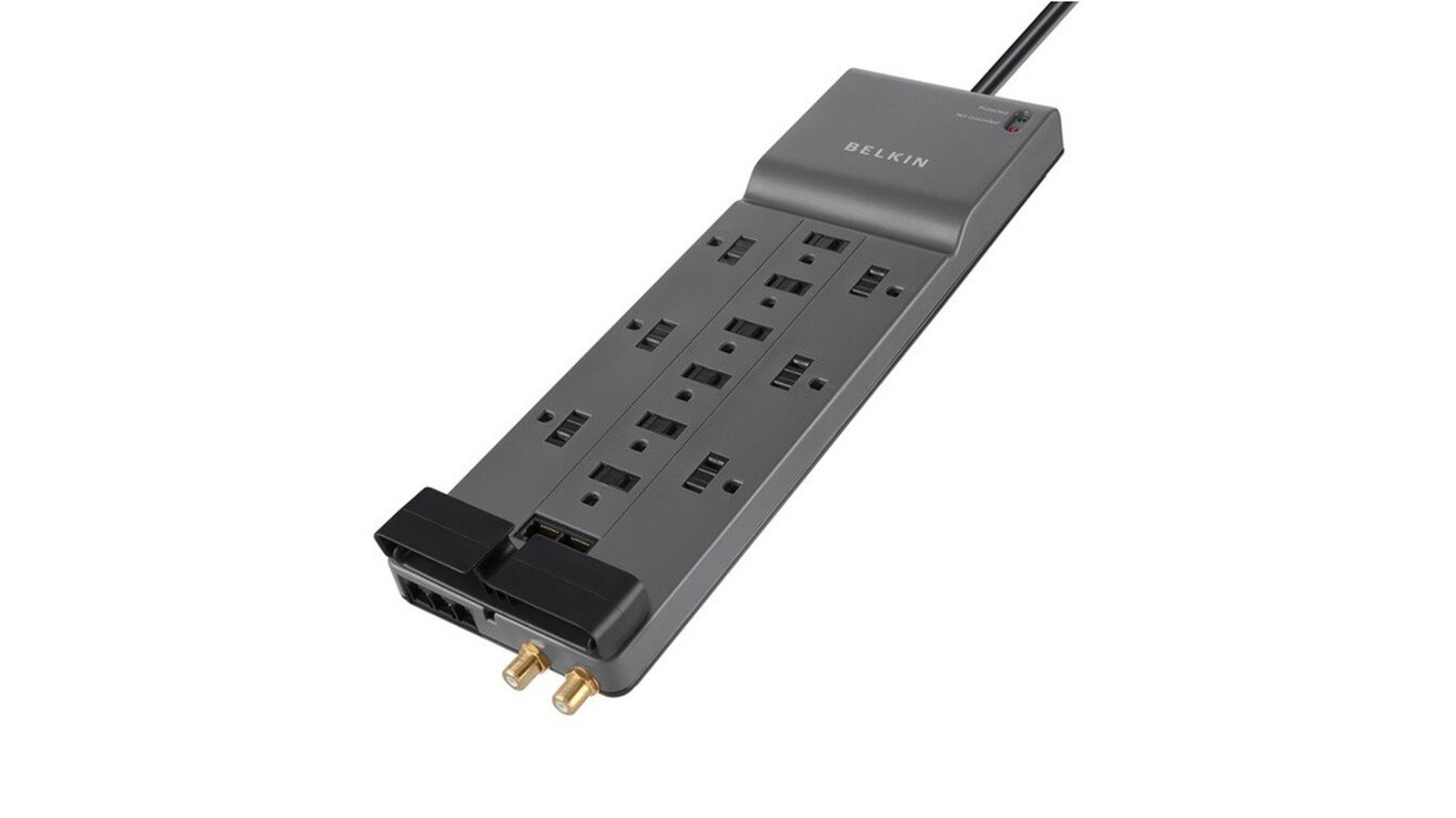
While the terms are often used interchangeably, not every power strip offers surge protection. Fortunately, determining if your power strip is a surge protector is fairly easy, even if these devices look very similar. Power surges in the home are a result of things like varying voltage levels entering the home, appliances kicking on and off, and even disruptions due to storm activity. Plugging your TV into a surge protector is a way to mitigate some of the risks associated with brief spikes in voltage. However, you may have noticed coax connectors on protective power strips. What are they for?
Coaxial cables are often used in the home for cable and satellite TV and internet access, to name a few. These cables excel at stopping outside electromagnetic interference by incorporating braided wiring and foil around the conductor to shield the signal. However, they can also experience surges that could carry into electrical devices.
Some power strips and surge protectors include coaxial cable protection that offers two connectors — one in and one out, for example. This is meant as an additional measure to help protect devices that have coaxial cables attached to them.
Should you run coaxial cable through your power strip?
While more robust coaxial cable surge protectors can help protect certain home setups as one component of a multifaceted strategy, the one on your power strip may not do much. In fact, it could instead result in signal loss. Systems like satellite TV are grounded (via a brass ground block), which provides specific protections to coaxial cables from surging voltage. This means the heavy lifting in terms of protection is already in place. In fact, by adding an additional connection on your power strip, you can weaken your signal or introduce noise.
Scenarios where you may want to incorporate coaxial surge protection are in relation to roof mounted TV and radio antennas. Though again, this is only a secondary measure in addition to properly grounding your equipment. Antennas are particularly susceptible to lightning strikes, which on average have the energy of around 1 billion joules. While no device can provide protection from a power surge created by a direct lightning strike, a basic power strip rated up to 2,000 joules will do little to prevent damage.
Better surge protection options for coaxial cables
Metal oxide varistors (MOVs) are a type of surge protection used by some power strips with coaxial cable connections. These help soak up the extra voltage from spikes by actively conducting during a surge and preventing damage. While MOVs work well with AC applications, like your home electronics, they do suffer degradation over time. This is why you might want to throw away your old surge protectors ASAP. In addition, they can also affect signal integrity over cables carrying high-speed data, like coaxial.
There are more effective, dedicated products like coaxial cable surge arrestors, which feature a place to attach a ground wire and utilize gas discharge tubes (GDT). The GDT comes in the form of a small cylinder within the arrestor in between the connection of two different coaxial cables. Essentially, inside the cylinder there are electrodes and an inert gas. When a surge reaches the GDT, the gas ionizes and creates a brief short circuit, preventing excess current from flowing to sensitive electronics. It’s recommended to place these arrestors near the equipment like a radio, rather than placing it near the antenna. These can help protect against power spikes as a result of indirect lightning strikes.

Comments are closed.