
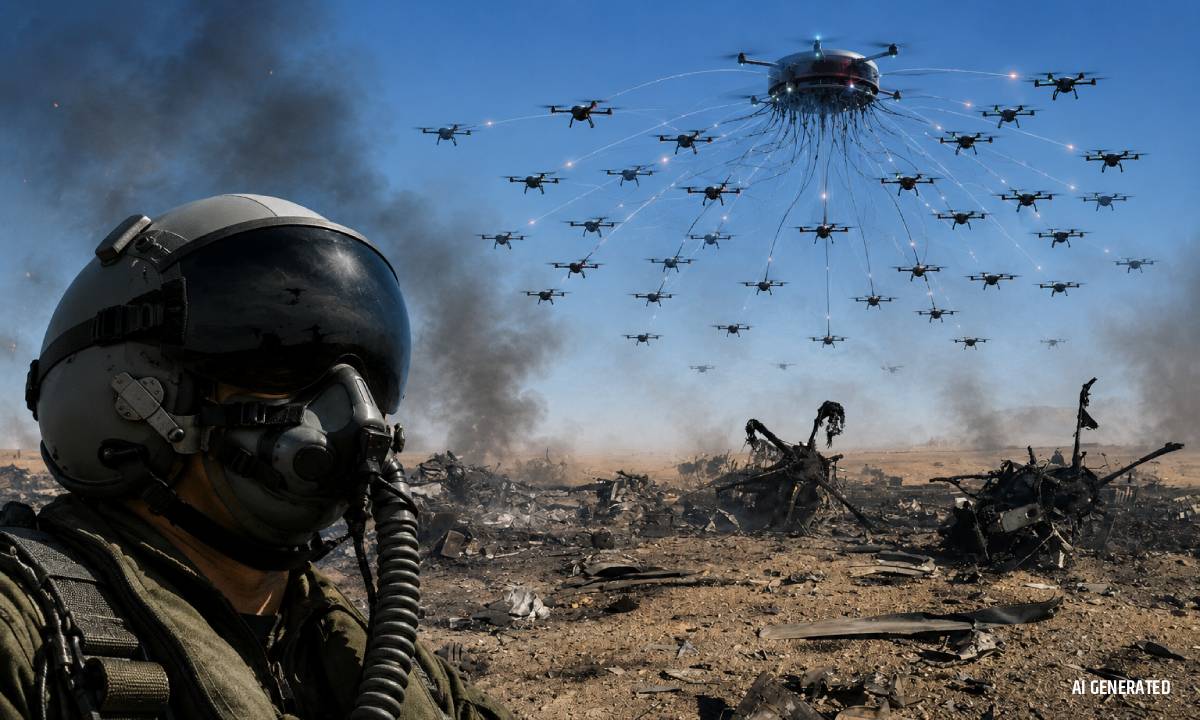

Jelly Fish Drone: The pilot of an American F-15 fighter plane shot down during a military operation over Iran has made a claim that has sparked a new debate about modern warfare technology and drone capabilities. According to the pilot, while ejecting from the plane and waiting for the rescue team, he saw an unusual sight in the sky, which even he himself could not believe at first.
According to reports, the pilot saw a group of Iranian drones in the sky which were flying in a coordinated manner and whose shape looked like a giant jellyfish. This incident took place in April, when an American F-15 aircraft was shot down during a combat operation. The pilot’s statement in this matter has now come to light.
Later, US Special Forces evacuated the pilot safely. This rescue operation was described by US President Donald Trump as “one of the most daring search and rescue operations in American history”.
What information came to light about Iran’s drones?
According to reports, after the rescue operation, the pilot explained his experience in detail to the intelligence officers during interrogation and debriefing. He said that what he saw in the sky was not a single plane, but a group of many interconnected drones, working together.
After the pilot’s statement, defense analysts started calling this system “jellyfish drone”. The reason for this is said to be its size and method of operation. According to analysts, the small drones appeared to operate around a central command unit like tentacles around a jellyfish.
This incident has drawn attention to the rapidly changing nature of drone technology and the increasing use of autonomous systems in modern warfare.
Why did the pilot feel like an alien?
According to accounts of the rescue operation, when the pilot saw the structure for the first time, he could not believe what he was actually seeing. The drones were seen becoming stable in the air and then changing their position simultaneously. Their operation was completely different from conventional aircraft.
According to the pilot, this scene looked like a jellyfish floating in water. Later, some people who analyzed the footage compared it to the techniques shown in science fiction films.
Experts say that the most unusual thing was that these drones seemed to behave not like separate machines but like a single living unit. Their activities were so coordinated that it seemed as if the entire group was operating with a single mind.
What is Jelly Fish Drone?
What the American pilot saw is called Swarm Technology. It is based on a network in which all the drones continuously share information with each other. In this system, operation does not depend on just one controller, but each drone contributes to the collective understanding and decision-making ability of the entire group.
Some drones work to gather intelligence, while others monitor potential threats. Some drones can do the work of disrupting communication systems, i.e. jamming, while some can also be equipped with weapons.
Information collected by a single drone is instantly shared across the network. This enables the entire group to react very quickly and make immediate changes to its strategy according to changing circumstances.
In many designs, a large drone acts as a command center or command hub, while several smaller drones operate around it. Even if one drone is destroyed during the mission, the remaining drones can continue the mission by changing their position.
This feature makes swarm technology different from traditional unmanned aircraft. Here each drone is not just an independent machine, but an active part of the entire network.
Are other countries also investing in this technology?
Many military powers of the world are investing heavily in drone swarm technology because it provides many strategic benefits in the battlefield. India is also one of those countries. Traditional air defense systems were typically designed to intercept a limited number of large and expensive targets, but intercepting a large group of incoming drones can be much more challenging. Additionally, drone swarms can conduct surveillance operations over wide areas and perform missions that do not require human pilots to be put at risk.
Continuous development in Artificial Intelligence (AI) has also greatly increased the capability of these systems. Due to greater independence and ability to take faster decisions, such systems are becoming more effective than before. Experts believe that the scene seen by the American F-15 pilot is an indication that such technologies are no longer limited to laboratories and test programs, but are also beginning to appear in actual military operations.
Are ‘jellyfish drones’ a glimpse of future wars?
According to experts, drone swarm technology may become one of the most important features of future wars in the coming years. As artificial intelligence and communications technology improve, drone constellations will be able to perform missions that today require multiple aircraft, soldiers and command centers.

Comments are closed.